
Grey Shrikethrush Identification Guide
A plain, olive-grey Australian songbird best known for its rich, melodious, far-carrying song, with a hooked bill hinting at its predatory feeding habits.
Read the full Grey Shrikethrush encyclopedia entry →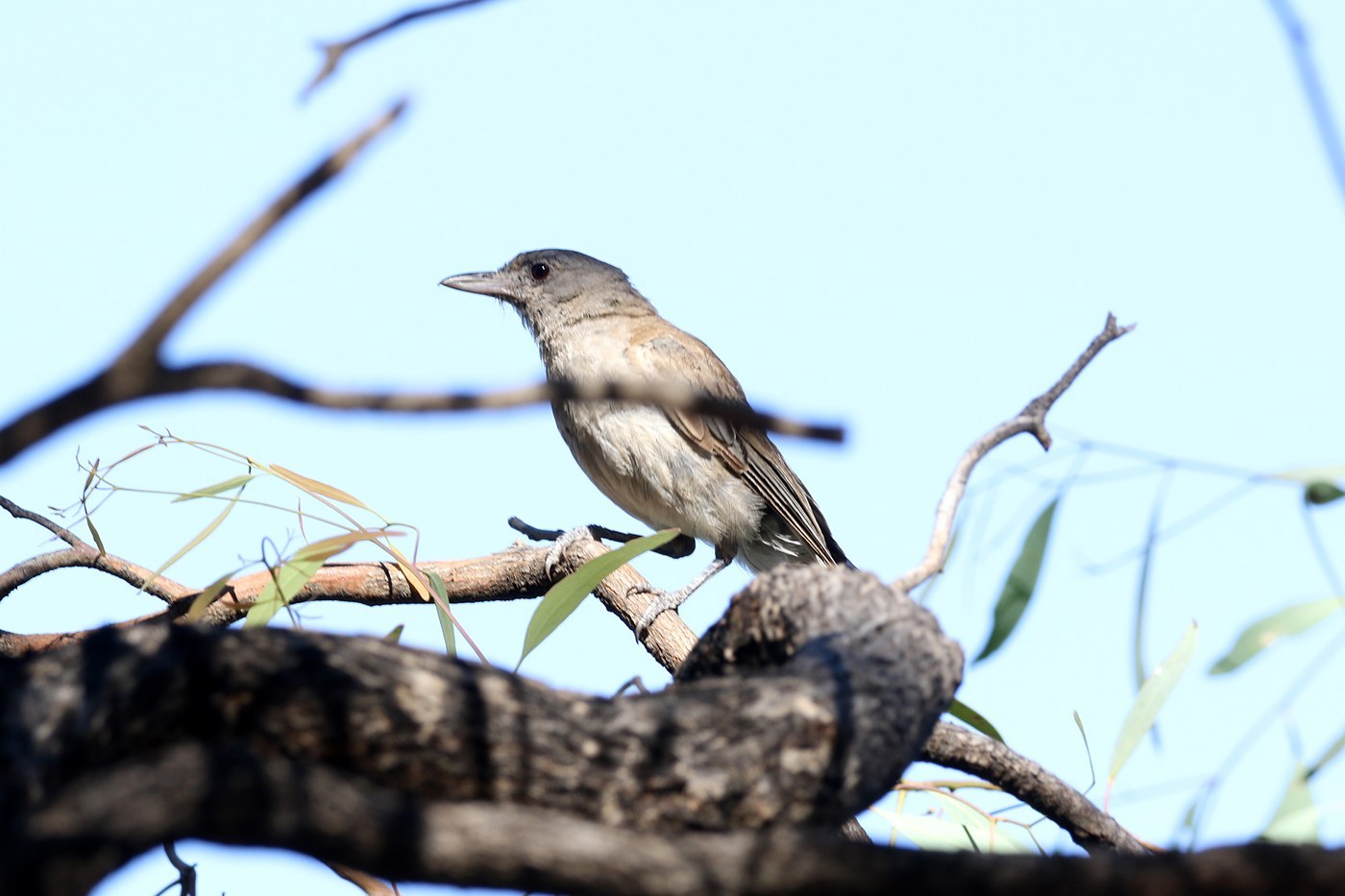
Key Field Marks
- Size & shape: A medium-sized, robust songbird about 22-27 cm (8.5-10.5 in) long, with a fairly large head, stout body, and a slightly hooked bill tip.
- Plumage: Predominantly plain grey-brown to olive-grey above, paler grey-buff below, with subtle regional variation across its many subspecies (some more olive, some greyer, some browner).
- Face: A faint pale eyebrow/lore area in some individuals, but overall a relatively plain-faced bird without bold markings.
- Bill: Stout, slightly hooked dark bill adapted for taking large insects and small vertebrates, unusual for a songbird and a clue to its shrike-like feeding habits despite being a true songbird (family Colluricinclidae/Pachycephalidae relatives).
- Behavior: Forages on the ground and in low-to-mid vegetation for insects, spiders, small reptiles, and occasionally eggs or nestlings; often perches conspicuously to sing but can be inconspicuous while foraging in leaf litter.
Similar Species
- Female/immature Golden Whistler: Similarly plain olive-grey but has a more rounded, less hook-tipped bill and different, whistled song; shrikethrush is larger and bulkier overall.
- Other shrikethrush species (e.g., Sandstone Shrikethrush, Little Shrikethrush) in areas of range overlap: separated mainly by voice, habitat, and subtle plumage/size differences.
- Various brown/grey Australian robins: Much smaller and more compact with different foraging behavior (perch-and-pounce vs. the shrikethrush's more thrush-like ground gleaning).
Where & When to See It
- Range: Widespread across mainland Australia and Tasmania in a variety of forms/subspecies, one of the most widely distributed Australian forest birds.
- Habitat: Extremely broad habitat tolerance — eucalypt forest and woodland, mallee, rainforest edges, mangroves, arid scrub, and even parks and gardens.
- Season: Resident year-round with no significant migration; territorial pairs sing throughout the year but especially during the breeding season.
Voice
- One of the most celebrated songs among Australian birds: a rich, ringing, fluty series of whistled phrases, loud and far-carrying, often described as one of the most beautiful songs in the Australian bush; also gives sharp scolding and chattering alarm notes.
Quick Tips for Confident ID
- Rely heavily on voice — the rich, fluty, ringing song is one of the best ways to confirm identification.
- Note the plain grey-olive plumage without strong facial or wing markings.
- Look for the stout, slightly hooked bill, distinguishing it from smaller whistlers and robins with similar coloring.
Frequently asked questions
Why is the Grey Shrikethrush called a 'shrikethrush' if it isn't a shrike or thrush?
Its name reflects a hooked, shrike-like bill combined with thrush-like foraging and body shape, though it is actually part of the whistler family (Pachycephalidae/Colluricinclidae) and not closely related to true shrikes or thrushes.
What does the Grey Shrikethrush sound like?
It has a rich, loud, fluty, ringing song made up of varied whistled phrases, widely regarded as one of the most beautiful and distinctive bird songs in the Australian bush.
What habitats can you find a Grey Shrikethrush in?
It is extremely adaptable, occurring in eucalypt forest, woodland, mallee, rainforest edges, mangroves, arid scrub, and even suburban parks and gardens across Australia.
Does the Grey Shrikethrush eat other birds' eggs or chicks?
Yes, in addition to insects and small vertebrates, it will occasionally raid nests for eggs or nestlings, a trait reflected in its stout, hooked bill.