
Grey-headed Woodpecker Identification Guide
A Eurasian green woodpecker relative with a plain grey head and face lacking a black moustache mark, separable from the Eurasian Green Woodpecker by its quieter, descending call and more restricted red cap.
Read the full Grey-headed Woodpecker encyclopedia entry →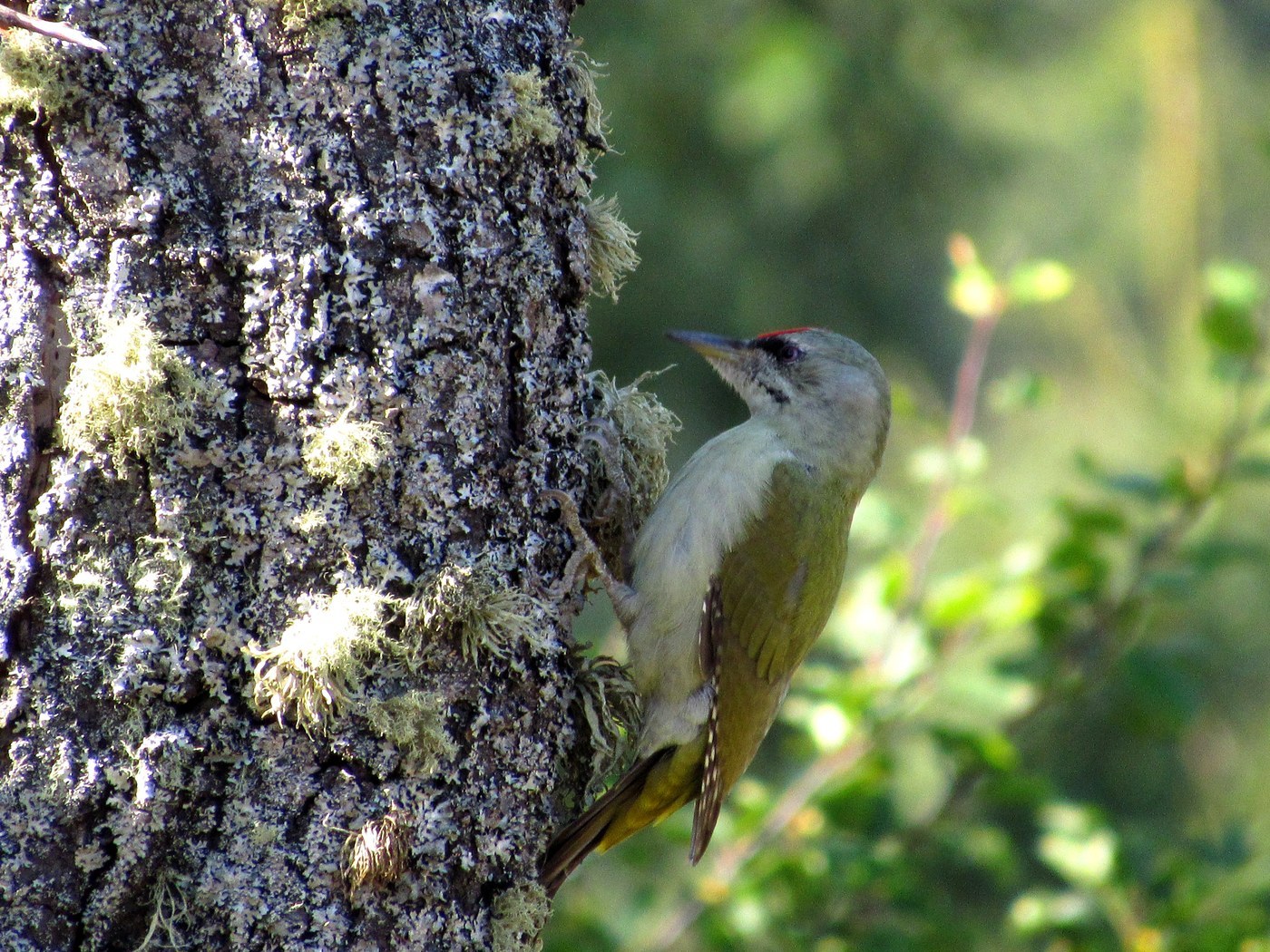
Key Field Marks
- Size & shape: Medium-large woodpecker, about 27-31 cm (10.5-12 in), similar in build to the Eurasian Green Woodpecker but slightly slimmer.
- Plumage: Olive-green upperparts and pale grey underparts, but the head and face are almost entirely plain grey — lacking the black face mask and thick black moustachial stripe shown by Eurasian Green Woodpecker.
- Crown: Males show a small red patch restricted to the forecrown only (not extending back over the whole crown); females often show little or no red, sometimes just a thin red line or none at all, unlike the more extensive red cap of the Green Woodpecker.
- Face: Plain grey face without a black surround to the eye; a faint, thin dark moustache may be present but is far less bold than in Green Woodpecker.
- Behavior: Forages both on the ground (probing for ants) and on tree trunks and branches; undulating flight typical of woodpeckers; somewhat shier and quieter than its Green Woodpecker relative.
Similar Species
- Eurasian Green Woodpecker: Has a bold black face mask, red extending further back on the crown, and a black-and-red moustachial stripe (red-centered in males); its laughing "yaffle" call is louder and more emphatic than the Grey-headed's call.
- Iberian Green Woodpecker (Iberia only, no overlap): Similar face pattern issues resolved by range, as it does not overlap with Grey-headed Woodpecker.
- Overall, the plain grey face with limited red cap is the key separator from all Green Woodpecker relatives across its Eurasian range.
Where & When to See It
- Range: Broad band across temperate Eurasia, from France and Scandinavia east through central Europe, Russia, and into East Asia including parts of China and the Himalayas.
- Habitat: Deciduous and mixed forest, forest edges, riverine woodland, and orchards; generally prefers slightly more mature, open forest than dense conifer stands.
- Season: Resident year-round throughout its range, with no significant migration; pairs hold territories permanently and can be found any time of year.
Voice
- A slower, more subdued, descending series of nasal notes compared to Green Woodpecker's loud ringing laugh — often rendered as a mellow, descending "kew-kew-kew-kew" that fades and slows toward the end.
Quick Tips for Confident ID
- Check the face for the absence of a bold black mask and thick moustache.
- Note the limited red patch confined to the forecrown, especially in males.
- Compare the call: a softer, more descending, less strident series of notes than the Green Woodpecker's ringing yaffle.
Frequently asked questions
How do you tell a Grey-headed Woodpecker from a Eurasian Green Woodpecker?
Grey-headed Woodpecker has a plain grey face without the bold black mask and thick moustachial stripe of Green Woodpecker, and its red crown patch is smaller and confined to the forecrown.
Do female Grey-headed Woodpeckers have red on the head?
Females typically show very little or no red, sometimes just a faint line on the forecrown, distinguishing them from males, which show a small red patch.
What kind of forest does the Grey-headed Woodpecker prefer?
It favors mature deciduous and mixed forest, forest edges, and riverine woodland across temperate Eurasia, generally avoiding dense unbroken conifer stands.
Is the Grey-headed Woodpecker migratory?
No, it is a non-migratory resident throughout its range, with pairs typically remaining on territory year-round.