
Grey Go-away-bird Identification Guide
A slender, pale grey turaco relative of southern African bush and savanna, instantly recognized by its tall pointed crest and nasal, complaining 'go-away' call.
Read the full Grey Go-away-bird encyclopedia entry →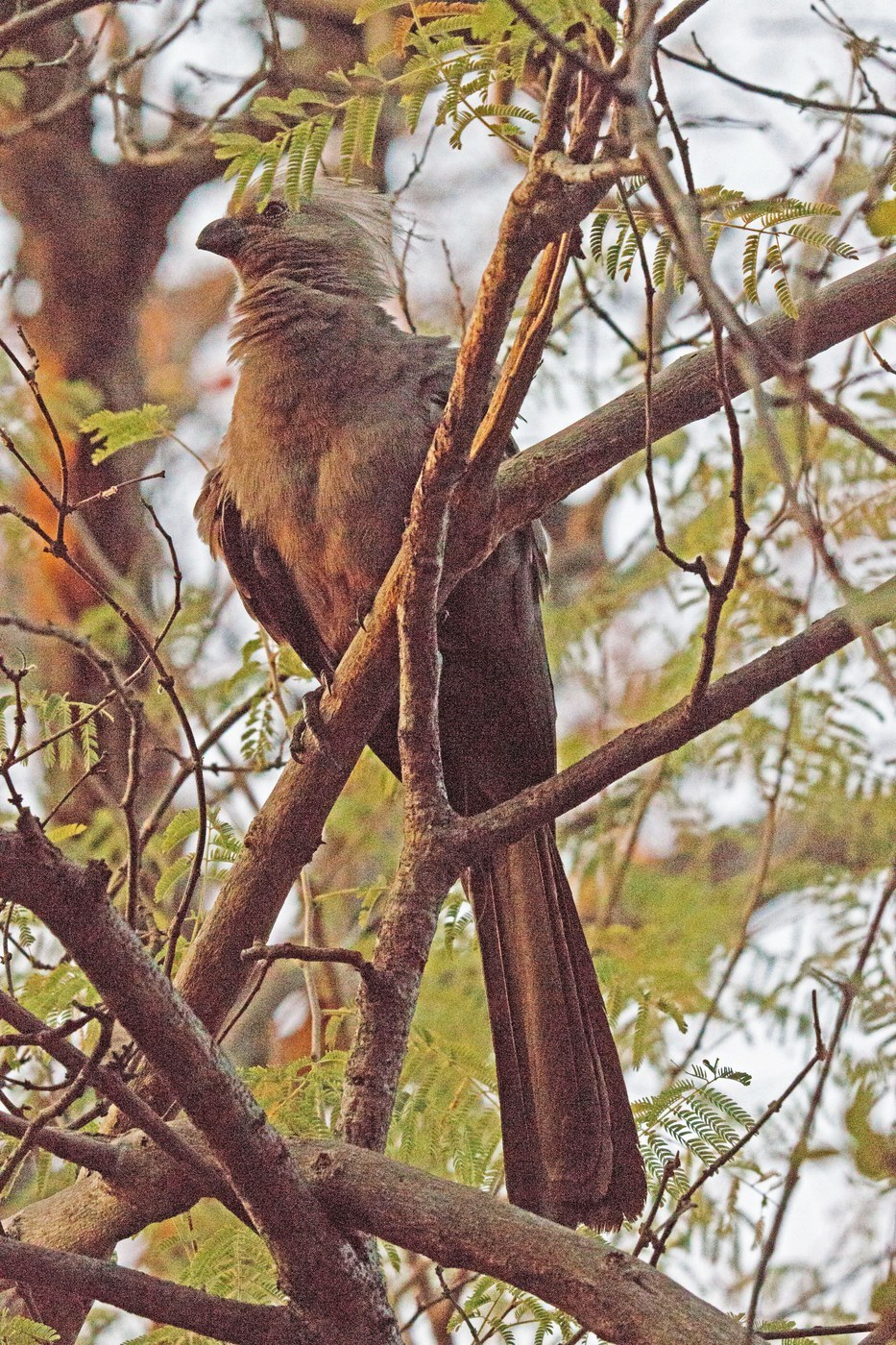
Key Field Marks
- Size & shape: A slim, long-tailed bird about 47-51 cm (18.5-20 in) long, with a long tail and an unmistakable tall, narrow, pointed crest on the crown.
- Plumage: Almost entirely pale ashy-grey, slightly paler on the underparts and darker grey on the wings and long tail; lacks bright colors typical of many turacos.
- Bill: Short, stout, black bill.
- Legs: Sturdy grey legs adapted for hopping along branches; go-away-birds are agile climbers and clamberers in trees, similar to other turacos.
- Behavior: Usually seen in small family groups moving through treetops or perched prominently on exposed branches; bounds and hops along branches rather than flying between every perch, with a somewhat labored, floppy flight over open ground.
Similar Species
- Bare-faced Go-away-bird: Found further north/central Africa; note bare blackish face skin versus the fully feathered grey face of the Grey Go-away-bird, and largely non-overlapping ranges.
- White-bellied Go-away-bird: Shows a whiter belly and blacker upperparts/wings, with more contrast than the uniformly grey Grey Go-away-bird; ranges overlap in parts of East Africa.
- No other bird in most of its southern African range combines the tall pointed grey crest with all-grey plumage, making confusion unlikely once the crest is seen.
Where & When to See It
- Range: Southern Africa, from southern Angola and Zambia south through Zimbabwe, Botswana, Mozambique, and into South Africa and Eswatini.
- Habitat: Dry savanna, woodland, riverine bush, and thornveld; frequently seen in acacia trees and around waterholes, also adapts well to gardens and lodges in bushveld areas.
- Season: Resident year-round with no significant migration; conspicuous throughout the year, often perched in the open at dawn.
Voice
- Its name-giving call is a loud, nasal, complaining "go-AWAY" or "kweh," frequently repeated and easily imitated by human observers — one of the most recognizable sounds of the African bush and often the first clue to the bird's presence before it is seen.
Quick Tips for Confident ID
- Listen first for the nasal "go-away" call, highly distinctive among African bushveld birds.
- Look for the tall, narrow, pointed grey crest silhouetted on an exposed branch.
- Confirm uniform pale grey plumage without a bare dark face to rule out the Bare-faced Go-away-bird where ranges might otherwise cause confusion.
Frequently asked questions
Why is it called the 'Go-away-bird'?
Its loud, nasal call sounds remarkably like a person saying 'go away,' a sound frequently heard across southern African bushveld and savanna.
Is the Grey Go-away-bird related to turacos?
Yes, go-away-birds belong to the turaco family (Musophagidae) but lack the bright greens and reds of forest turacos, instead showing plain grey plumage suited to open savanna habitat.
How do you separate Grey Go-away-bird from Bare-faced Go-away-bird?
The Bare-faced Go-away-bird shows patches of bare dark skin around the eye and face, while the Grey Go-away-bird's face is fully feathered grey; their ranges also barely overlap.
What habitat is best for finding a Grey Go-away-bird?
Dry acacia savanna, thornveld, and riverine woodland in southern Africa, especially near waterholes where family groups often perch conspicuously in the open.