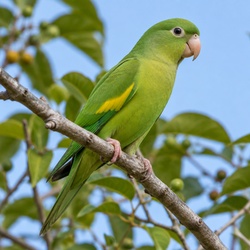
Grey-cheeked Parakeet Identification Guide
A small, mostly green parakeet of dry forests in southwest Ecuador and northwest Peru, told apart by its pale grey head and cheeks and orange under-wing flash in flight.
Read the full Grey-cheeked Parakeet encyclopedia entry →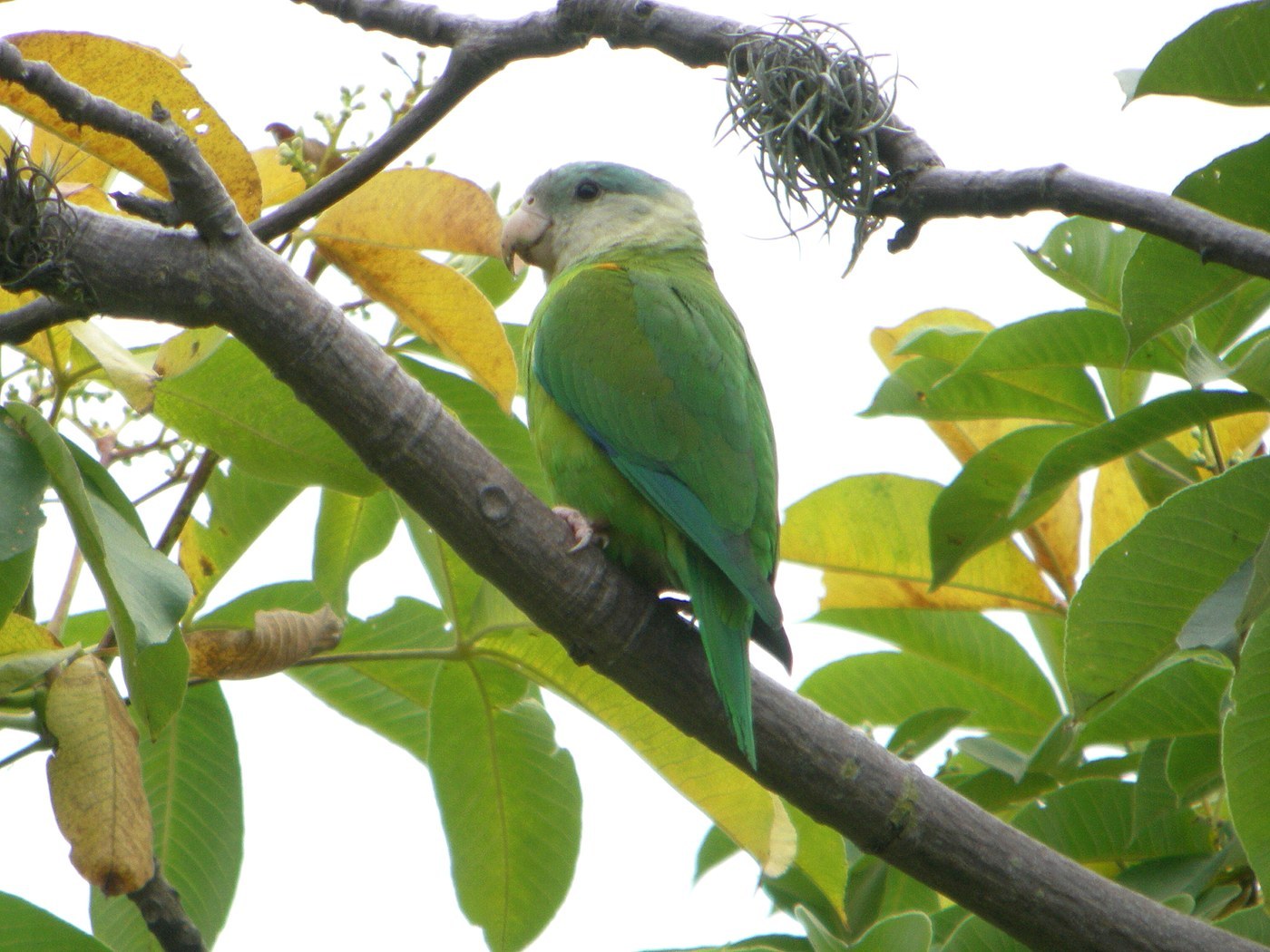
Key Field Marks
- Size & shape: A small parrot, roughly 18-19 cm (7-7.5 in) long, with a short square tail typical of Brotogeris parakeets — noticeably smaller and more compact than most other parrots in its range.
- Plumage: Overall bright grass-green body. The head, especially the crown, face, and throat, is washed pale grey-brown, giving the species its name and creating a hooded look against the green body and back.
- Bill: Small, pale horn-colored to pinkish bill, not the heavy black bill of larger parrots.
- Wings: In flight, look for a flash of orange-yellow under the wing coverts and yellowish-olive edging on the flight feathers — this under-wing color is one of the best marks when birds fly overhead.
- Legs & feet: Grey-pink, zygodactyl (two toes forward, two back), typical parrot feet, often visible when perched and clambering through foliage.
- Behavior: Highly social, moving in noisy, fast-flying flocks that chatter constantly; feeds acrobatically on fruit, seeds, and blossoms, often hanging upside-down from twigs.
Similar Species
- Pacific Parrotlet: Much smaller and stockier, with no grey hood, and males show blue in the wings and rump; parrotlets fly with quicker, more direct wingbeats and lack the orange under-wing flash.
- Other Brotogeris parakeets (e.g., Orange-chinned Parakeet, outside range overlap): Distinguished by the grey head versus a plain green head or bronze/orange throat patch in relatives.
- Escaped/feral parrots in urban areas: Feral Grey-cheeked Parakeets occur in some US and European cities (e.g., parts of California, Florida); confusion is mainly with other small feral parakeets, so check for the diagnostic grey face and orange wing linings.
Where & When to See It
- Range: Endemic to the Tumbesian dry forest region of southwest Ecuador and northwest Peru; also established as a naturalized feral population in a handful of cities in North America and Europe from the pet trade.
- Habitat: Deciduous and semi-deciduous dry forest, scrub, and woodland edges at low to middle elevations; also visits parks, gardens, and cultivated areas including feral populations in urban settings.
- Season: Resident year-round; look for flocks moving between fruiting trees at dawn and dusk when they are most vocal and active.
Voice
- A high, chattering, rolling screech given constantly in flight and while perched — a fast, scratchy "chee-chee-chee" or twittering chatter that carries well and often reveals a flock before it is seen.
Quick Tips for Confident ID
- Look first for the pale grey head contrasting with an otherwise all-green body.
- Confirm with the orange-yellow flash under the wing as the bird flies away.
- Listen for constant chattering contact calls from tight, fast-moving flocks.
Frequently asked questions
What makes the Grey-cheeked Parakeet different from other small green parakeets?
Its pale grey head and cheeks contrasting with a green body, combined with an orange-yellow flash under the wing in flight, are unique among the small parakeets sharing its range.
Where is the best place to see a Grey-cheeked Parakeet in the wild?
Dry forest reserves in the Tumbes region of northwest Peru and the Guayas/Loja lowlands of southwest Ecuador hold the native population; feral flocks also persist in a few cities such as parts of coastal California.
Is the Grey-cheeked Parakeet the same as feral 'parrots' seen in US cities?
Some feral urban flocks are indeed Grey-cheeked Parakeets descended from escaped or released pet birds, distinct from the more commonly reported feral Monk Parakeets or Red-crowned Amazons.
How can I tell a Grey-cheeked Parakeet from a parrotlet?
Parrotlets are smaller, lack any grey on the head, and males show blue in the wing; Grey-cheeked Parakeets are larger-bodied with a clear grey hood and orange under-wing linings.
Grey-cheeked Parakeet identified by the community
Recent Grey-cheeked Parakeet sightings identified with Bird Identifier.