
Green Woodpecker Identification Guide
Europe's largest common woodpecker, a ground-feeding species with olive-green upperparts, a bright yellow rump, and a striking crimson crown, often first noticed by its loud, laughing call.
Read the full Green Woodpecker encyclopedia entry →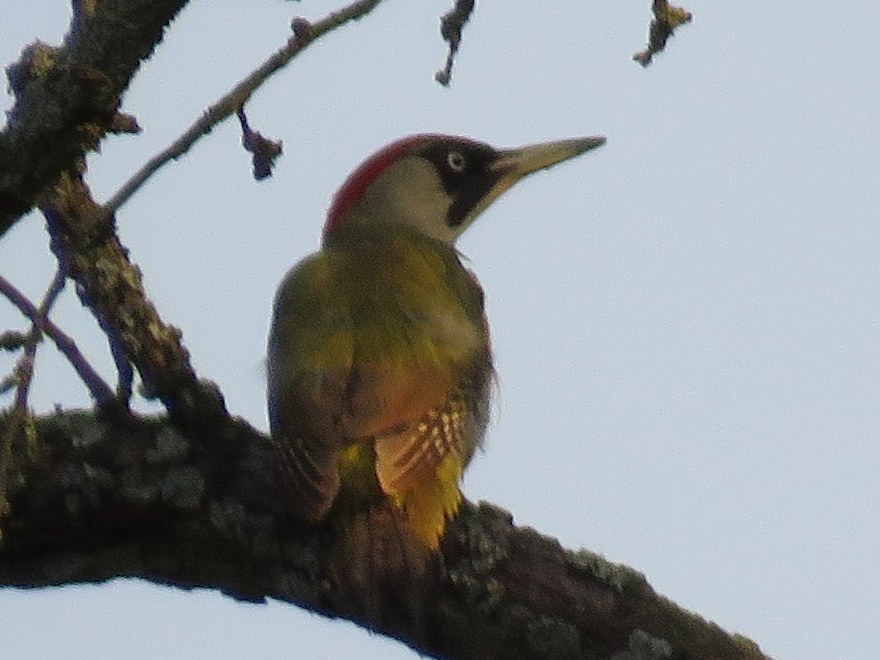
Key Field Marks
- Size and shape: A large woodpecker, about 12–13 inches long, bulkier and longer-tailed than the spotted woodpeckers it shares range with, with a strong, straight, chisel-like bill.
- Plumage: Olive-green upperparts and pale grayish-green underparts, with a bright yellow rump that flashes conspicuously in flight; the crown and nape are bright crimson-red, and the face shows a bold black mask around the eye.
- Sex differences: Males show a red center to the black mustachial stripe below the eye, while females have an all-black mustachial stripe without red.
- Behavior: Unusually terrestrial for a woodpecker, spending much time feeding on the ground, especially on ants, hopping across lawns and open grassy areas; when disturbed it typically flies to a nearby tree with a strong, deeply undulating flight.
Separating It From Similar Species
- Grey-headed Woodpecker: Similar in overall green-and-yellow coloring, but has a gray head and face lacking the bold black eye-mask, and the red on the crown is reduced to a small patch on the forecrown in males (absent in females) rather than covering the whole crown and nape.
- Spotted woodpeckers (Great Spotted, etc.): Much smaller, black-and-white or pied in pattern, without the extensive green body color of Green Woodpecker.
- Iberian Green Woodpecker: A very similar, closely related species found in the Iberian Peninsula, distinguished mainly by a grayer face lacking the black mask around the eye and subtle vocal differences; ranges are essentially separate.
- The bright yellow rump combined with a mostly green body and red crown is diagnostic across most of the species' range.
Where and When to See It
- Habitat: Open woodland, parkland, farmland with hedgerows, and large gardens with short grass for ant-feeding, avoiding dense unbroken forest.
- Range: Widespread across much of Europe and into western Asia, generally absent from Ireland, northern Scotland, and the far north.
- Season: A non-migratory resident throughout its range, present and active year-round.
Voice and Song Cues
- Best known for its loud, ringing, laughing call, often rendered as "yaffle", a series of far-carrying notes that give the bird one of its old folk names.
- Drums far less frequently than other European woodpeckers, relying mainly on its distinctive vocal call for territorial announcement rather than bill-drumming.
Frequently asked questions
Why is the Green Woodpecker often heard before it is seen?
It has a loud, distinctive laughing call, sometimes called a "yaffle," that carries well and is given frequently, often alerting birders to its presence before it comes into view.
How can I tell a male from a female Green Woodpecker?
Check the mustachial stripe below the eye: males show red within the black stripe, while females have an entirely black mustachial stripe.
Why do I often see Green Woodpeckers on the ground?
Unlike most woodpeckers, this species feeds heavily on ants and spends a large amount of time foraging on open lawns and grassy areas rather than climbing tree trunks.
How do I distinguish Green Woodpecker from Grey-headed Woodpecker?
Green Woodpecker has a full red crown and nape with a bold black eye-mask, while Grey-headed Woodpecker has a gray face without the black mask and much less red, confined to the forecrown in males only.
Does the Green Woodpecker drum like other woodpeckers?
It drums only rarely compared with other European woodpeckers, relying mainly on its loud laughing call for communication and territory defense.