
Green Wood Hoopoe Identification Guide
A noisy, sociable African bird with a long, curved red bill, glossy dark green plumage, and a long tail flashed with white, usually seen probing bark in chattering family groups.
Read the full Green Wood Hoopoe encyclopedia entry →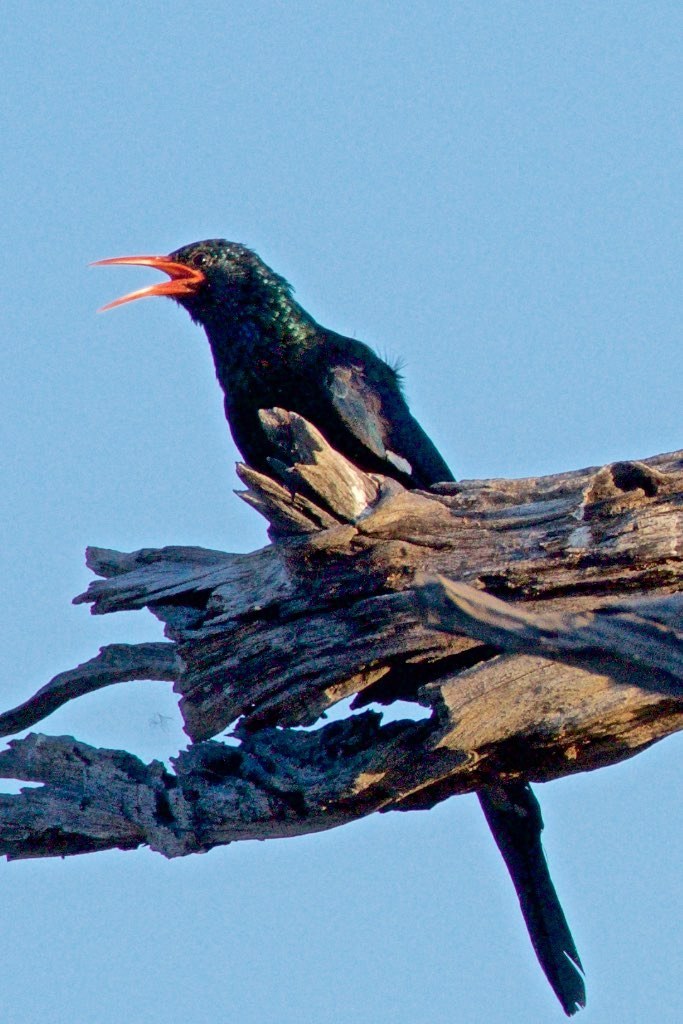
Key Field Marks
- Size and shape: A slender, long-tailed bird about 13.5 inches long, with a notably long, downcurved, bright red bill and a long, graduated tail.
- Plumage: Overall glossy, iridescent dark green to blue-green plumage, appearing almost black in poor light but flashing bright metallic green and purple in good sun; white spots are visible on the wings in flight, and the outer tail feathers show white tips and bands.
- Bill and legs: Long, thin, strongly downcurved red bill (juveniles have a duller, blackish bill that reddens with age); short red legs.
- Behavior: Highly social, moving in noisy family groups of half a dozen or more through trees, probing bark crevices and dead wood with the long bill for insects; frequently clings sideways or upside-down on trunks and branches like a woodpecker or nuthatch.
Separating It From Similar Species
- Violet Wood Hoopoe and other Phoeniculus species (where ranges overlap): Similar in shape, but Green Wood Hoopoe shows a more uniformly green (rather than strongly violet or blue-tinged) gloss and is best separated by range and, at close range, subtle color differences in good light.
- Common Hoopoe: Unrelated in appearance despite the similar name; Common Hoopoe has a striking pink-and-black-and-white pattern, a fan-like crest, and a shorter, straighter bill, quite unlike the glossy dark green, long red-billed Wood Hoopoe.
- Scimitarbills: Smaller, with a thinner, more strongly curved black bill and lacking the bold white wing and tail markings of Green Wood Hoopoe.
- The combination of loud, cackling group calls and a family party moving together through the canopy is itself a strong identification clue.
Where and When to See It
- Habitat: Open woodland, savanna, riverine forest, and wooded gardens with large trees offering bark crevices and dead wood for foraging.
- Range: Widespread across sub-Saharan Africa, from East Africa south through much of southern Africa.
- Season: A non-migratory resident, present and active year-round, often most conspicuous in the early morning when family groups forage and call together.
Voice and Song Cues
- Extremely vocal, giving a loud, raucous, cackling "kek-kek-kek-kek" chorus as a group, often rising and falling in a chattering cacophony that is one of the most distinctive sounds of African woodland.
- Also gives softer, harsher single notes when foraging alone or communicating within the group at close range.
Frequently asked questions
Is the Green Wood Hoopoe related to the Common Hoopoe?
They are related at the order level but look quite different; Common Hoopoe has a pink, black, and white pattern with a fan crest, while Green Wood Hoopoe is glossy dark green with a long red bill and lacks a crest.
What is the most reliable way to identify a Green Wood Hoopoe in the field?
Look for a long, downcurved red bill, glossy dark green plumage, a long tail with white markings, and the habit of traveling in noisy, chattering family groups.
Why does the Green Wood Hoopoe's bill color vary?
Juveniles have a duller, blackish bill that gradually turns bright red as the bird matures.
What kind of habitat should I look in for this species?
Search open woodland, savanna, and riverine forest with large trees, particularly areas with dead wood and bark crevices for foraging.
Why are Green Wood Hoopoes so easy to hear?
They are highly social and frequently give a loud, cackling group chorus, making family parties easy to locate by sound even before they are seen.