
Green-winged Teal Identification Guide
North America's smallest dabbling duck, a compact, fast-flying teal with a chestnut-and-green head pattern on drakes and a bright green wing patch shared by both sexes.
Read the full Green-winged Teal encyclopedia entry →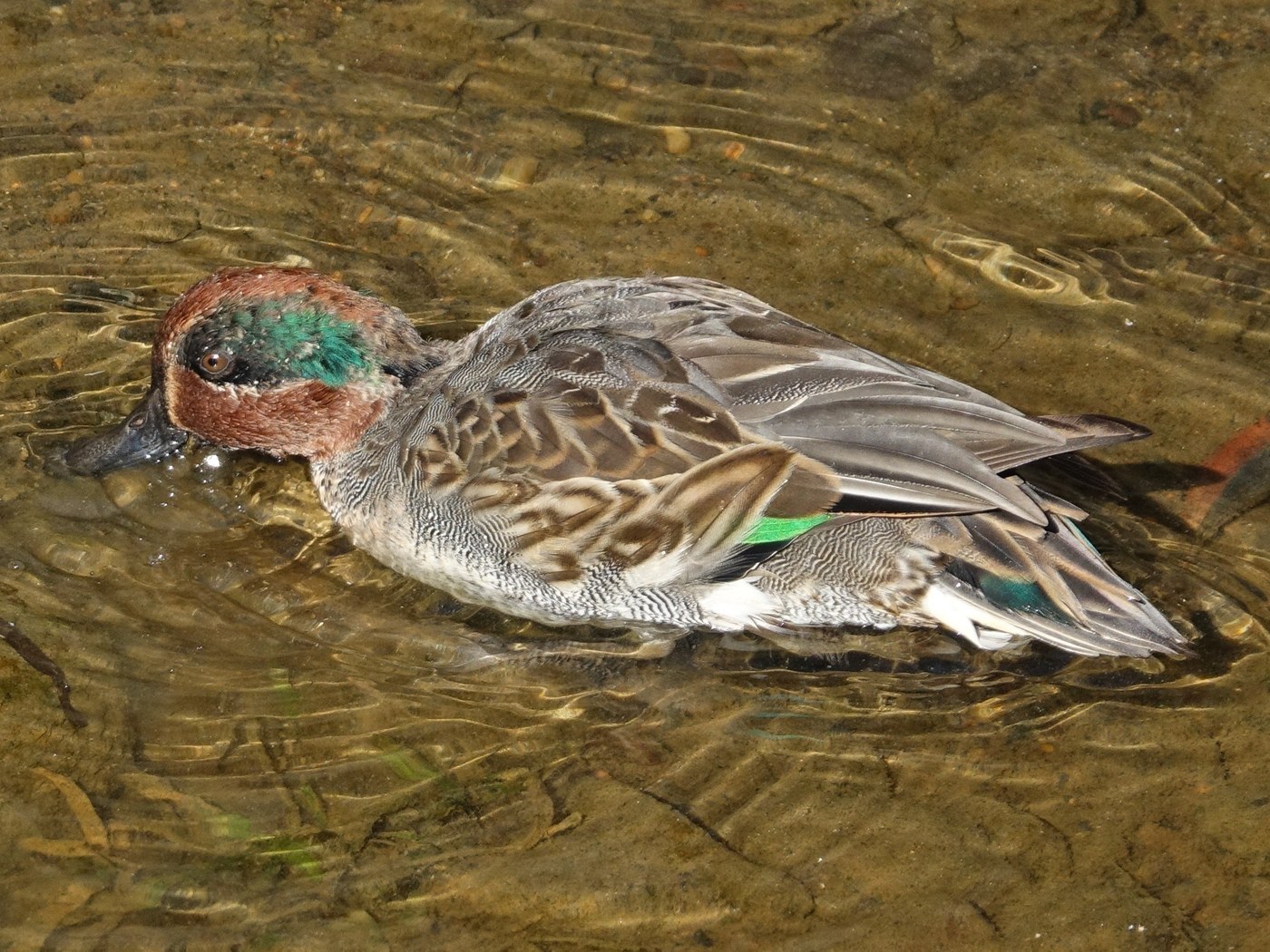
Key Field Marks
- Size and shape: The smallest dabbling duck in North America, about 12.5–15.5 inches long, with a small, rounded head, short neck, and compact body that give it a distinctive silhouette compared with larger dabblers.
- Male plumage: Rich chestnut head with a wide, iridescent green swath running from the eye back to the nape, a finely vermiculated gray body, a horizontal white vertical stripe on the side (in the American form), and a buffy-yellow patch under the tail bordered in black.
- Female plumage: Mottled brown overall, closely resembling other small female dabblers, but note the small size, plain gray-brown face often with a slightly paler area at the base of the bill, and a dark eye-line.
- Speculum: Both sexes show a bright green speculum (wing patch) bordered by buff or white, conspicuous in flight and sometimes visible at rest.
- Behavior: Highly gregarious, often forming large, tight flocks that fly with quick, agile, twisting maneuvers; dabbles and up-ends in shallow water and readily walks and feeds on mudflats.
Separating It From Similar Species
- Blue-winged Teal: Blue-winged Teal shows a pale blue wing patch (not green) and, in males, a bold white facial crescent; females are best told from female Green-winged Teal by larger bill size and different head shape.
- Female Mallard and other female dabblers: Green-winged Teal is much smaller and more compact, with a shorter neck and a proportionally smaller bill.
- Eurasian Teal ("Common Teal"): Regarded as a subspecies or close relative depending on taxonomy; males lack the vertical white side-stripe of the American form and instead show a horizontal white stripe along the scapulars, a key mark where the two forms overlap.
- In flight, the small size, fast wingbeats, and tight flock formations are useful supporting clues even at a distance.
Where and When to See It
- Habitat: Shallow marshes, flooded fields, mudflats, and small ponds; during migration and winter, often found on both fresh and brackish wetlands.
- Range: Breeds across northern and interior North America, including boreal Canada and Alaska; winters throughout the southern U.S., Mexico, and Central America.
- Season: A migrant and winter resident across much of the continental U.S., with breeding largely restricted to more northern latitudes in summer.
Voice and Song Cues
- Males give a clear, ringing, whistled "kreek" or bell-like note, distinctive among dabbling ducks and often given in flight or while resting on the water.
- Females give a soft, descending quack, higher-pitched and weaker than that of a Mallard.
Frequently asked questions
What is the fastest way to recognize a Green-winged Teal drake?
Look for the small size combined with a chestnut head marked by a bold green swath from the eye to the nape, along with a bright green wing patch visible in flight.
How do I identify a female Green-winged Teal?
Focus on small overall size, a compact body and short neck, a small bill, and the bright green speculum bordered in buff, since plumage alone is very similar to other female dabbling ducks.
How does Green-winged Teal differ from Blue-winged Teal?
Green-winged Teal shows a green (not blue) wing patch and males have a chestnut-and-green head rather than the blue-gray head and white facial crescent of male Blue-winged Teal.
What makes the Eurasian form of this teal different?
Eurasian Teal drakes lack the vertical white side-stripe of the American form and instead show a horizontal white line along the scapulars, a useful distinction where the two forms are compared.
What habitat is best for finding Green-winged Teal?
Shallow marshes, flooded agricultural fields, and muddy pond edges are ideal, especially during migration and winter when large flocks gather.