
Green-winged Macaw Identification Guide
One of the largest macaws, a deep-red parrot with green-and-blue wings and a bare white face crossed by fine lines of tiny red feathers, found in Neotropical lowland forest.
Read the full Green-winged Macaw encyclopedia entry →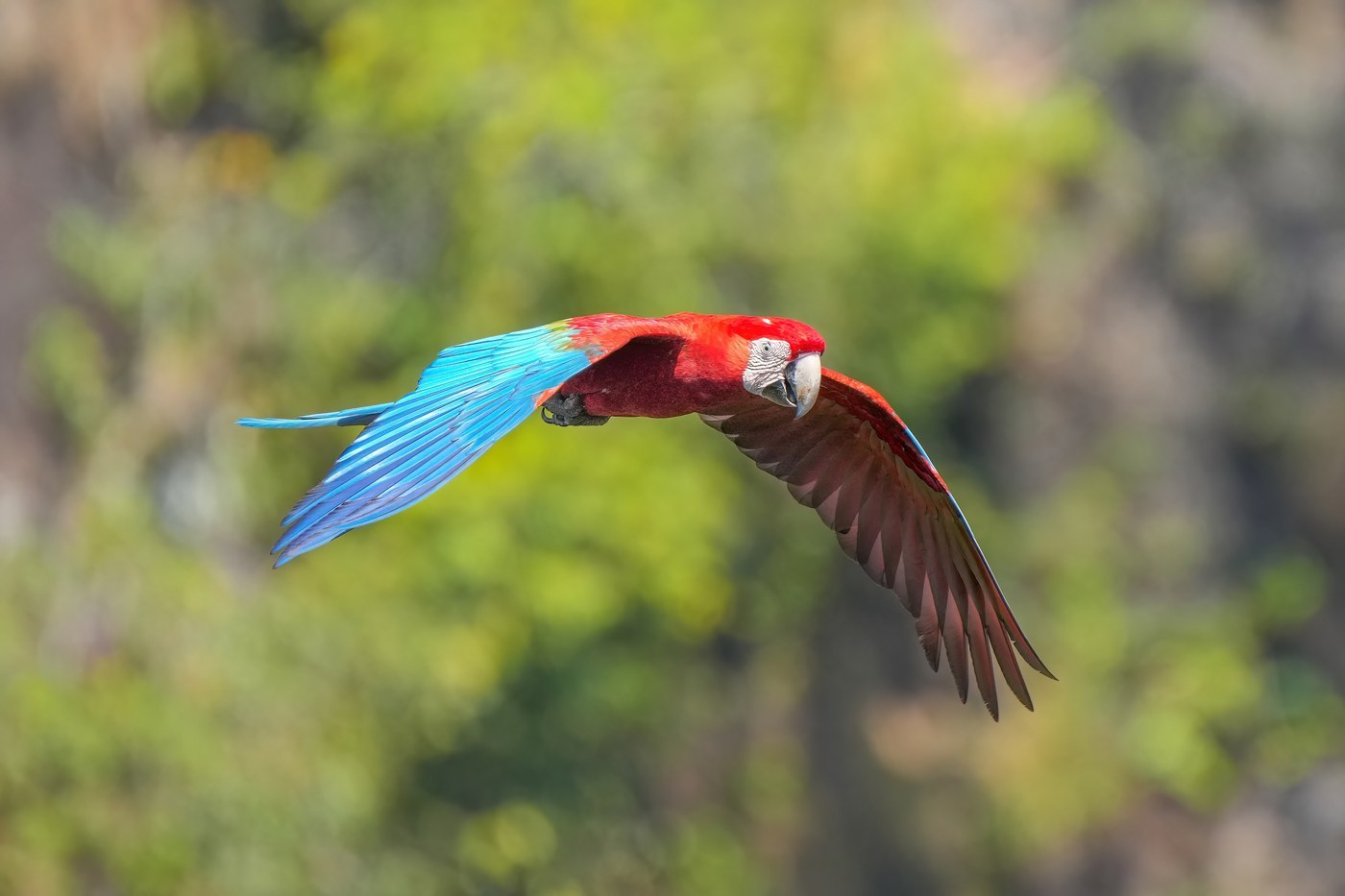
Key Field Marks
- Size and shape: A huge, long-tailed parrot, among the largest macaws, reaching roughly 33–39 inches in total length including a very long, pointed tail; heavy, deep-based bill typical of macaws.
- Plumage: Predominantly deep crimson-red body and head, with green wing coverts forming a broad green band across the upper wing, blue flight feathers and lower back, and a red tail broadly tipped in blue.
- Bare facial skin: Large area of bare white-to-pale-pink skin around the eye and cheeks, crossed by thin lines of small red feathers, a useful mark separating it from the similarly patterned Scarlet Macaw.
- Bill and legs: Massive, mostly blackish-gray bill (sometimes described as showing paler areas at the base of the upper mandible); dark gray legs and feet.
- Behavior: Usually seen in pairs or small family groups, often flying high over the canopy with slow, powerful wingbeats and a very long tail trailing behind; also gathers at clay licks with other macaws in parts of its range.
Separating It From Similar Species
- Scarlet Macaw: Scarlet Macaw shows yellow (not green) wing coverts between the red body and blue flight feathers, creating a red-yellow-blue wing pattern versus the red-green-blue pattern of Green-winged Macaw.
- Facial feathering: Green-winged Macaw's bare white face is crossed by fine rows of small red feathers, giving a lined appearance, whereas Scarlet Macaw's face is essentially all bare white skin without this feathering.
- Size: Green-winged Macaw is slightly larger and bulkier overall than Scarlet Macaw, with a notably heavier bill.
Where and When to See It
- Habitat: Humid lowland and foothill forest, gallery forest, and forest edge, often near rivers; also visits clay licks in some regions.
- Range: Widely but patchily distributed across northern and central South America, including the Amazon basin, extending into eastern Panama in Central America.
- Season: Non-migratory resident throughout its range; present year-round, though local movements track fruiting trees.
Voice and Song Cues
- Gives loud, harsh, far-carrying squawks and screeches, typical of large macaws, often heard well before the bird is seen as pairs call to each other in flight.
- Contact calls between paired birds are lower and more grating than the higher screams given in alarm.
Frequently asked questions
How do I tell Green-winged Macaw from Scarlet Macaw?
Look at the wing coverts: Green-winged Macaw shows a green band between the red body and blue flight feathers, while Scarlet Macaw shows yellow in that position instead of green.
What does the bare facial skin of a Green-winged Macaw look like?
It is largely white to pale pink and crossed by narrow lines of small red feathers, giving a subtly striped appearance, unlike the essentially featherless white face of a Scarlet Macaw.
Where does the Green-winged Macaw live?
It inhabits humid lowland forest across much of northern and central South America, with a small range extending into eastern Panama.
Is the Green-winged Macaw the same as the Red-and-green Macaw?
Yes, "Green-winged Macaw" and "Red-and-green Macaw" are alternate common names for the same species, Ara chloropterus.
Do Green-winged Macaws travel in flocks?
They are usually seen in pairs or small family groups rather than large flocks, though multiple pairs may gather at clay licks or fruiting trees.