
Green Sandpiper Identification Guide
A dark-backed, white-rumped Eurasian shorebird of quiet freshwater margins, often flushed with a sharp, whistled call and a bounding, snipe-like flight.
Read the full Green Sandpiper encyclopedia entry →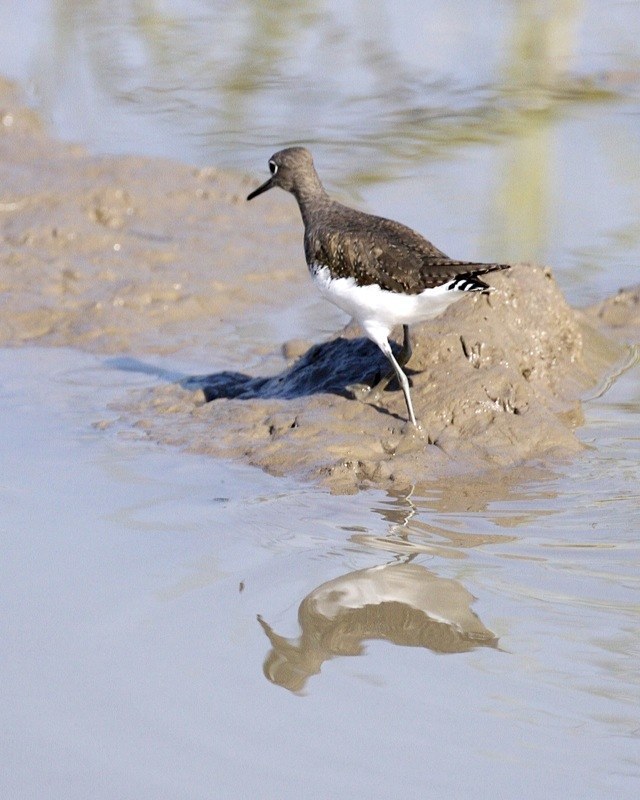
Key Field Marks
- Size and shape: A medium-small, stocky sandpiper about 8.5–9.5 inches long, with a relatively short neck, medium-length dark greenish legs, and a straight, medium-length dark bill.
- Plumage: Very dark, blackish-olive upperparts finely spotted with white, contrasting sharply with clean white underparts; in flight shows a striking, contrasting white rump and blackish underwings, a key identification feature.
- Bill and legs: Straight, dark bill; dull greenish legs, shorter and less brightly colored than those of the similar Wood Sandpiper.
- Behavior: Typically solitary or in loose small groups, feeding along muddy edges with a bobbing, teetering gait; flushes abruptly with a towering, zigzagging flight and loud call, recalling a snipe.
Separating It From Similar Species
- Wood Sandpiper: Paler and more delicately marked above, with a more finely spotted brown back, longer yellowish-green legs, less contrasting rump-to-back pattern, and paler underwings in flight; Wood Sandpiper is also generally less shy and flushes with a different, more disyllabic call.
- Common Sandpiper: Smaller, browner, lacks the bright white rump, and has a distinctive stiff-winged, flickering flight low over water, plus a constant bobbing tail.
- Solitary Sandpiper (in the Americas, a close ecological counterpart): Very similar in habits, but Green Sandpiper does not normally occur in the New World; where relevant, Solitary Sandpiper shows a barred rather than solid white outer tail and different underwing pattern.
- The strong contrast between the very dark upperparts/underwings and the bright white rump is the single best mark for Green Sandpiper in flight.
Where and When to See It
- Habitat: Small freshwater pools, ditches, flooded fields, sewage works, and wooded stream margins; often uses surprisingly small, overgrown, or shaded water bodies that other shorebirds avoid.
- Range: Breeds across northern Europe and Asia in boggy forest and taiga; winters from southern Europe and Africa across the Middle East and South Asia.
- Season: A passage migrant and winter visitor across much of its non-breeding range, with breeding confined to the far north in summer.
Voice and Song Cues
- The flushing call is a loud, ringing, three- or four-note "tlui-wit-wit" or "weet-a-weet", often the first and only clue to its presence as it towers away.
- Generally quieter and more retiring than many other shorebirds when undisturbed, often going unnoticed until flushed.
Frequently asked questions
What is the best flight mark for identifying a Green Sandpiper?
Look for the strong contrast between very dark, blackish upperparts and underwings and a bright white rump, visible as the bird flushes and flies away.
How do I tell Green Sandpiper from Wood Sandpiper?
Green Sandpiper is darker overall with duller greenish legs and a more contrasting white rump, while Wood Sandpiper is paler, more finely spotted, longer-legged, and shows less contrast between back and rump.
What kind of water bodies does Green Sandpiper prefer?
It favors small, often shaded or overgrown freshwater pools, ditches, and stream edges rather than large open mudflats or estuaries.
What does a flushed Green Sandpiper sound like?
It gives a loud, ringing, whistled call often rendered as "tlui-wit-wit," typically the first indication it has been disturbed.
Is the Green Sandpiper found in North America?
No, it is a Eurasian species; its closest ecological counterpart in North America is the Solitary Sandpiper, which shares similar solitary habits and habitat preferences.