
Green Peafowl Identification Guide
A large, endangered Southeast Asian pheasant with iridescent green-and-bronze scaled plumage and a tall, spiky crest, distinct from the more familiar blue-necked Indian peafowl.
Read the full Green Peafowl encyclopedia entry →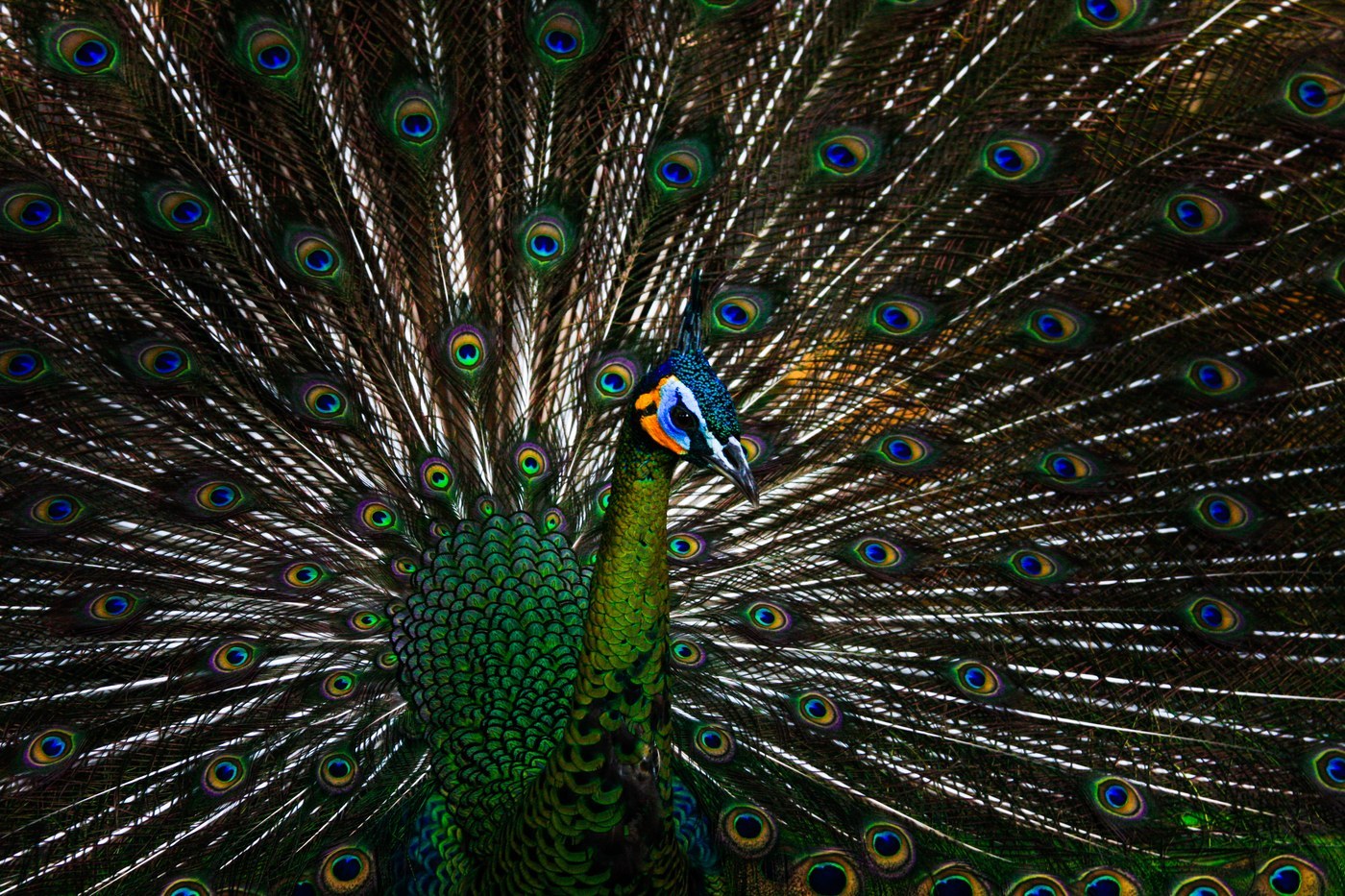
Key Field Marks
- Size and shape: A huge galliform, with males (peacocks) reaching up to about 10 feet including their extravagant train, and females (peahens) smaller but still substantial, around 3.5–4 feet long; both sexes stand tall with long necks and legs.
- Plumage: Overall metallic green and bronze, with tightly scaled, iridescent feathering across the neck and breast rather than the solid blue neck of Indian Peafowl; males have an elaborate train of elongated upper-tail coverts marked with iridescent eye-spots, raised and fanned in display.
- Head: Both sexes show a tall, narrow, upright crest of stiff feathers (unlike the fan-shaped crest of Indian Peafowl), with bare blue-and-yellow facial skin around the eye.
- Behavior: Wary and far less tame than Indian Peafowl; forages on the ground in small groups for seeds, fruit, invertebrates, and small vertebrates, retreating to trees to roost at night.
Separating It From Similar Species
- Indian (Blue) Peafowl: Indian Peafowl males have a solid, iridescent blue neck and breast and a fan-shaped crest, versus the scaled green neck and narrow, upright spiky crest of Green Peafowl; female Indian Peafowl also lacks a train and has a duller brown body.
- Female Green Peafowl, unlike female Indian Peafowl, retains bright, scaled green-bronze plumage similar to the male, though without the elongated train, making the sexes more alike in this species than in Indian Peafowl.
- Hybrid peafowl between the two species occur in captivity and can show intermediate features, complicating identification in non-wild settings.
Where and When to See It
- Habitat: Open forest, forest edge, and grassy clearings near rivers and wetlands in tropical and subtropical lowlands and foothills.
- Range: Historically widespread across Southeast Asia from northeastern India through Myanmar, Thailand, Indochina, and Java, but now highly fragmented and endangered, with strongholds remaining in parts of Myanmar, Cambodia, Vietnam, Laos, and Java.
- Season: A non-migratory resident; best located in the early morning or late afternoon when birds are most active and vocal.
Voice and Song Cues
- Gives a far-carrying, trumpeting "ki-wao" or "ah-ee-ow" call, especially at dawn and dusk, audible over long distances in forest habitat.
- Alarm calls are sharp, harsh, and repeated, often given before the bird flushes into nearby trees.
Frequently asked questions
What is the main difference between Green Peafowl and the more familiar Indian Peafowl?
Green Peafowl has a scaled green-bronze neck and a narrow, upright spiky crest, while Indian Peafowl has a solid blue neck and a rounded, fan-shaped crest; female Green Peafowl is also much more colorful than the drab brown female Indian Peafowl.
Is the Green Peafowl endangered?
Yes, it is classified as Endangered due to habitat loss, hunting, and poisoning across its Southeast Asian range, with populations now fragmented and much reduced.
Where is the best place to see wild Green Peafowl?
Remaining strongholds include protected forest and grassland areas in parts of Myanmar, Cambodia, Vietnam, Laos, and the island of Java, though the species is wary and often difficult to observe.
Do female Green Peafowl have a train like the males?
No, only males grow the elongated, eye-spotted train used in courtship display; females are similarly green and iridescent but lack the long train feathers.
What time of day is best for hearing Green Peafowl calls?
Dawn and dusk are the most reliable times, when the loud, trumpeting calls carry well through forest habitat.