
Green Kingfisher Identification Guide
The smallest kingfisher in the Americas, a sparrow-sized, dark green-and-white bird that perches low over clear streams before diving for tiny fish.
Read the full Green Kingfisher encyclopedia entry →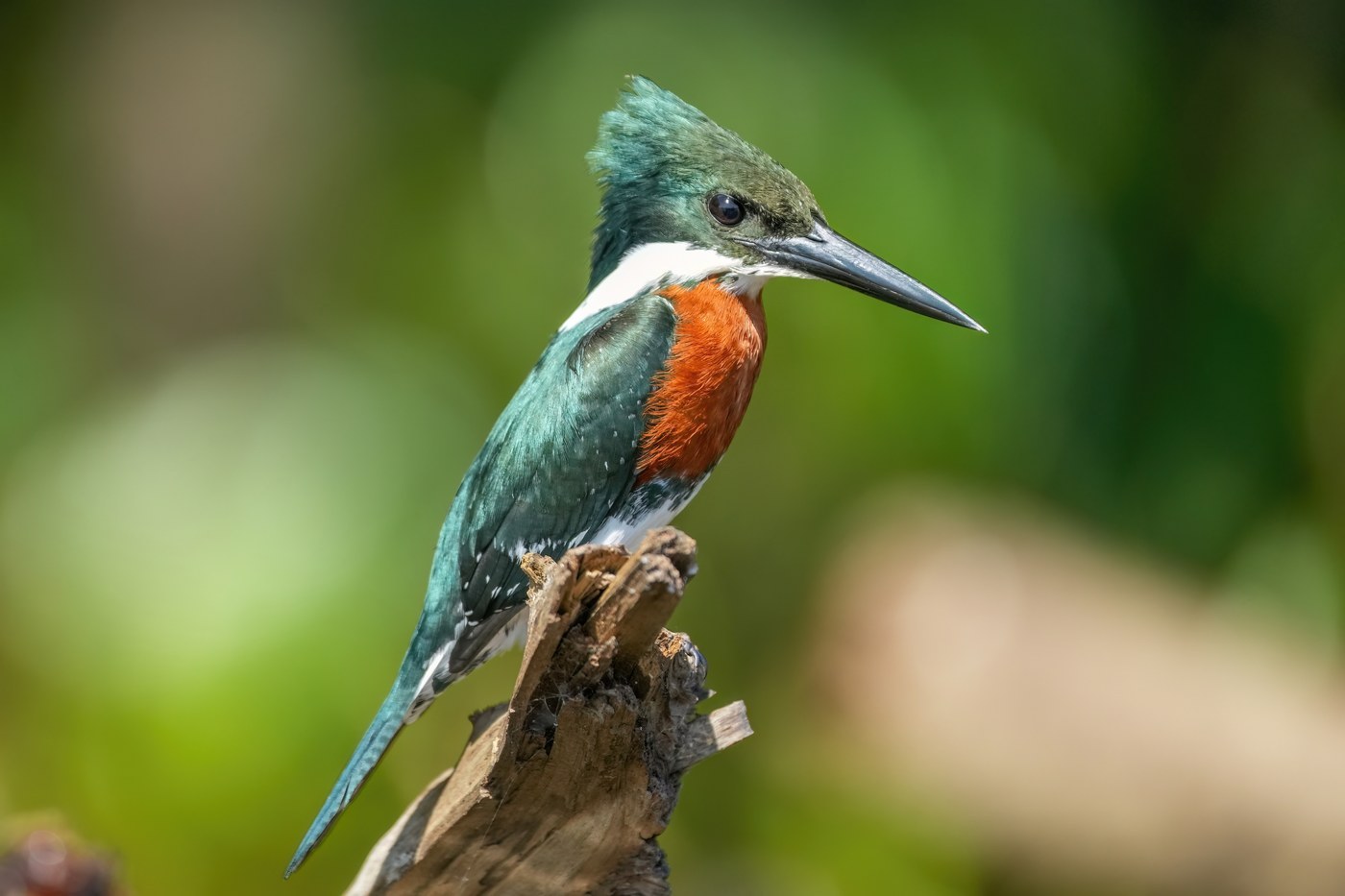
Key Field Marks
- Size and shape: Small, compact, and short-legged, about 7–8.75 inches long including a long, straight, dagger-shaped bill that looks oversized for the body.
- Male plumage: Glossy dark green upperparts finely spotted with white, a white collar, and a broad rufous-chestnut breast band on white underparts.
- Female plumage: Similar green-and-white pattern but lacks the solid chestnut breast band, instead showing one or two narrow greenish or green-spotted bands across the chest.
- Bill and legs: Long, straight, all-dark bill; short dark legs, typical of the low, perch-and-dive foraging style of kingfishers.
- Behavior: Perches low, often just a few feet above the water on branches, wires, or rocks, bobbing its head and flicking its tail before plunge-diving for small fish and aquatic insects.
Separating It From Similar Species
- Amazon Kingfisher: Much larger, with a proportionally bigger bill and bulkier build; Green Kingfisher is noticeably smaller and daintier.
- Ringed Kingfisher: Considerably larger and bulkier with a heavier bill and gray-blue upperparts rather than green.
- Belted Kingfisher (where ranges overlap): Belted Kingfisher is larger, blue-gray above rather than green, and has a shaggy crest that Green Kingfisher lacks.
- Sex can be told apart by breast pattern: solid rufous band on males versus interrupted, greenish band(s) on females.
Where and When to See It
- Habitat: Clear, shallow streams, rivers, and lagoons with wooded or brushy banks; prefers smaller, quieter waterways over large open water.
- Range: Resident from South Texas and Mexico south through Central America and much of South America.
- Season: A non-migratory resident throughout its range, present year-round wherever suitable clear-water habitat exists.
Voice and Song Cues
- Gives a sharp, dry, ticking "tik-tik-tik" call, often repeated rapidly when flushed or in flight along a stream.
- Lacks the loud rattle typical of larger kingfishers; its calls are notably softer and higher-pitched.
Frequently asked questions
How can I tell a male from a female Green Kingfisher?
Males show a solid, wide chestnut band across the white breast, while females have one or two narrower, greenish or spotted bands instead of a solid rufous band.
How is Green Kingfisher different from the larger Amazon Kingfisher?
Green Kingfisher is noticeably smaller and more delicate with a shorter, thinner bill, while Amazon Kingfisher is larger and bulkier with a heavier bill; both share a similar green-and-white pattern.
What kind of water bodies does this species prefer?
It favors small, clear streams, creeks, and quiet lagoons with wooded banks rather than large open rivers or lakes.
Is the Green Kingfisher found in the United States?
Yes, in a limited range in South Texas along the Rio Grande, where it can be seen perched low over clear streams.
What does the Green Kingfisher's call sound like?
It gives a dry, ticking series of notes, quite different from the loud rattling call of the larger Belted or Ringed Kingfishers.