
Green Heron Identification Guide
A small, stocky, dark heron of pond and stream edges, told by its chestnut neck, greenish-black cap, and crouched, ambush-hunting posture.
Read the full Green Heron encyclopedia entry →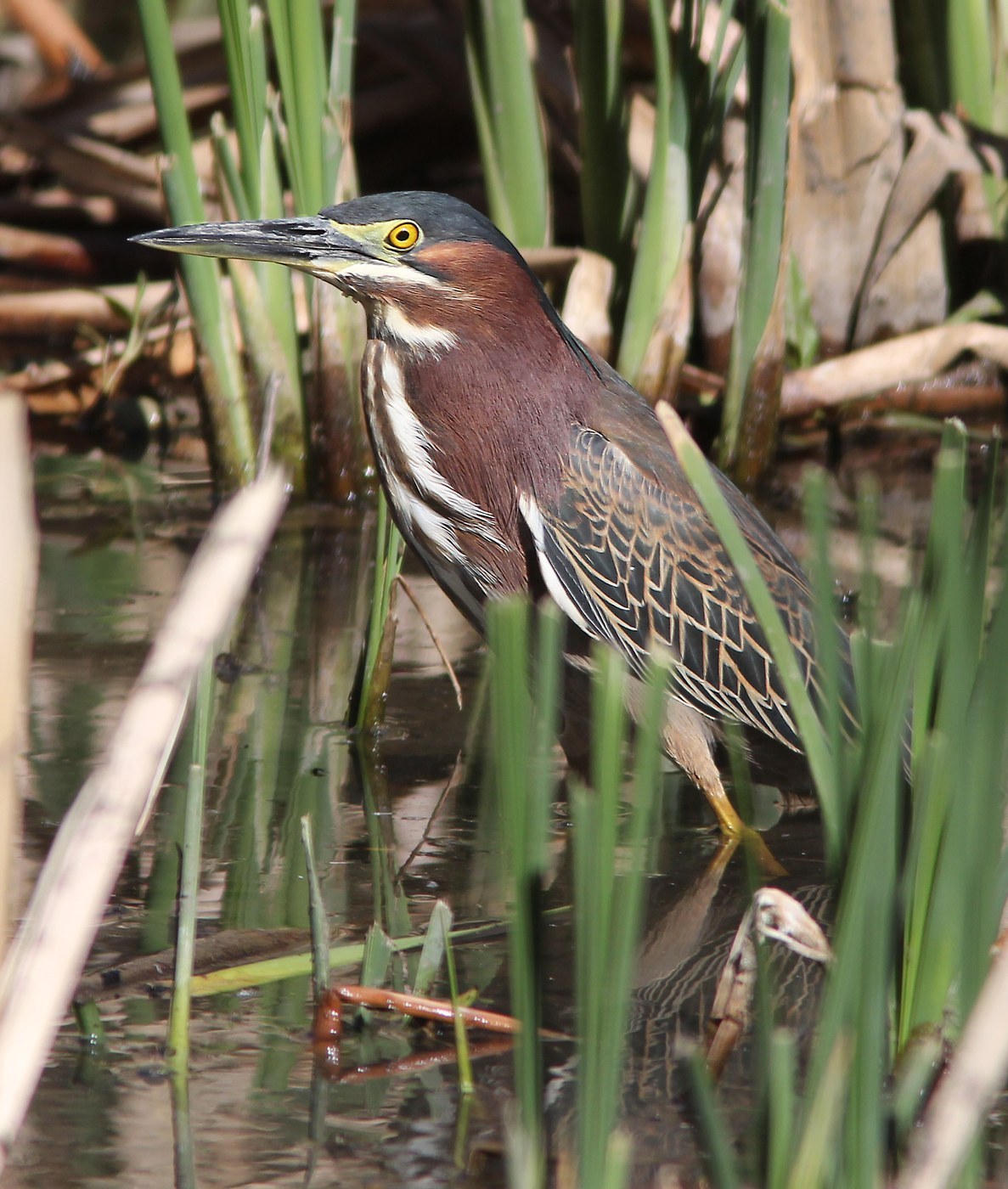
Key Field Marks
- Size and shape: A small, compact heron, roughly crow-sized (about 16–18 inches long including neck and bill), with a short neck that is often pulled in tight against the body, giving it a hunched, football-shaped silhouette.
- Plumage: Dark, glossy greenish-black cap and back (the "green" is often more of a blue-gray or dull olive sheen in the field, only showing rich green in good light), rich chestnut-rufous neck and sides, and a gray-and-white streaked throat and foreneck.
- Bill and legs: Long, dagger-like dark bill; legs are dull yellow-green, but turn bright orange in breeding adults.
- Behavior: Typically seen alone, standing motionless or in a crouched stance at the water's edge, neck retracted, waiting to strike at prey. Often flicks its short tail and raises a shaggy crest when agitated. Frequently perches on branches, snags, or docks just above the water.
Separating It From Similar Species
- Least Bittern: Much smaller and paler with buffy wing patches and a more skulking, reed-loving habit; Green Heron is darker overall and more often seen perched in the open.
- Juvenile Black-crowned Night-Heron: Larger, heavily streaked brown overall, thicker-necked, and lacks the chestnut neck of Green Heron.
- Striated/other small herons (where ranges overlap): Green Heron's chestnut neck and dark cap are diagnostic; similar species in other regions lack the combination of chestnut neck and glossy dark crown.
- In flight, Green Heron shows uniformly dark upperwings and a short-necked, crow-like flight profile, distinguishing it from long-necked herons and egrets.
Where and When to See It
- Habitat: Edges of ponds, marshes, streams, ditches, mangroves, and other shallow, still or slow-moving freshwater and brackish wetlands with overhanging vegetation.
- Range: Widespread across much of North and Central America; breeds through the eastern and central United States and parts of the West, wintering from the southern U.S. through Central America and the Caribbean.
- Season: Present year-round in the southern part of its range; a summer breeder farther north, arriving in spring and departing by early fall.
Voice and Song Cues
- Most often detected by its sharp, explosive "skeow" or "kyow" flight call, given when flushed or in flight, often at dusk or dawn.
- Also gives a rapid series of clucking or scolding notes when alarmed near the nest.
Frequently asked questions
Why is the Green Heron called "green" when it looks mostly dark or gray?
The cap and back feathers have an iridescent greenish sheen that is only visible in good, direct light; in typical field conditions the bird often appears dark gray, blue-gray, or blackish.
How can I tell a Green Heron from a young night-heron?
Green Heron is smaller and more compact with a solid chestnut neck and dark cap, while juvenile night-herons are larger, thicker-necked, and covered in bold brown streaking with white spots on the wings.
Does the Green Heron use tools to catch fish?
Yes, it is one of the few birds known to use bait, dropping small objects like insects, feathers, or bread onto the water's surface to lure fish within striking range.
Where is the best place to look for a Green Heron?
Scan quietly along the edges of ponds, slow streams, and marshes near overhanging brush or low branches; the bird often stands motionless in a crouched posture and can be easy to overlook.
What does a Green Heron's call sound like?
The most common vocalization is a loud, sharp "skeow" given as it flies off, often the first clue to its presence before it is seen.