
Green Bee-eater Identification Guide
A slender, brilliant green bird of open country across Africa and Asia, the Green Bee-eater is identified by its long central tail streamers, thin curved black bill, black eye-stripe, and graceful aerial hawking for insects.
Read the full Green Bee-eater encyclopedia entry →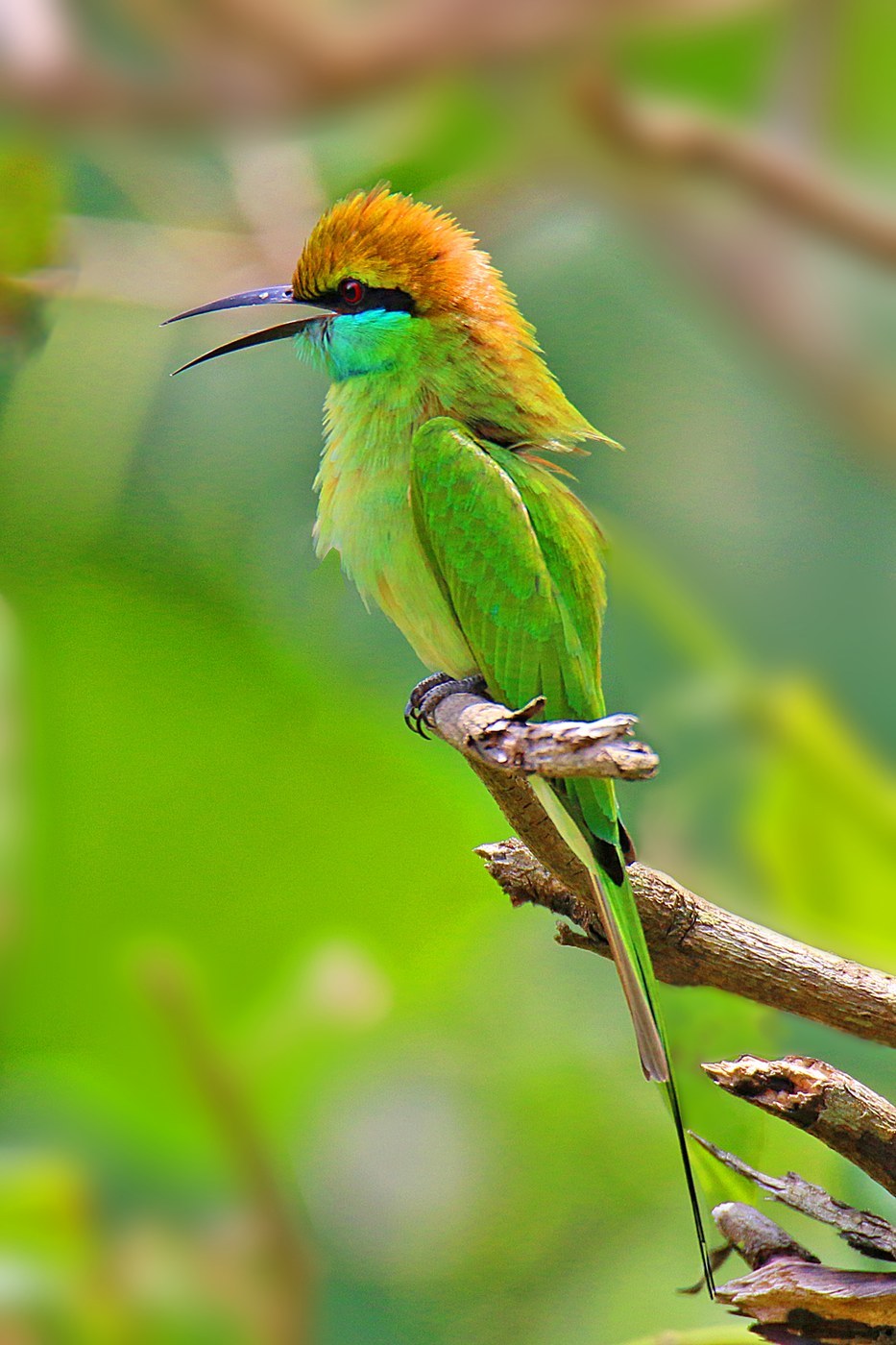
Key Field Marks
- Size & shape: A small, slim bee-eater about 6.5–8 inches (16–20 cm) including two elongated central tail feathers that project as fine points beyond the rest of the tail.
- Plumage: Bright grass-green overall, with a bluish tinge on the throat and cheeks in some populations, a coppery-golden wash on the crown and upper back in others (varies by subspecies/region), and a thin black line through the eye.
- Throat: Often shows a narrow black gorget line separating a blue or greenish throat from the breast, though this is subtle and varies geographically.
- Bill: Long, thin, and strongly downcurved, black — typical bee-eater shape for snatching flying insects.
- Tail: Central tail feathers extended into fine needle-like streamers, longer and thinner than in most other bee-eaters, though sometimes worn or broken and less obvious.
- Behavior: Perches conspicuously on wires, bare branches, or fence posts, sallying out in swift, agile flight to catch bees, wasps, and other flying insects, then returning to the same perch to beat the prey before swallowing.
Separating It From Similar Species
- Blue-cheeked Bee-eater and Blue-tailed Bee-eater are both larger, longer-winged, and show more blue in the plumage (especially cheeks or tail) rather than being essentially all green; Green Bee-eater is noticeably smaller and slimmer than either.
- European Bee-eater is far more colorful, with chestnut/yellow upperparts and a yellow throat, entirely unlike the uniform green Green Bee-eater.
- Within its range, the combination of small size, mostly uniform green plumage, and fine tail streamers is diagnostic; regional subspecies vary somewhat in throat color (blue vs. green) and the presence/strength of a black gorget.
Where & When to See It
- Habitat: Open and semi-open country — scrub, farmland, grassland, light woodland, and gardens; frequently seen perched on wires and fences, avoiding dense forest.
- Range: Widespread across sub-Saharan Africa, the Middle East, and South and Southeast Asia (from Egypt and the Arabian Peninsula east through India to Southeast Asia); largely resident, with some local seasonal movement.
- Season: Present year-round through most of its range; more conspicuous in the breeding season when pairs excavate nest burrows in sandy banks or flat ground and defend territories vocally.
Voice
- A cheerful, rolling, trilled tree-tree-tree or ti-ti-ti, often given in flight — a light, musical, and frequently repeated call that draws attention to foraging or perched birds.
Frequently asked questions
What makes the Green Bee-eater's tail distinctive?
Its two central tail feathers are extended into fine, thin, needle-like streamers noticeably longer and more delicate than the tail projections of most other bee-eater species.
How do you separate Green Bee-eater from Blue-cheeked Bee-eater?
Green Bee-eater is smaller and essentially uniform green, while Blue-cheeked Bee-eater is larger, longer-winged, and shows more extensive blue on the face and underparts rather than looking almost entirely green.
What habitat should I look for Green Bee-eaters in?
Open and semi-open country such as farmland, scrub, and grassland, especially where wires, fences, or bare branches offer hunting perches.
Does the Green Bee-eater's plumage vary across its range?
Yes — throat color (blue versus green) and the strength of a black throat gorget vary among the several recognized subspecies spread across Africa and Asia, though all share the overall green body and fine tail streamers.