
Greater Yellowlegs Identification Guide
A tall, elegant shorebird of shallow wetlands, the Greater Yellowlegs shows long bright-yellow legs, a long slightly upturned bill, and a loud, ringing three- or four-note call, closely resembling the smaller Lesser Yellowlegs.
Read the full Greater Yellowlegs encyclopedia entry →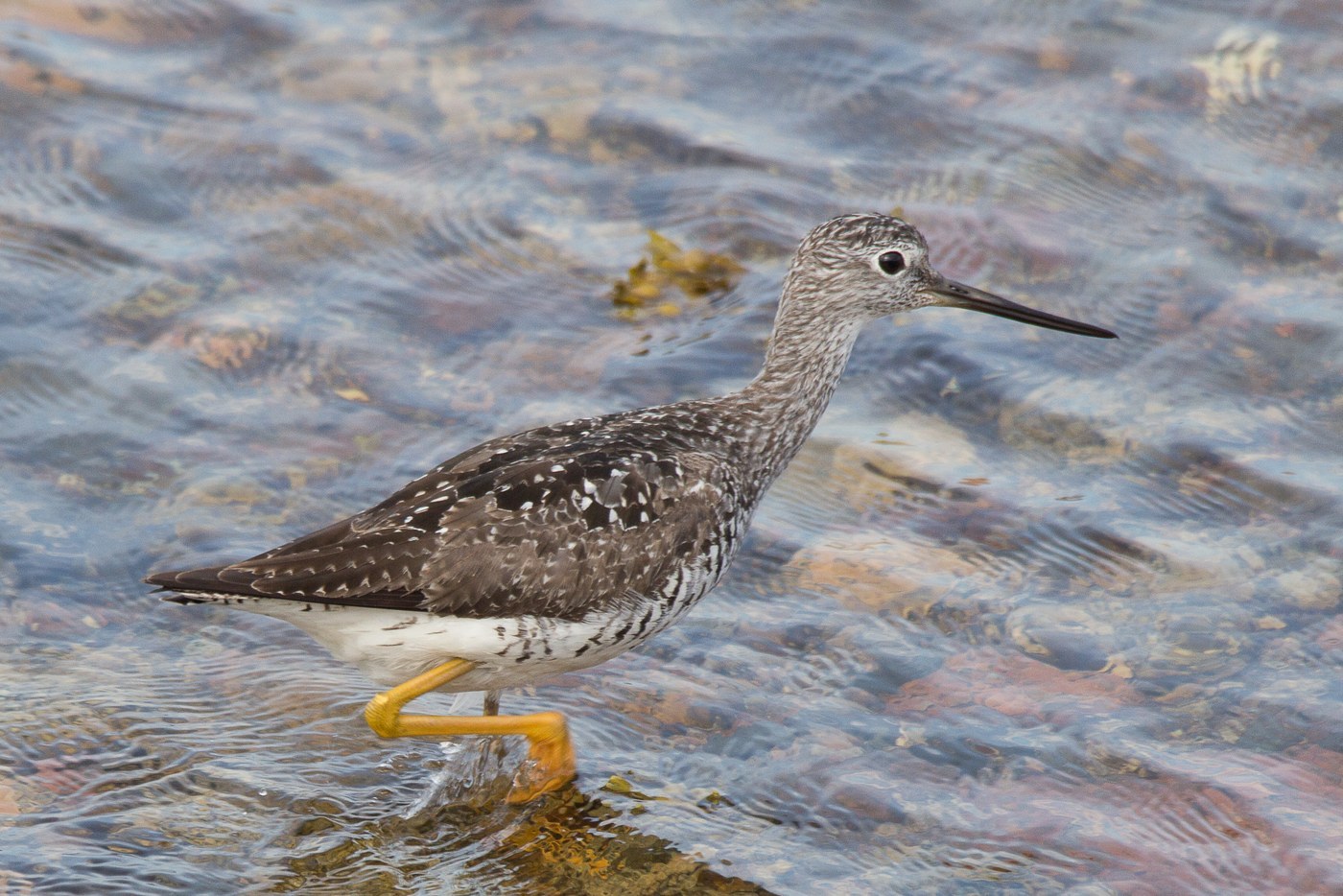
Key Field Marks
- Size & shape: A tall, lanky sandpiper roughly 11–15 inches (28–38 cm) long, with a long neck, long bill, and very long bright yellow legs.
- Plumage: Gray-brown above with fine white spotting/mottling in breeding plumage, becoming plainer gray in winter; underparts white with dark streaking on the neck and flanks, heavier in breeding plumage.
- Bill: Long (roughly 1.5x head length or more), fairly stout, and very slightly upturned, often bicolored gray-based with a darker tip.
- Legs: Long and bright yellow to yellow-orange, a defining feature shared with Lesser Yellowlegs but proportionally longer here.
- Behavior: Forages actively, often running through shallow water while sweeping its bill side to side or jabbing at small fish and invertebrates; bobs its tail and body; frequently wary and quick to call in alarm.
Separating It From Similar Species
- Lesser Yellowlegs is the primary confusion species: noticeably smaller and more delicate, with a shorter, straighter, thinner, and entirely dark bill (roughly equal to head length, not longer), a gentler expression, and a shorter, more even two-note call (tu-tu) versus Greater's louder three-to-four note call. Bill length relative to head size and the slight upturn are the most reliable structural marks.
- Willet is bulkier and grayer with a thicker, straighter bill and blue-gray (not yellow) legs, and shows a bold black-and-white wing pattern in flight.
- Stilt Sandpiper is smaller, with a longer, more strongly drooped bill tip and greenish-yellow (not bright yellow) legs.
Where & When to See It
- Habitat: Shallow freshwater and brackish wetlands, flooded fields, mudflats, marsh edges, and shoreline pools; more likely than Lesser Yellowlegs to use deeper water and coastal habitats.
- Range: Breeds in boreal forest bogs and muskeg across Canada and Alaska; winters along the southern U.S. coasts, Mexico, Central America, and South America, with wide passage across the interior during migration.
- Season: A migrant across most of North America in spring (April–May) and fall (July–October), a winter resident along southern coasts, and a summer breeder only in the far north.
Voice
- A loud, ringing, far-carrying three- or four-note whistle, often rendered tew-tew-tew or dear-dear-dear, typically given when disturbed or in flight — louder and more insistent than the flatter two-note call of Lesser Yellowlegs.
Frequently asked questions
What is the easiest way to tell Greater from Lesser Yellowlegs?
Bill length and shape are most reliable: Greater Yellowlegs has a longer bill (noticeably longer than the head, often with a slight upward tilt) while Lesser Yellowlegs has a shorter, straighter, thinner, all-dark bill about equal to head length. Calls also differ — Greater gives a loud three-to-four note whistle, Lesser a flatter two-note call.
Do Greater Yellowlegs and Willets ever get confused?
They can at a distance, but Willet is bulkier with blue-gray legs (not yellow), a thicker straight bill, and a bold black-and-white flight pattern, all of which separate it from the slimmer, yellow-legged Greater Yellowlegs.
When is the best time to see Greater Yellowlegs?
During migration — spring (April–May) and especially fall (July–October) — when they pass through wetlands across most of North America; they also winter along southern U.S. coasts.
What habitat should I check for Greater Yellowlegs?
Shallow wetlands, flooded fields, mudflats, and marsh edges with some open water, where it actively wades and sweeps its bill for small fish and invertebrates.