
Greater Scaup Identification Guide
A stocky diving duck of large lakes, bays, and coastal waters, the Greater Scaup shows a rounded green-glossed head, pale gray back, and clean white flanks, closely resembling the Lesser Scaup but slightly bulkier and more coastal.
Read the full Greater Scaup encyclopedia entry →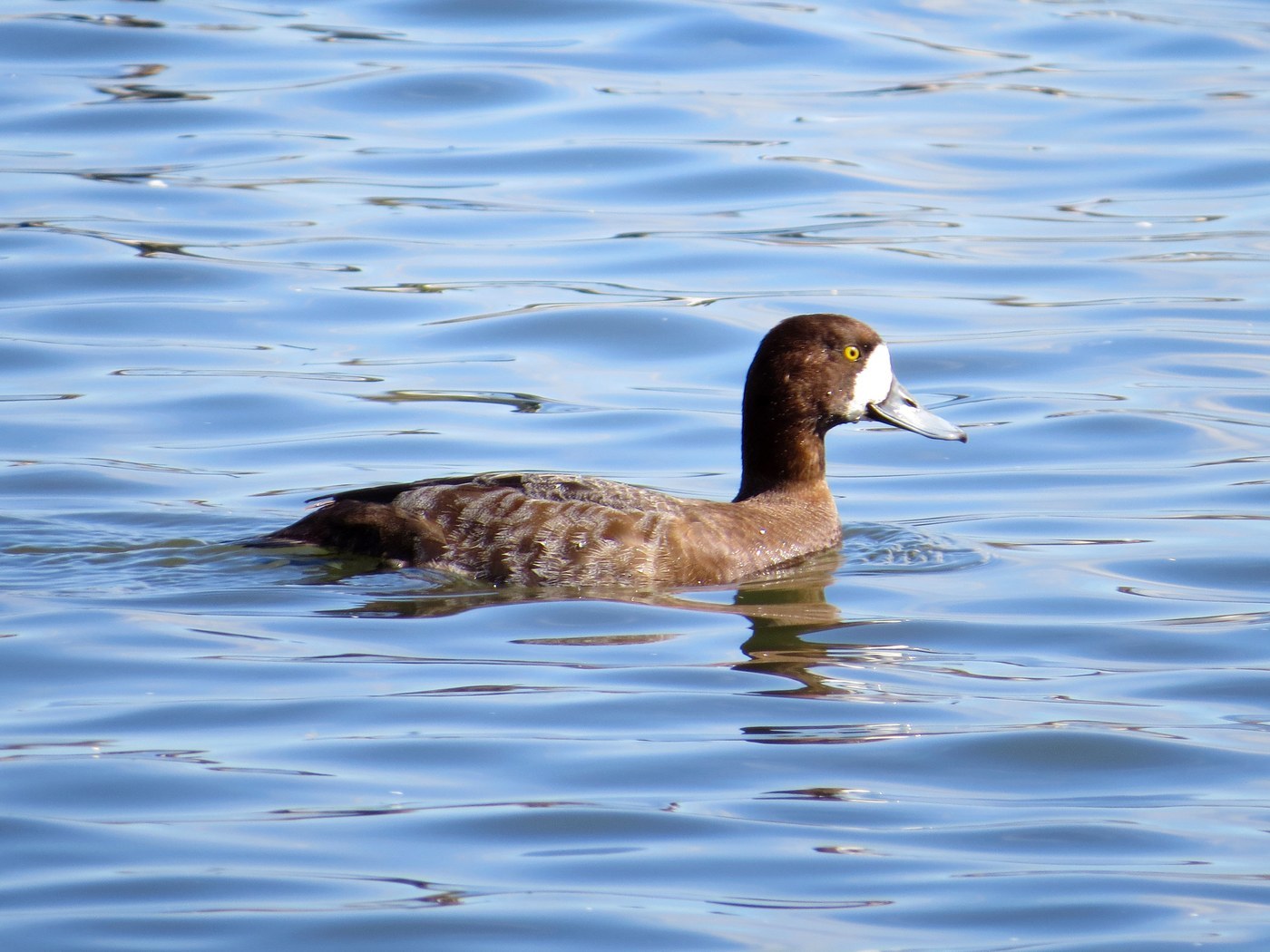
Key Field Marks
- Size & shape: A medium-large diving duck (bay duck) with a rounded head profile, broad body, and relatively short neck; appears bulkier and more front-heavy than Lesser Scaup.
- Male plumage: Glossy dark head with a green sheen (in good light), black breast, pale gray back finely vermiculated with black-and-white, and clean white flanks; black tail end.
- Female plumage: Rich brown overall with a bold, sharply defined white patch at the base of the bill — larger and more clean-edged than on female Lesser Scaup.
- Bill: Broad, blue-gray ("blue bill") with a black nail at the tip; noticeably broader than Lesser Scaup's bill, with the black nail comparatively small.
- In flight: Shows a white wing stripe that extends well out into the primaries (unlike Lesser Scaup, where it is mostly limited to the secondaries) — the single most reliable mark for separating the two species in flight.
- Behavior: Dives frequently to feed on mollusks and aquatic invertebrates; forms large rafts, often in open water well offshore, more so than Lesser Scaup.
Separating It From Similar Species
- Lesser Scaup is the classic confusion species: Lesser has a more peaked head shape (with a slight bump toward the rear crown), a purple (not green) gloss on the male's head in good light, a narrower bill with a larger black nail, and a shorter white wing stripe confined mostly to the secondaries. Head shape is the most useful mark on swimming birds; the wing stripe is definitive in flight.
- Ring-necked Duck shows a peaked head, a white ring near the bill tip and a pale band on the bill, and a black back (vs. pale gray on scaup) — readily separable with a good look.
- Female scaup can suggest female Ring-necked Duck, but Ring-necked lacks the sharply set-off round white face patch and shows the peaked head and pale-ringed bill instead.
Where & When to See It
- Habitat: Large lakes, reservoirs, coastal bays, and estuaries; more tied to big, open, often brackish or salt water than Lesser Scaup, especially in winter.
- Range: Breeds across the far north (Alaska, northern Canada, Arctic tundra and taiga); winters along both U.S. coasts, the Great Lakes, and larger inland lakes across temperate North America, as well as parts of Europe and Asia (Holarctic distribution).
- Season: A winter visitor through most of its U.S./southern Canada range, present roughly October–April, with breeding confined to the Arctic and subarctic in summer.
Voice
- Generally quiet away from breeding grounds. Males give soft, discordant whistling notes during courtship; females give a harsher, growling arrr or garf call, mainly on breeding territory.
Frequently asked questions
What is the best field mark to separate Greater Scaup from Lesser Scaup?
In flight, the white wing stripe on Greater Scaup extends well into the primaries, while on Lesser Scaup it is largely confined to the secondaries. On the water, head shape helps: Greater is rounded, Lesser shows a slight peak toward the back of the crown.
Does head color reliably separate Greater and Lesser Scaup?
Not reliably — the green (Greater) versus purple (Lesser) head gloss depends heavily on light angle and can be misleading; use head shape, bill width, and the wing stripe in flight as more consistent marks.
Where do Greater Scaup nest?
They breed in the Arctic and subarctic, on tundra and taiga wetlands across northern Alaska, northern Canada, and parts of northern Eurasia, and move south to temperate coasts and lakes only for winter.
Are Greater Scaup usually found on salt water or fresh water?
Both, but they show a stronger preference for large open lakes, coastal bays, and estuaries — often more brackish or saline water — than Lesser Scaup, which favors smaller inland lakes and ponds more often.