
Greater Roadrunner Identification Guide
A large, long-tailed ground cuckoo of the American Southwest, the Greater Roadrunner is easily identified by its streaky brown-and-white plumage, shaggy crest, and habit of sprinting across open desert on long legs.
Read the full Greater Roadrunner encyclopedia entry →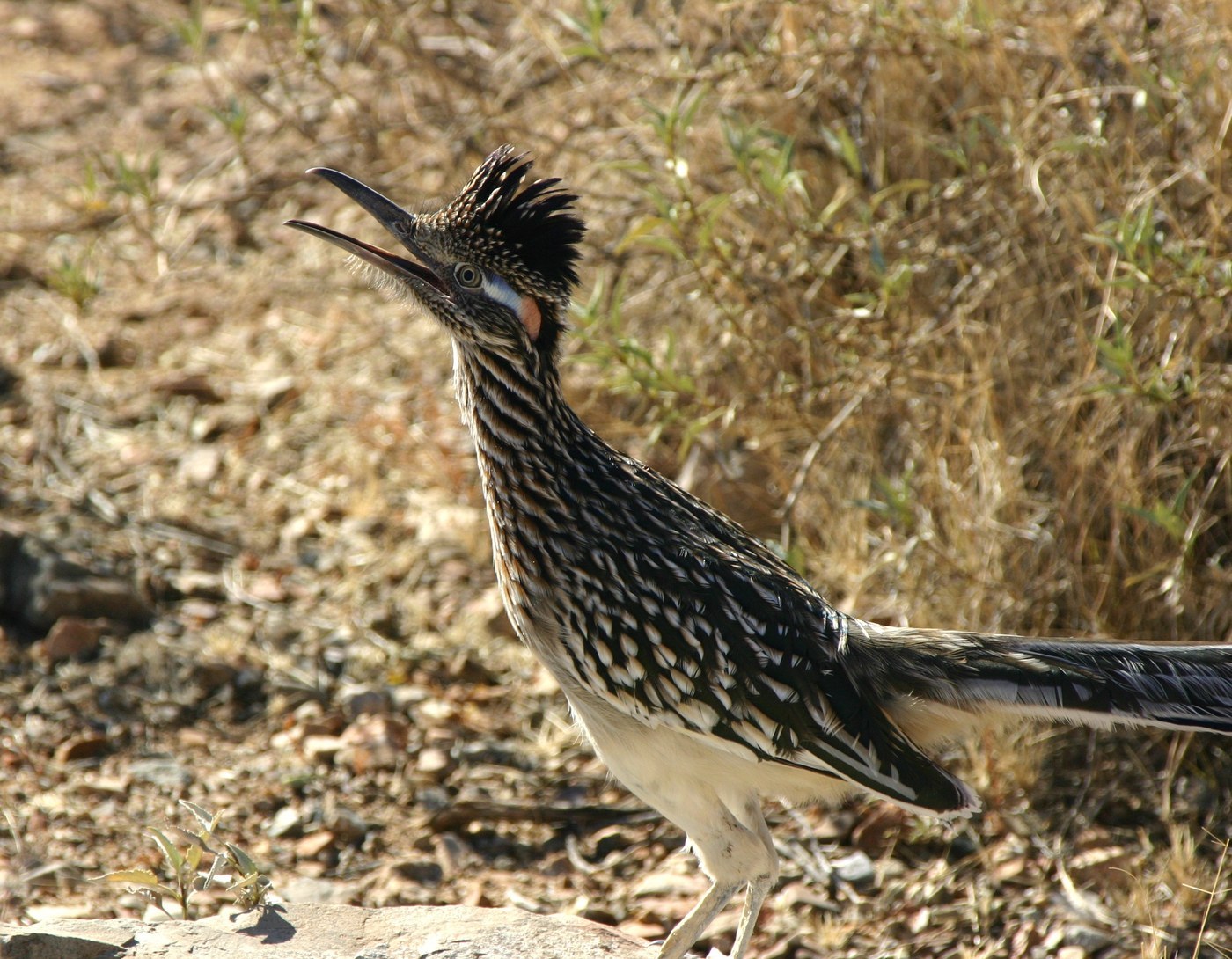
Key Field Marks
- Size & shape: A large cuckoo, roughly 20–24 inches (50–60 cm) long, over half of which is a long, graduated dark tail. Body is elongated and low-slung with long legs adapted for running.
- Plumage: Heavily streaked brown, buff, and white above and on the breast, giving a mottled, camouflaged look; belly is paler and less streaked. A shaggy, often raised blue-black crest tops the head.
- Bare skin: A patch of bare skin behind the eye shows blue fading to red/orange — visible at close range or in good light.
- Bill: Long, heavy, slightly downcurved, dark above and pale below.
- Legs: Long, sturdy, grayish, built for running rather than perching; toes are zygodactyl (two forward, two back), typical of cuckoos.
- Behavior: Spends nearly all its time on the ground, running rapidly (up to 20 mph) with tail held out for balance, then freezing or crouching low; flight is short, low, and labored, used mainly to reach a low perch or escape danger.
Separating It From Similar Species
- No other North American bird shares its combination of large size, long tail, streaky plumage, and ground-running habit, so misidentification is uncommon within its range.
- A perched or crouched bird might briefly suggest a large female pheasant or a grouse to an inexperienced observer, but the very long tail, thin cuckoo-like bill, and shaggy crest are diagnostic.
- Juveniles look like duller, less crested versions of adults but show the same overall shape and streaking.
Where & When to See It
- Habitat: Arid and semi-arid country — desert scrub, chaparral, mesquite grassland, and dry open woodland edges; also found around ranches, dry washes, and suburban edges in the Southwest.
- Range: Resident year-round across the southwestern United States (California, Arizona, Nevada, New Mexico, Texas, Oklahoma) and much of Mexico.
- Season: Present all year; most active and visible in the cooler parts of the day (early morning, late afternoon) during hot months, and more active at midday in cooler seasons.
Voice
- Song is a descending series of low, dove-like coo-coo-coo-coo-coo notes, dropping in pitch and slowing toward the end.
- Also gives a distinctive bill-clattering rattle used in communication and display, quite unlike typical bird calls.
Frequently asked questions
Can Greater Roadrunners fly?
Yes, but only weakly and for short distances — mainly to reach a low branch or fence, escape a predator, or glide down a slope. They rely on running, not flying, for most travel.
What does a Greater Roadrunner's call sound like?
Its song is a slow, descending series of low coo notes reminiscent of a dove, and it also makes a dry, clattering rattle by snapping its mandibles together.
How fast can a Greater Roadrunner run?
Roadrunners can sprint up to about 20 mph (32 km/h) on the ground, among the fastest running speeds of any flying bird.
What habitat is best for finding a Greater Roadrunner?
Open, arid country with scattered scrub or cactus — desert flats, dry washes, chaparral, and rural edges throughout the southwestern U.S. and Mexico — offers the best chances.