
Greater Rhea Identification Guide
South America's largest bird, the Greater Rhea is a huge flightless ratite identified by its long bare legs, grayish-brown shaggy plumage, and habit of moving in loose flocks across open grasslands.
Read the full Greater Rhea encyclopedia entry →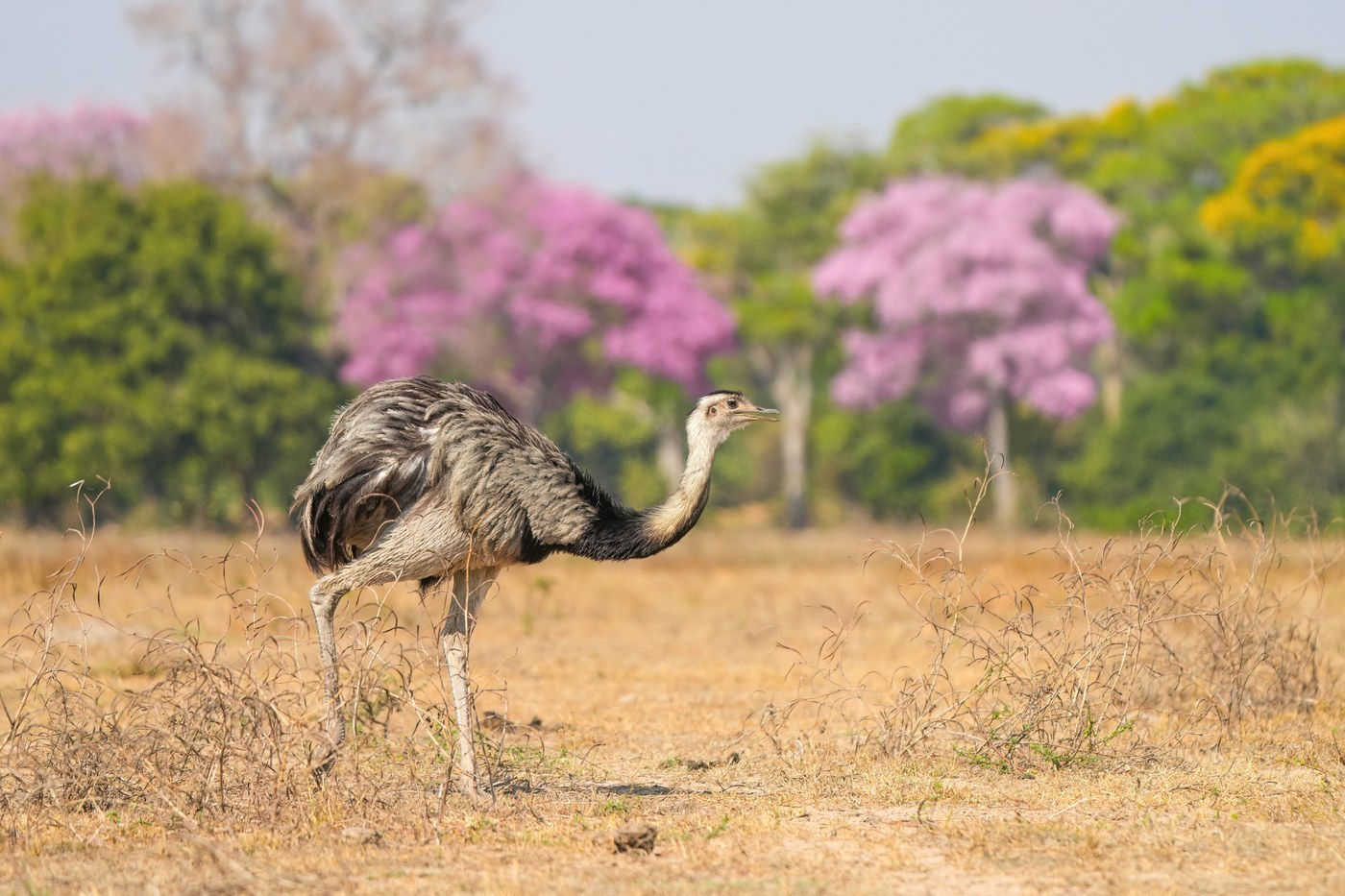
Key Field Marks
- Size & shape: A massive flightless bird standing 4.5–5.5 feet (1.4–1.7 m) tall, with a long neck, small flattened head, and large three-toed feet. Body silhouette is bulky and oval, carried on long bare legs.
- Plumage: Loose, shaggy grayish-brown to grayish-tan feathers overall, paler on the belly and flanks. Males are darker on the neck and often show a blackish collar-like patch at the base of the neck during breeding.
- Bill: Short, flat, and broad, duck-like in shape, pale grayish in color.
- Legs: Long, bare, and pale gray-pink, ending in three forward-pointing toes (no hind toe) — a useful trait when a bird is seen closely or in tracks.
- Behavior: Walks and runs (up to 40+ mph when alarmed) rather than flies; uses partially spread wings for balance while running and for display. Often seen in loose groups grazing or foraging on the ground.
Separating It From Similar Species
- The only large flightless bird native to its South American range, so confusion with other wild birds is minimal. The smaller, more localized Lesser (Darwin's) Rhea of Patagonia and the Andes is the main look-alike: it is noticeably smaller, paler, and more spotted/mottled on the back and neck, with feathered (rather than fully bare) lower legs and a proportionally shorter neck.
- Farmed or escaped ostriches and emus (kept on some ranches) differ in having only two toes (ostrich) or a very different neck/plumage pattern (emu, shaggy dark brown with a distinct facial pattern).
Where & When to See It
- Habitat: Open grasslands, savanna, scrub, and agricultural pasture; avoids dense forest. Often near water in the dry season.
- Range: Central and eastern South America, including the pampas of Argentina, Uruguay, Paraguay, and the cerrado of central Brazil and Bolivia.
- Season: Resident year-round; most visible early morning and late afternoon when foraging groups are active. Breeding season (spring, roughly September–December in the Southern Hemisphere) brings male display behavior and larger creche groups of chicks.
Voice
- Generally silent outside the breeding season. Breeding males give a deep, booming, resonant roar-like call — sometimes rendered as a low "nandu" boom — audible over long distances across open country and used in territorial and courtship display.
Frequently asked questions
How can I tell a Greater Rhea from a Lesser Rhea?
Greater Rhea is larger and plainer grayish-brown with mostly bare lower legs, while Lesser (Darwin's) Rhea is smaller, paler, more spotted/mottled, and has some feathering lower on the legs. Range also helps: Lesser Rhea occurs farther south and at higher elevations.
Do Greater Rheas fly?
No. Like all rheas they are flightless; they use their large wings for balance, steering while running, and courtship display rather than flight.
What is the best time of day to see Greater Rheas?
Early morning and late afternoon, when they are actively grazing and foraging in open grassland or pasture; they rest in shade during the hottest midday hours.
Are male and female Greater Rheas easy to tell apart?
Breeding males are somewhat darker overall, especially on the neck, and are the ones giving the booming display call and tending chicks, but plumage differences between sexes are subtle in the field.