
Greater Prairie-Chicken Identification Guide
A heavily barred grassland grouse of the central Great Plains, best known for males' booming lek displays with erect neck pinnae and inflated orange air sacs.
Read the full Greater Prairie-Chicken encyclopedia entry →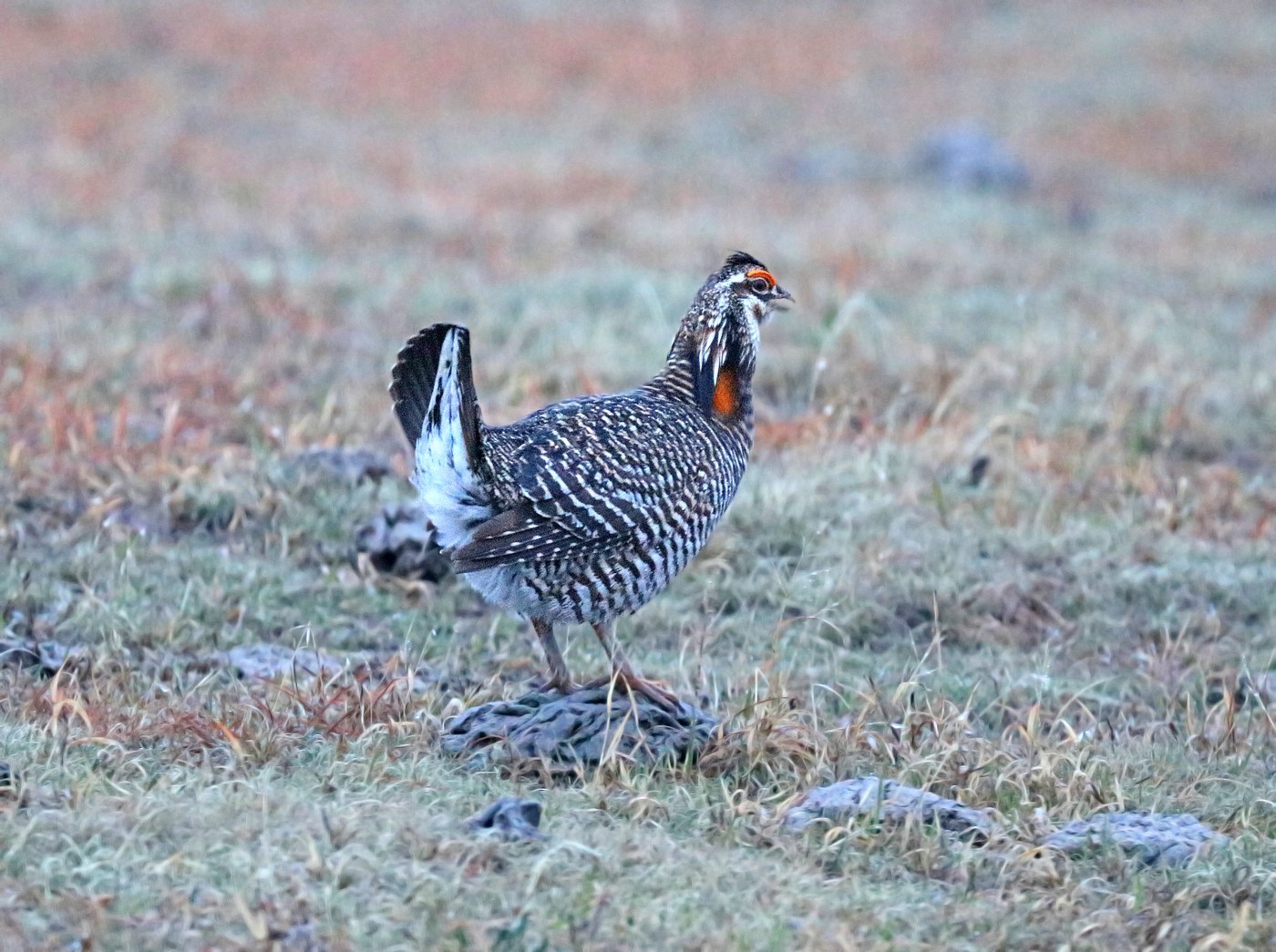
Key Field Marks
- Size & shape: A medium-large, chunky grouse with a short, rounded, dark tail and a fairly short neck.
- Plumage: Heavily barred brown and white/buff across the body, giving an overall mottled appearance that provides excellent camouflage in grass.
- Male display features: Long, pointed neck feathers (pinnae) that are raised during display; bright orange-yellow eyebrow combs; and orange-red gular (throat) air sacs that inflate dramatically during booming courtship displays.
- Female: Similar barred plumage to the male but with shorter pinnae and no inflatable air sacs, making her less conspicuous.
- Behavior: Gathers on traditional communal display grounds (leks) at dawn, where males stamp their feet, boom, and spar for the attention of visiting females.
Separating It From Similar Species
- Lesser Prairie-Chicken: Smaller and paler overall with more reddish-toned barring, a pinkish-red (rather than orange) gular sac, and a range restricted to drier shortgrass/sand-sagebrush habitat further southwest.
- Sharp-tailed Grouse: Has a pointed central tail rather than a short rounded one, more V-shaped chevron markings on the underparts, and purplish (not orange) neck sacs during display.
- Greater Sage-Grouse: Much larger, with a black belly patch, spiky pointed tail feathers, and a very different, more elaborate strutting display; found in sagebrush habitat rather than tallgrass prairie.
Where and When to See One
- Range: Fragmented populations across the central Great Plains of the United States, including Nebraska, Kansas, Oklahoma, and parts of the Midwest, with a notable insular population in coastal Texas (Attwater's prairie-chicken, now critically endangered).
- Habitat: Native tallgrass and mixed-grass prairie; increasingly dependent on protected grassland reserves due to habitat loss.
- Season: Present year-round; lek displays peak in early spring (roughly March through May), the best time to visit a blind for viewing.
Voice Cues
- The male's "booming" call is a low, hollow, three-syllable sound produced by expelling air from the inflated gular sacs, often likened to blowing across the top of a bottle; it carries remarkably far across open prairie at dawn.
- Males also give cackling and clucking calls during sparring and chases on the lek.
Frequently asked questions
How do you identify a greater prairie-chicken?
Look for a stocky, heavily barred brown-and-white grouse with a short dark tail; displaying males show erect pointed neck feathers and inflated orange throat sacs on a lek.
What is the difference between greater and lesser prairie-chicken?
Greater prairie-chicken is larger and darker-barred with orange gular sacs, while lesser prairie-chicken is smaller, paler, more reddish-barred, has pinkish-red sacs, and lives in drier shortgrass habitat further southwest.
When is the best time to see greater prairie-chickens displaying?
Early spring, roughly March through May, at dawn on traditional lek display grounds.
What sound does a booming male greater prairie-chicken make?
A low, hollow, three-note booming sound produced by air rushing from inflated orange throat sacs, audible over long distances across open prairie.
What habitat do greater prairie-chickens need?
Large expanses of native tallgrass and mixed-grass prairie, which have become increasingly fragmented, making the species dependent on protected grassland reserves.