
Greater Flamingo Identification Guide
The largest and palest flamingo species, with whitish-pink plumage, pink legs, and a black-tipped bill, found on saline lakes across Africa, southern Europe, and Asia.
Read the full Greater Flamingo encyclopedia entry →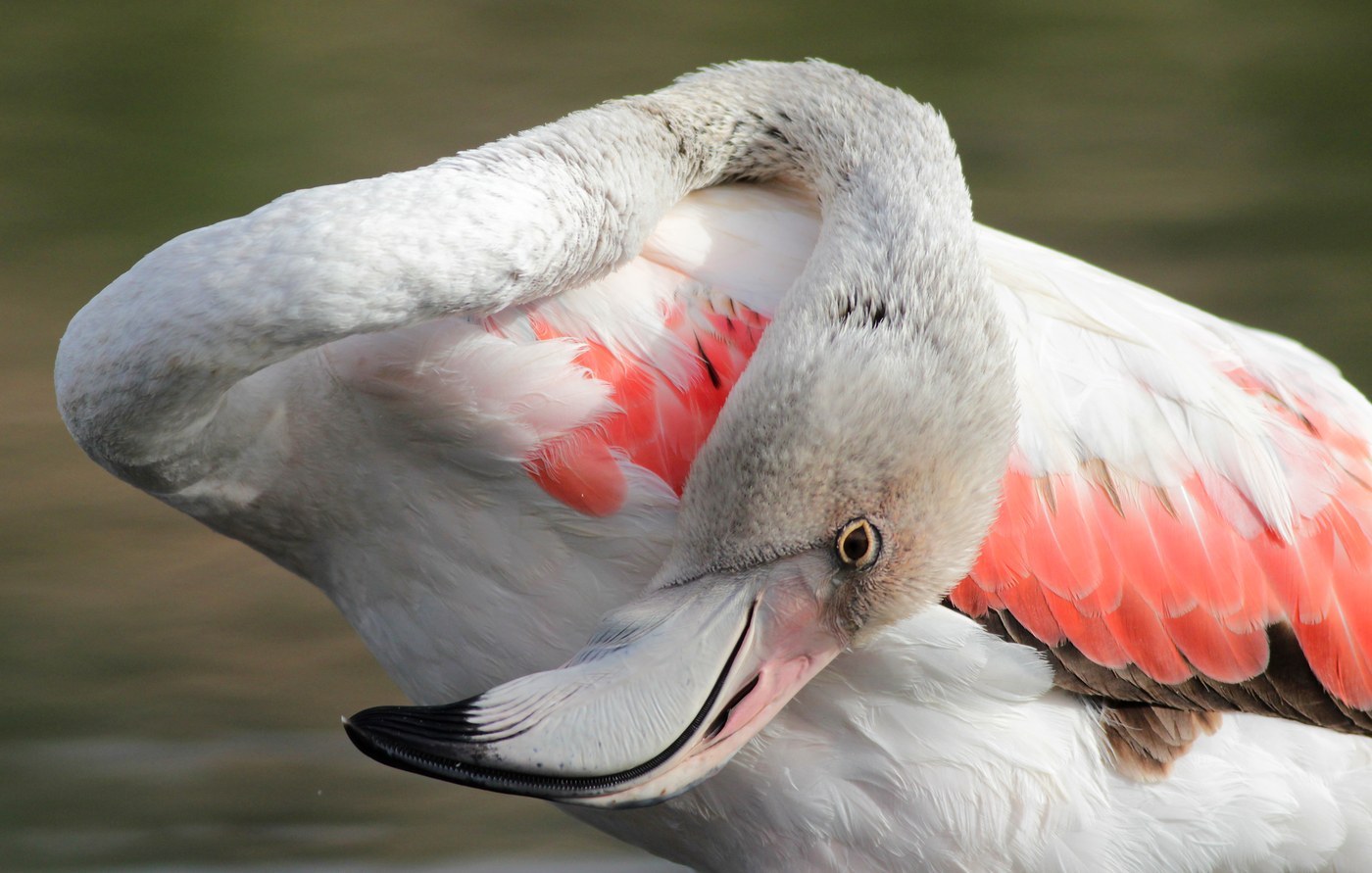
Key Field Marks
- Size & shape: The largest of all flamingo species, standing very tall on long, thin legs with a long, sinuous neck.
- Plumage: Pale pinkish-white overall, much less saturated than several other flamingo species, with black primary and secondary flight feathers revealed mainly in flight or when wings are stretched.
- Bill: Pale pink at the base with a sharply defined black tip, strongly downward-kinked in the middle.
- Legs: Uniformly pink from top to bottom.
- Behavior: Feeds with the head inverted underwater, sweeping the bill side to side to filter tiny invertebrates, algae, and plankton from shallow, often saline water.
Separating It From Similar Species
- American (Caribbean) Flamingo: Much more deeply saturated orange-red in color and restricted to the Americas, whereas greater flamingo is paler and found in the Old World.
- Lesser Flamingo: Considerably smaller, with a dark maroon-red, almost entirely dark bill, and often a deeper overall pink hue on a much smaller frame.
- Chilean Flamingo: Grayer-pink overall with gray legs showing pink joints; a South American species, generally not overlapping in range with wild greater flamingo.
- Pale plumage combined with the largest overall size among flamingos is the best combination of clues for greater flamingo.
Where and When to See One
- Range: Breeds locally in scattered colonies across Africa, the Mediterranean (notably southern France, Spain, and Sardinia), the Middle East, and South and Central Asia (including large populations around India's Rann of Kutch).
- Habitat: Shallow saline or alkaline lakes, coastal lagoons, and salt pans.
- Season: Present year-round in many areas, though some populations shift seasonally between breeding and wintering wetlands depending on water levels.
Voice Cues
- Loud, goose-like honking calls and nasal gabbling, especially in flight or at large communal gatherings.
- Vocal chatter helps flocks stay coordinated during feeding and flight, and calling often increases noticeably just before a flock takes flight together.
Frequently asked questions
What is the largest flamingo species?
The greater flamingo is the largest of all flamingo species, standing taller than American, Chilean, Andean, James's, or lesser flamingos.
How do you tell a greater flamingo from an American flamingo?
Greater flamingo is paler pinkish-white and found in Africa, Europe, and Asia, while American flamingo is a much more saturated orange-red and restricted to the Americas.
Where can you see wild greater flamingos in Europe?
The Camargue region of southern France and wetlands in Spain and Sardinia host significant breeding and wintering populations.
What does a greater flamingo eat?
Small aquatic invertebrates, algae, and plankton, filtered from shallow saline water using its specialized bent bill.
How do greater and lesser flamingos differ?
Greater flamingo is much larger and paler with a mostly pale pink bill tipped black, while lesser flamingo is smaller with a dark maroon-red bill and deeper pink coloring.