
Great Shearwater Identification Guide
A long-distance ocean traveler, the Great Shearwater is identified at sea by its sharply capped dark head, scaly-backed plumage, and a dark belly smudge on an otherwise white underside.
Read the full Great Shearwater encyclopedia entry →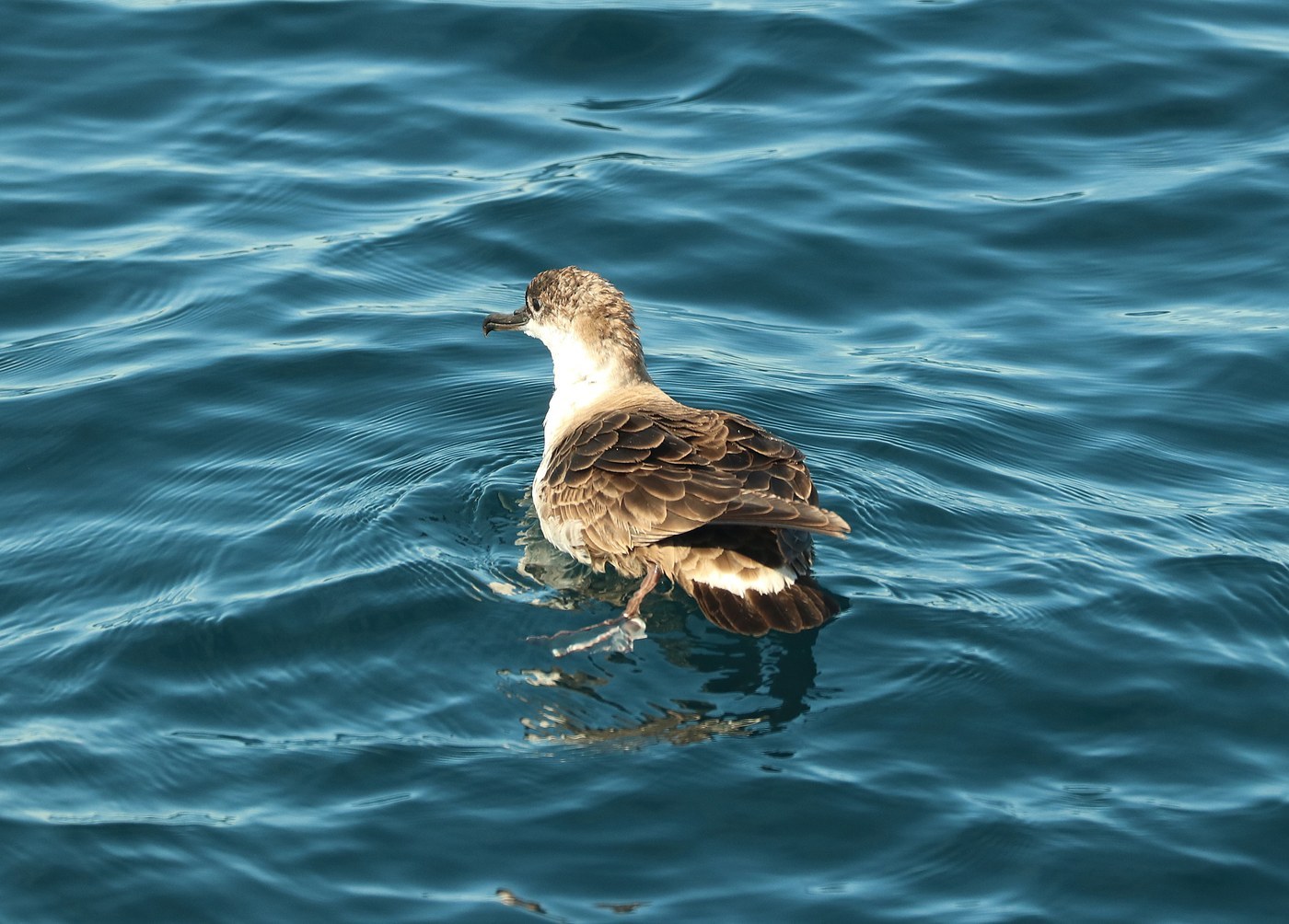
Key Field Marks
- Size & shape: Length 43–51 cm (17–20 in), wingspan around 105 cm (41 in); a robust, stiff-winged shearwater with a stout, dark bill (a "tubenose" typical of the petrel family).
- Head: Dark blackish-brown cap sharply demarcated from a clean white face and throat, giving a distinctive capped appearance visible even at a distance.
- Upperparts: Dark brown with pale feather edges creating a scaly appearance across the back and wings; a white patch at the base of the tail (uppertail coverts) often forms a visible horseshoe or band.
- Underparts: White with a distinctive dark smudgy patch on the belly, a key mark for separating it from similar shearwaters, plus dark markings on the underwing.
- Behavior: Flies with stiff, straight wings held flat, alternating rapid flaps with long, low glides over the wave troughs ("shearing" the water); plunge-dives and surface-seizes to catch fish and squid, and readily follows fishing vessels and feeds alongside whales.
Separating Great Shearwater from Similar Species
- Cory's Shearwater: Lacks the sharply defined dark cap (head blends more gradually into the body color), has a paler yellowish bill, and typically lacks a dark belly patch; flight is more languid with slower wingbeats.
- Sooty Shearwater: Entirely dark brown-black overall (no white face/underparts) but shows silvery-white underwing linings in good light.
- Manx Shearwater: Much smaller, crisply black-and-white with no dark cap contrast and no belly smudge.
Where & When to See One
Great Shearwaters breed on a handful of islands in the South Atlantic, chiefly the Tristan da Cunha group and the Falkland Islands, during the austral summer. Outside the breeding season they undertake a huge transequatorial migration, spending the northern summer feeding in the North Atlantic (including waters off the northeastern United States and Canada, and in the eastern Atlantic off Europe), before returning south again. In North American and European waters they are essentially a summer/early autumn visitor, best looked for on pelagic boat trips or scanning from headlands during onshore winds.
Voice
Mostly silent at sea except when feeding in flocks, where they may give harsh, cackling notes; at breeding colonies they produce loud, harsh caterwauling calls at night.
Frequently asked questions
How can I tell a Great Shearwater from a Cory's Shearwater?
Great Shearwater has a sharply defined dark cap contrasting with a white face and often a dark belly patch, while Cory's Shearwater has a more blended, less contrasting head pattern, a paler yellowish bill, and lacks the belly smudge.
Where do Great Shearwaters breed?
They breed on remote South Atlantic islands, primarily the Tristan da Cunha group and the Falkland Islands, during the austral summer (our winter).
When are Great Shearwaters seen in the Northern Hemisphere?
They migrate north after breeding and are typically present in the North Atlantic, including U.S. and European coastal waters, from late spring through early autumn.
What is the best way to see a Great Shearwater?
Take a pelagic (offshore) birding boat trip, since shearwaters are true seabirds rarely seen from land except during storms or strong onshore winds.