
Great Potoo Identification Guide
A master of camouflage, the Great Potoo perches bolt upright by day to resemble a broken tree stub, only revealing itself at night with huge glowing eyes and an eerie roaring call.
Read the full Great Potoo encyclopedia entry →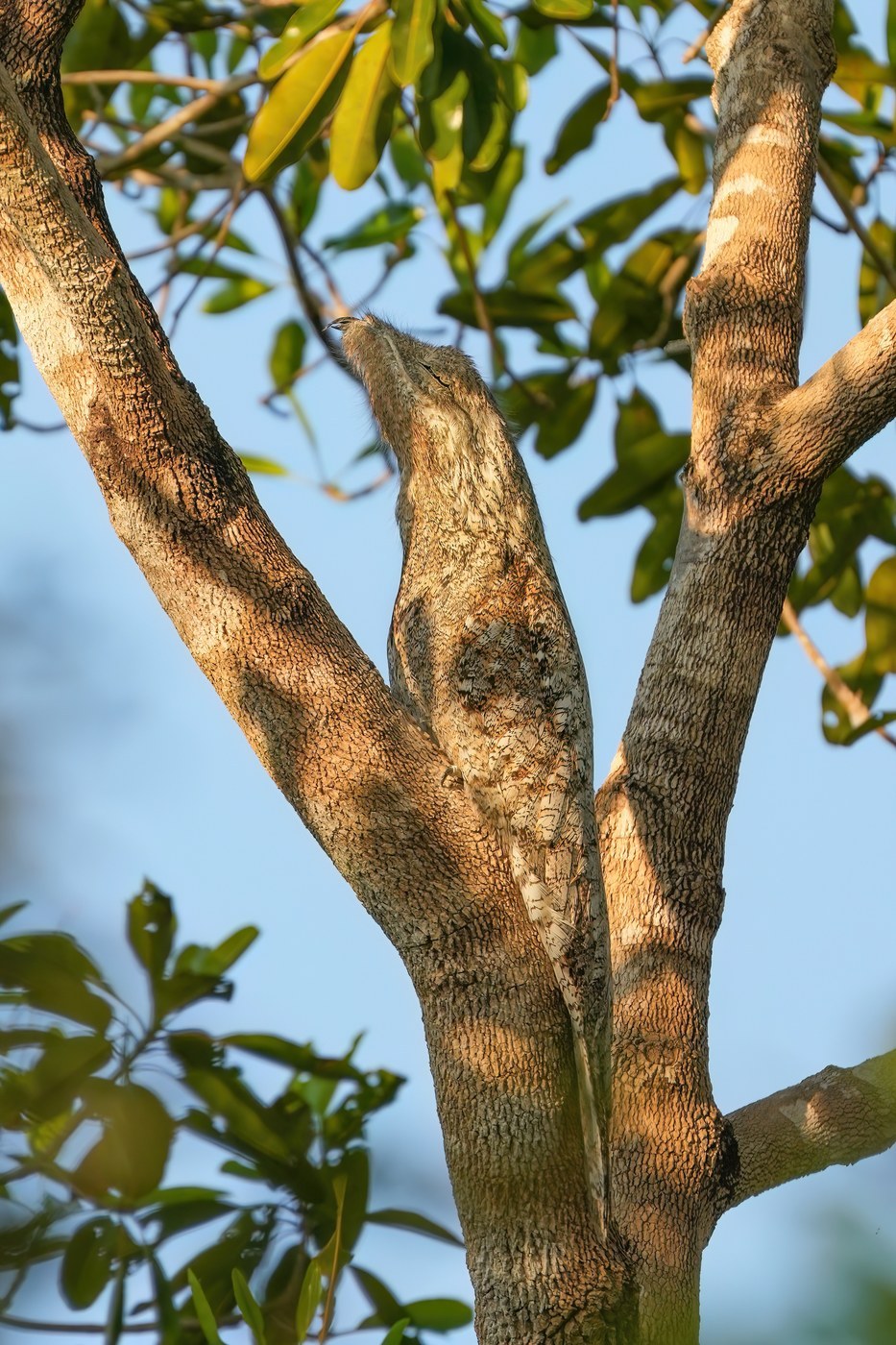
Key Field Marks
- Size & shape: Large for a potoo, 48–60 cm (19–24 in), with a big head, huge wide gape, very short weak legs, and a long tail; overall bulky, upright silhouette when perched.
- Plumage: Intricately mottled gray, brown, and whitish, closely mimicking lichen-covered or broken bark — exceptional camouflage that makes daytime birds extremely difficult to spot even when perched in the open.
- Eyes: Enormous yellow eyes adapted for night vision; produce a strong orange-red eyeshine when caught in a spotlight or flashlight beam at night, the most reliable way to locate one after dark.
- Bill: Short and stubby but capable of an enormous gape used to snap up prey in flight.
- Behavior: By day, roosts motionless in an upright posture on a bare branch or stub, bill pointed skyward, eyes narrowed to slits, relying entirely on camouflage to avoid detection. At night, becomes an active aerial hunter, sallying from a perch to catch large flying insects and occasionally bats, then returning to the same perch.
Separating Great Potoo from Similar Species
- Common Potoo: Considerably smaller and slimmer, with a more slender build and a different, softer, descending wailing song.
- Long-tailed Potoo: Smaller with a proportionally much longer tail and different, more patterned plumage.
- Nightjars: Smaller overall, with more pointed wings, a tiny bill, and typically a different, flatter roosting posture (usually along a branch rather than upright on a stub).
Where & When to See One
Great Potoos are resident year-round in lowland tropical forest, forest edge, and gallery forest from southern Mexico and Central America through much of Amazonian South America. They favor tall trees with open, bare branches for daytime roosting and nighttime hunting perches. Best located after dark using a spotlight to pick up their bright eyeshine, then confirmed by their distinctive call; by day, experienced guides can sometimes pick out a roosting bird by its telltale silhouette against the sky.
Voice
A deep, guttural, far-carrying roar or growl, often rendered as "BWAAAAAAAH," descending in pitch — one of the eerier sounds of the neotropical night and quite unlike typical bird vocalizations.
Frequently asked questions
How do Great Potoos avoid being seen during the day?
They perch bolt upright and motionless on bare branches or stubs, with cryptic bark-like plumage and narrowed eyes, making them look like part of the tree.
What is the best way to find a Great Potoo?
Search at night with a spotlight or strong flashlight for their bright orange-red eyeshine, then listen for their deep roaring call to confirm the species.
What does a Great Potoo eat?
Primarily large flying insects such as beetles and moths, caught in short sallying flights from a perch; it occasionally takes small bats as well.
Is the Great Potoo related to owls?
No, potoos are more closely related to nightjars and frogmouths, though they share a similar nocturnal, camouflaged lifestyle with owls through convergent evolution.