
Great Horned Owl Identification Guide
A powerful, adaptable predator found across nearly every habitat in the Americas, the Great Horned Owl is easily recognized by its large size, prominent ear tufts, and deep hooting call.
Read the full Great Horned Owl encyclopedia entry →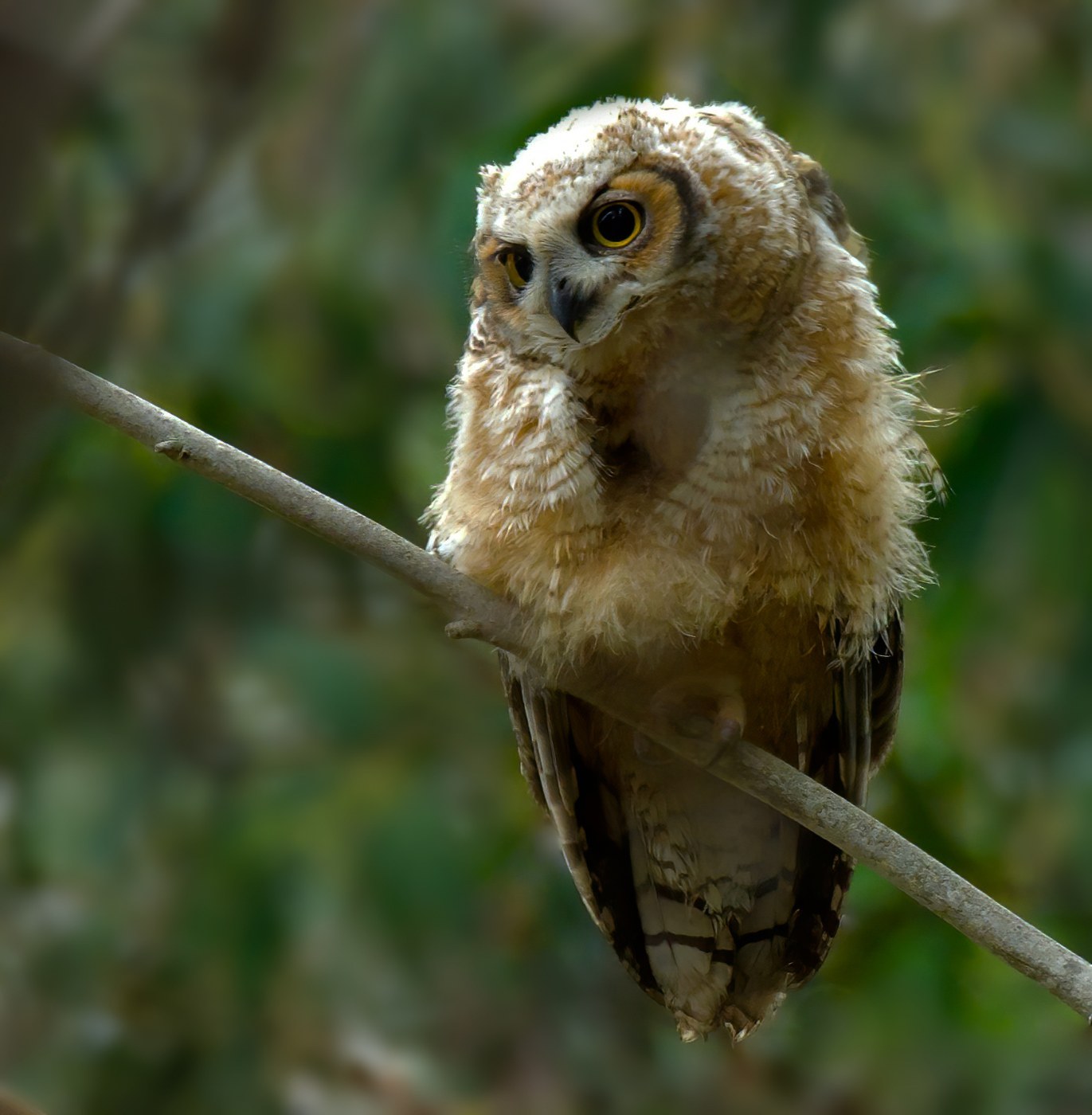
Key Field Marks
- Size & shape: Large and bulky, 46–63 cm (18–25 in) long, with a barrel-chested body and broad, rounded wings.
- Head: Prominent ear tufts ("horns") widely spaced atop the head; large yellow eyes; a distinct white throat patch that puffs out when calling.
- Plumage: Mottled brown, gray, and buff overall with fine dark barring across the underparts; overall coloration varies regionally from pale (desert populations) to very dark (Pacific Northwest).
- Bill & talons: Strong, sharply hooked black bill; powerful feet and talons capable of exerting extreme grip strength, allowing it to take prey larger than itself.
- Behavior: A generalist, nocturnal predator taking everything from rodents and rabbits to skunks, herons, and even other raptors such as Ospreys and smaller owls. Typically nests in old stick nests built by hawks, crows, or herons rather than building its own. Flight is silent thanks to specialized feather edges that dampen sound.
Separating Great Horned Owl from Similar Species
- Great Gray Owl: Lacks ear tufts entirely and has a much larger, more evenly ringed facial disc with smaller-looking eyes.
- Long-eared Owl: Considerably smaller and slimmer, with ear tufts set closer together near the center of the head, and a more streaked (not barred) underside.
- Barred Owl: No ear tufts, dark brown (not yellow) eyes, and vertical streaking rather than horizontal barring on the belly.
Where & When to See One
Great Horned Owls are year-round residents across virtually the entire Western Hemisphere from the subarctic tundra edge of Canada and Alaska south through Central and much of South America, occupying forests, deserts, grasslands, wetlands, and urban/suburban parks alike. Because they are so adaptable, they are one of the most widespread owls in the Americas and can be found in almost any wooded or semi-open habitat. Listen for their calls especially in late winter, the height of the breeding/territorial season.
Voice
A deep, resonant series of hoots, typically rendered as "hoo-h'HOO-hoo-hoo" or "who's awake, me too," given by both sexes (females are higher-pitched despite being larger); pairs often duet at dusk and before dawn.
Frequently asked questions
What are the 'horns' on a Great Horned Owl?
They are simply tufts of feathers (plumicorns), not ears — the actual ear openings are on the sides of the head, hidden by facial feathers.
How strong is a Great Horned Owl's grip?
Its talons can exert several hundred pounds per square inch of pressure, allowing it to kill prey much larger than itself, including skunks and other raptors.
Do Great Horned Owls build their own nests?
No, they typically take over old nests built by hawks, crows, herons, or squirrels, or use tree cavities and cliff ledges.
How do I tell a Great Horned Owl from a Long-eared Owl?
Great Horned Owls are noticeably larger and bulkier with widely spaced ear tufts, while Long-eared Owls are slimmer with ear tufts set close together and streaked (not barred) underparts.