
Great Hornbill Identification Guide
One of Asia's most spectacular forest birds, the Great Hornbill is a massive black-and-white bird crowned with an enormous yellow casque atop its huge bill.
Read the full Great Hornbill encyclopedia entry →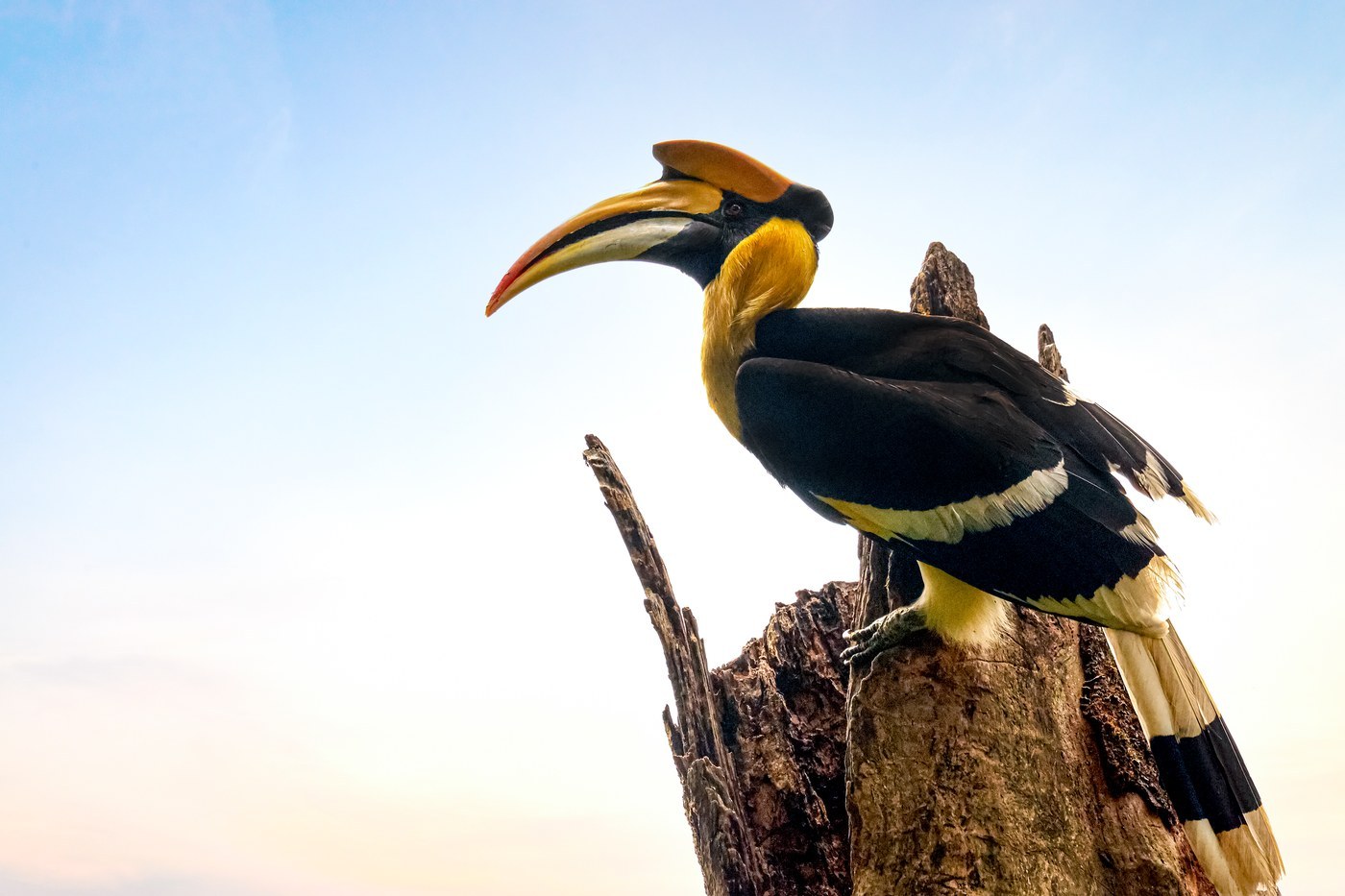
Key Field Marks
- Size & shape: Very large, 95–130 cm (37–51 in) long including a long tail, with broad, deep wingbeats that produce a loud whooshing sound audible well before the bird comes into view.
- Bill & casque: Massive yellow bill topped by a prominent, hollow, U-shaped or concave-topped casque, often stained yellow-orange from preen-gland oil; casque size and shape differ slightly between the sexes.
- Plumage: Body mostly black with a white neck, white lower belly and thighs, and a black band across an otherwise white tail; wings show a broad white trailing edge visible in flight.
- Eyes: Males have red eyes with red orbital skin; females have whitish eyes with pink-red orbital skin — a useful way to sex the species at close range.
- Behavior: Primarily frugivorous (figs are a key food) but also takes small animals; forages in the canopy in pairs or small family groups; nests in large tree cavities, where the female seals herself in with mud and droppings, leaving only a narrow slit through which the male passes food.
Separating Great Hornbill from Similar Species
- Rhinoceros Hornbill (Southeast Asian islands, limited range overlap): Casque curves upward at the front rather than sitting flat/concave, and is often more reddish.
- Malabar Pied Hornbill: Considerably smaller, with a more slender bill and a differently shaped, smaller casque, and more extensive white in the plumage.
- Wreathed Hornbill: Lacks the tall casque, instead showing a series of low ridges, and has a pouch of bare throat skin (blue in females, yellow in males).
Where & When to See One
Great Hornbills inhabit dense evergreen and moist deciduous forests of the Indian subcontinent and Southeast Asia, from the Western Ghats and Himalayan foothills of India through Southeast Asia to Sumatra. They are resident year-round but make local seasonal movements tracking fruiting fig trees. Best located by listening for their loud wingbeats and far-carrying calls, then scanning fruiting canopy trees.
Voice
Loud, deep, barking or roaring calls, often described as a series of grunts building to a loud "kroh" or roar; pairs sometimes call in duet, and the sound carries long distances through the forest.
Frequently asked questions
What is the yellow structure on top of a Great Hornbill's bill?
It is the casque, a hollow, lightweight keratin structure that sits atop the bill; its exact function is debated but it may amplify calls and signal fitness or age.
How can you tell a male from a female Great Hornbill?
Males have red eyes, while females have whitish eyes; the casque shape and size also differ subtly between the sexes.
Why is the Great Hornbill so loud in flight?
Unlike most birds, hornbills lack underwing covert feathers that muffle sound, so their wingbeats produce a distinctive loud whooshing noise.
What does a Great Hornbill eat?
Mainly fruit, especially figs, supplemented with small reptiles, insects, and other small animals, particularly when feeding chicks.