
Great Grey Shrike Identification Guide
A pale, predatory songbird nicknamed the 'butcher bird,' the Great Grey Shrike hunts from exposed perches and impales prey on thorns, identifiable by its gray-and-white plumage and bold black mask.
Read the full Great Grey Shrike encyclopedia entry →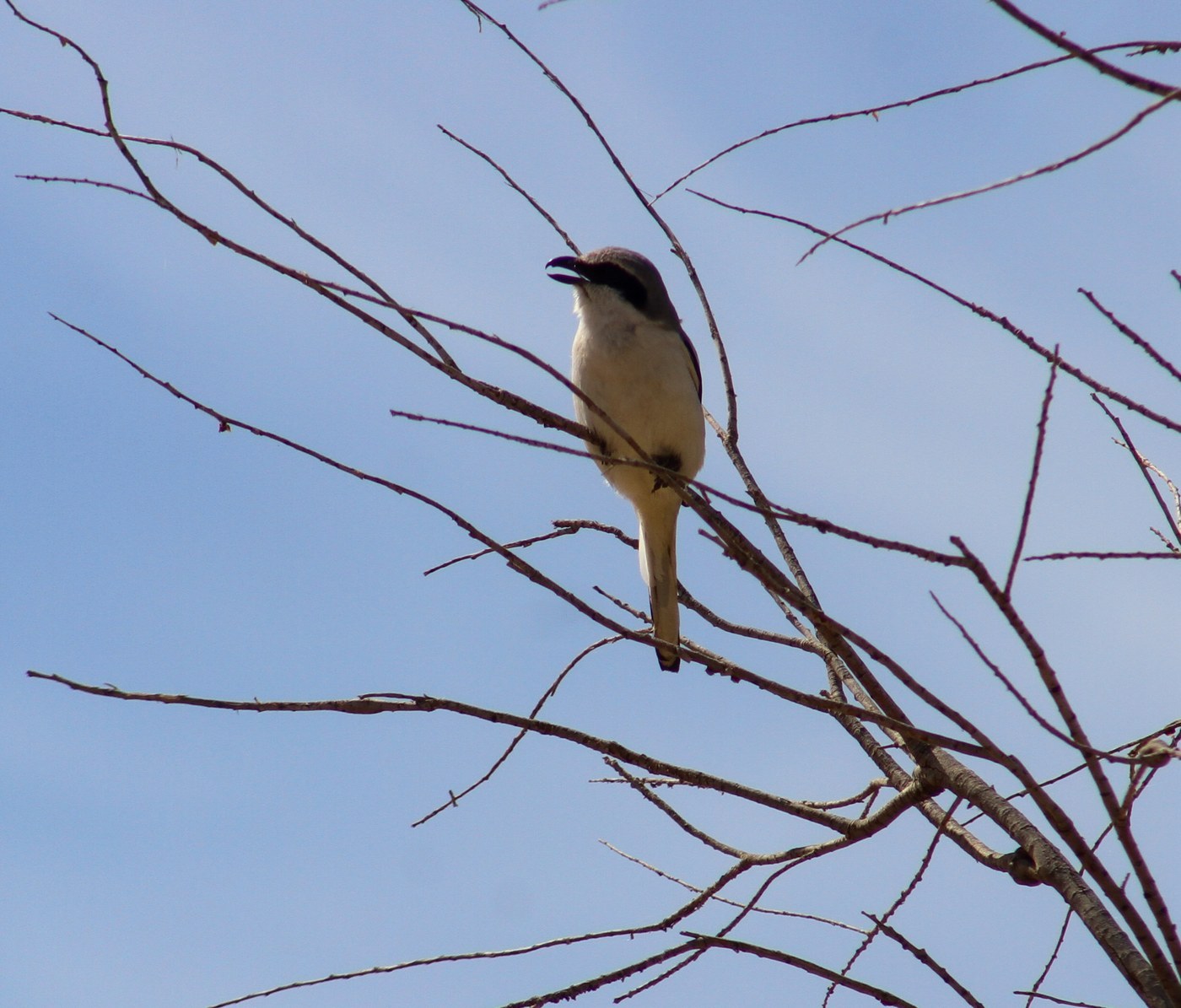
Key Field Marks
- Size & shape: About 24 cm (9.4 in), roughly thrush-sized, with a fairly long tail, a big head, and a stout, hook-tipped bill.
- Plumage: Pale blue-gray crown, nape, and back; clean white underparts; black wings with a bold white patch visible at rest and in flight; black tail edged in white.
- Face: Broad black mask running through the eye but not crossing the forehead (the crown stays pale gray).
- Bill: Black, stout, with a small hook at the tip typical of shrikes, used to kill prey.
- Behavior: Perches conspicuously on wires, fence posts, hedgerow tops, or isolated treetops to scan for prey, then drops down to catch large insects, small mammals, and small birds. Famous for impaling prey on thorns or barbed wire as a "larder," earning shrikes the nickname "butcher birds." Flight is low and undulating, often finishing with an upward swoop to the next perch.
Separating Great Grey Shrike from Similar Species
- Lesser Grey Shrike: Black mask extends up over the forehead (not just through the eye), underparts show a pinkish wash, and the tail is proportionally shorter.
- Northern Shrike (North America, formerly considered the same species): Very similar in appearance; separated largely by range, with subtle differences in mask width, bill size, and faint barring on the underparts of Northern Shrike, especially in immatures.
- Woodchat Shrike: Has a chestnut-rufous crown and nape, clearly different from the plain gray crown of Great Grey Shrike.
Where & When to See One
Great Grey Shrikes breed across northern and central Eurasia in open country with scattered trees or scrub — heathland, forest edge, taiga clearings, and farmland with hedgerows. Northern populations are migratory or partially migratory, moving south in winter to more temperate open habitats, while southern/western populations are largely resident. Look for a lone bird perched prominently and motionless atop an isolated bush, wire, or treetop, often the only bird visible in an otherwise empty field.
Voice
A harsh, chattering "shek-shek-shek" alarm call; the song is a mix of harsh notes and surprisingly musical warbling phrases, and shrikes are accomplished mimics of other birds' calls.
Frequently asked questions
Why does the Great Grey Shrike impale its prey on thorns?
Lacking strong feet like a hawk, it uses thorns, spikes, or barbed wire to hold prey steady while tearing it apart, and also creates a food cache ("larder") for later.
How do I tell Great Grey Shrike from Lesser Grey Shrike?
Lesser Grey Shrike's black mask extends across the forehead and it shows pinkish underparts, while Great Grey Shrike has a plain gray crown with the mask confined to the eye area and whiter underparts.
Where should I look for a Great Grey Shrike?
Open country with scattered perches — hedgerows, heathland, farmland, or forest clearings — scanning from a prominent lookout such as a wire or bush top.
Is the Great Grey Shrike the same as the Northern Shrike?
They were once considered the same species; Northern Shrike (North America) is now usually treated as a separate but very similar species, distinguished mainly by range and subtle plumage details.