
Great Grey Owl Identification Guide
The largest owl by length in the Northern Hemisphere, the Great Grey Owl is a huge, ghostly gray forest owl with a massive ringed facial disc and no ear tufts.
Read the full Great Grey Owl encyclopedia entry →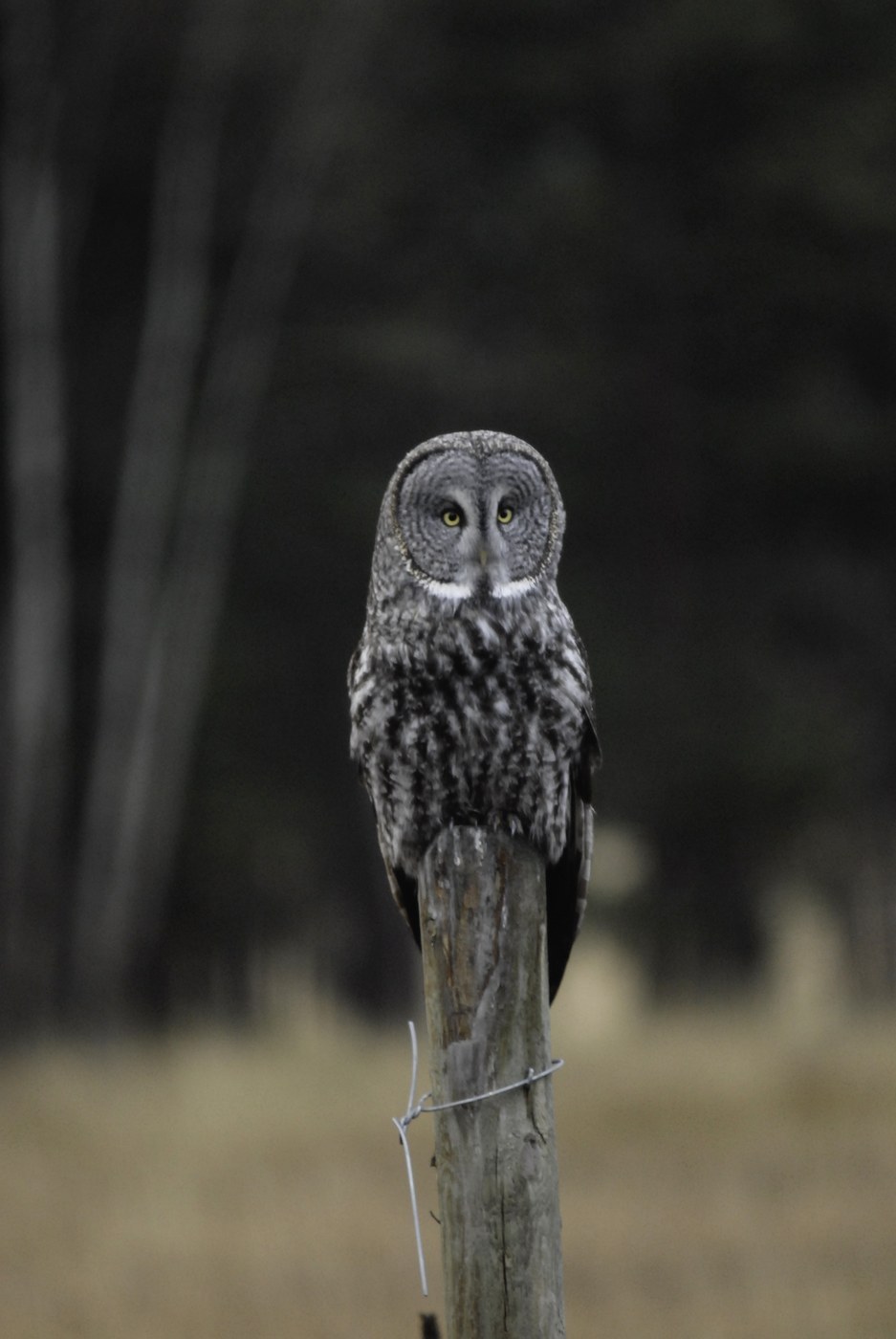
Key Field Marks
- Size & shape: Length 61–84 cm (24–33 in), the longest owl species in the Northern Hemisphere, though its apparent bulk comes mostly from thick, fluffy plumage rather than actual mass.
- Head: Very large, round facial disc etched with fine concentric gray rings; small yellow eyes set relatively close together; no ear tufts, giving a smooth, round-headed silhouette.
- Plumage: Overall mottled gray with fine brown-gray barring and streaking, providing excellent camouflage against tree bark; a black-and-white "bow tie" patch is visible below the chin.
- Bill: Small, yellowish, largely obscured by facial feathering.
- Behavior: A sit-and-wait hunter that perches low over open ground, listening for small mammals moving under vegetation or snow, then drops down and plunges feet-first to seize prey. Flight is slow, silent, and buoyant on broad wings.
Separating Great Grey Owl from Similar Species
- Eagle Owl (Eurasian Eagle-Owl): Much bulkier and heavier with prominent ear tufts and large orange eyes, unlike the tuftless Great Grey Owl.
- Ural Owl: Smaller and paler, with dark eyes (not yellow) and a longer tail proportionally, and lacks the fine concentric rings on the facial disc.
- Tawny Owl: Considerably smaller and more compact, with dark eyes and rounder, less distinctly ringed facial disc.
Where & When to See One
The Great Grey Owl has a circumpolar distribution across the boreal forest (taiga) of Scandinavia, Russia, and northern Asia, as well as North America (where it is also called Great Gray Owl). It favors dense conifer stands next to open bogs, meadows, or clearcuts used for hunting, and is present year-round, though birds may wander south in winters when rodent populations are low.
Voice
A series of deep, soft, evenly spaced hoots — "whoo whoo whoo whoo" — delivered at a slow, steady pace and carrying surprisingly far given how muted the call sounds up close.
Frequently asked questions
Is Great Grey Owl the same species as Great Gray Owl?
Yes, these are simply British and American spellings of the same species, Strix nebulosa.
How do I distinguish a Great Grey Owl from an Eagle Owl?
Eagle Owls have prominent ear tufts and large orange eyes; Great Grey Owls lack ear tufts entirely and have smaller yellow eyes set in a much larger, ringed facial disc.
What habitat should I search for a Great Grey Owl?
Dense boreal conifer forest bordering open meadows, bogs, or clearings, where the owl can perch at the forest edge and scan open ground for prey.
Are Great Grey Owls active during the day?
They are primarily crepuscular/nocturnal but readily hunt in daylight, especially in northern summers with long daylight hours or when feeding hungry chicks.