
Great Gray Owl Identification Guide
The largest owl by length in North America, the Great Gray Owl is a ghostly gray giant of the boreal forest with a huge round facial disc and no ear tufts.
Read the full Great Gray Owl encyclopedia entry →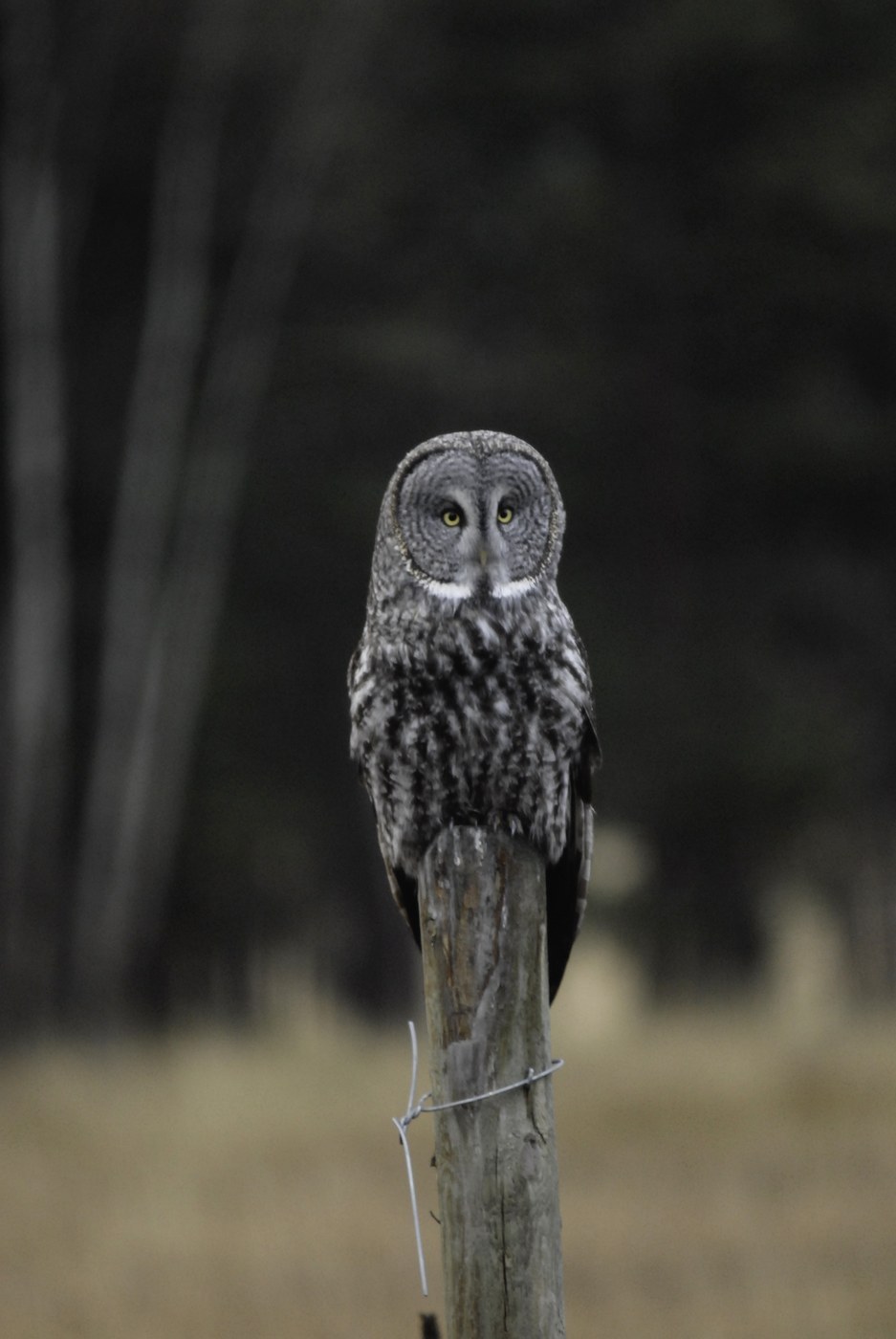
Key Field Marks
- Size & shape: Length 61–84 cm (24–33 in), making it the longest owl in North America, though its bulky look is mostly fluffy plumage — it actually weighs less than a Great Horned Owl or Snowy Owl.
- Head: Enormous, round facial disc marked with fine concentric gray rings; relatively small, piercing yellow eyes set close together; no ear tufts.
- Plumage: Mottled gray-brown overall with fine barring and streaking; a distinctive black-and-white "bow tie" mark below the chin.
- Bill: Small and mostly hidden by facial feathers, yellowish.
- Behavior: Hunts primarily by sound, perching low on a stub or fence post and watching/listening for rodents in open meadows, then gliding down and plunging feet-first through snow (even snow deep enough to fully bury the bird) to catch voles. Flight is slow, buoyant, and silent.
Separating Great Gray Owl from Similar Species
- Great Horned Owl: Has prominent ear tufts, larger yellow eyes, and a more compact, powerful build; Great Gray lacks ear tufts entirely.
- Barred Owl: Smaller, with dark brown eyes (not yellow), a smaller facial disc, and bold vertical streaking on the belly rather than fine barring.
- Snowy Owl: Much whiter overall, found in open tundra/fields rather than forest, with a smaller-looking head relative to body.
Where & When to See One
Great Gray Owls inhabit dense boreal and subalpine coniferous forest interspersed with open meadows or bogs where they hunt, across Alaska, Canada, the Pacific Northwest, and the Sierra Nevada, as well as Scandinavia and northern Russia (Eurasian populations sometimes still called Great Grey Owl). They are present year-round in their core range but can irrupt farther south in winter during years when vole populations crash, sometimes appearing conspicuously at forest edges hunting in daylight, especially at dawn and dusk.
Voice
Males give a series of deep, soft, evenly spaced hoots, "whoo whoo whoo whoo," lower and more subdued than a Great Horned Owl's call, often audible only at close range.
Frequently asked questions
How do I tell a Great Gray Owl from a Great Horned Owl?
The easiest mark is ear tufts: Great Horned Owls have prominent tufts and Great Gray Owls have none, along with a much larger, more finely ringed facial disc.
Is the Great Gray Owl really the biggest owl?
It is the longest owl in North America, but much of its bulk is fluffy insulating plumage — Great Horned and Snowy Owls actually weigh more.
Where is the best place to see a Great Gray Owl?
Boreal forest edges and mountain meadows in Canada, Alaska, the Pacific Northwest, and the Sierra Nevada, especially at dawn or dusk when they hunt in open clearings.
Do Great Gray Owls really catch prey under snow?
Yes, they can detect voles moving under snow up to about 45 cm (18 in) deep by sound alone and dive feet-first through the snow to catch them.