
Great Frigatebird Identification Guide
An enormous, long-winged tropical seabird with a deeply forked tail, the Great Frigatebird is best known for the male's inflatable scarlet throat pouch and its aerial piracy against other seabirds.
Read the full Great Frigatebird encyclopedia entry →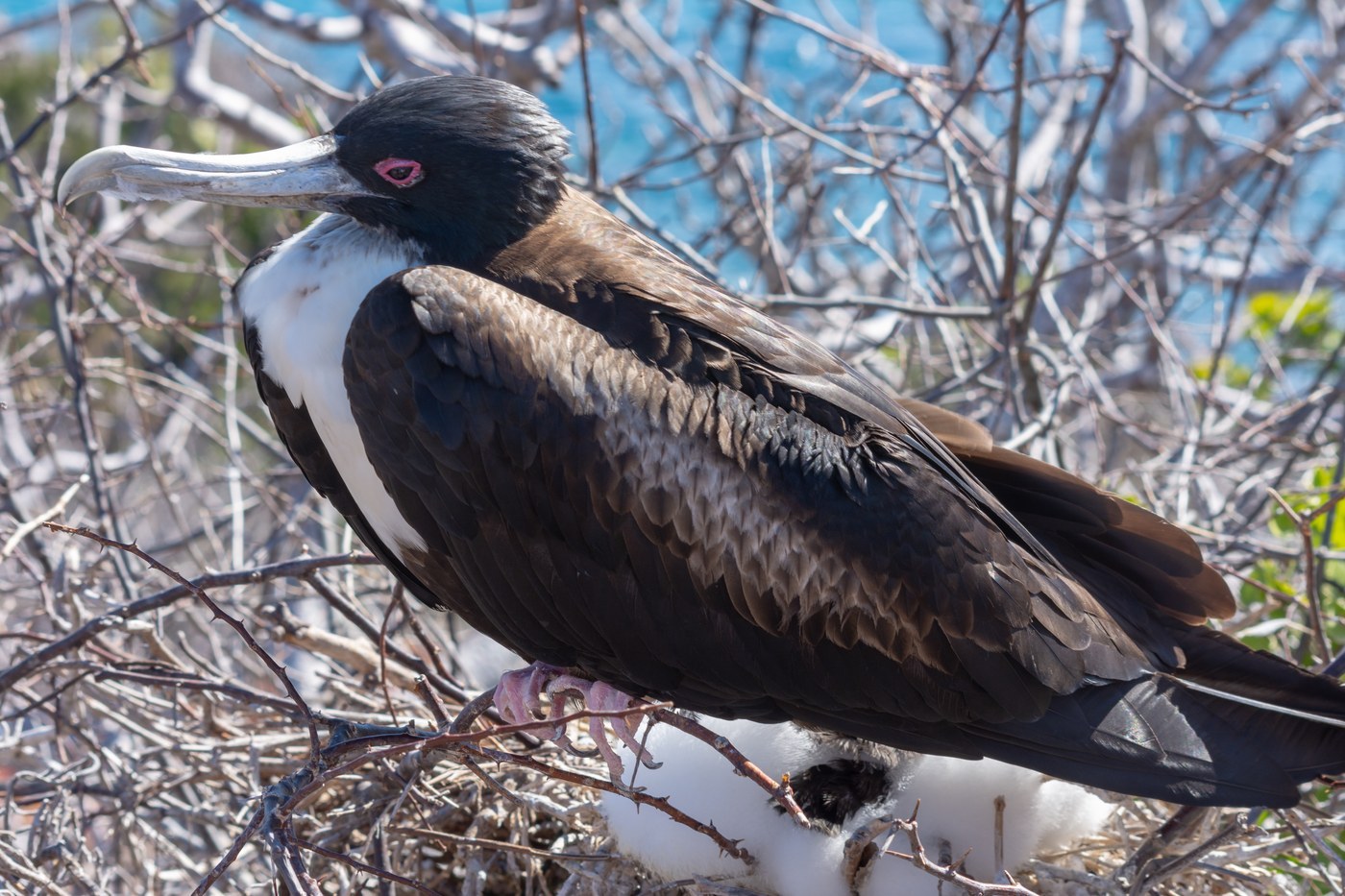
Key Field Marks
- Size & shape: One of the largest frigatebirds, wingspan up to 2.3 m (7.5 ft), with long, angular, bowed wings, a long hooked bill, and a deeply forked tail often held closed into a point in flight.
- Adult male: Entirely glossy black with a greenish sheen on the upperwing coverts; inflates a bright red gular (throat) pouch during courtship display.
- Adult female: Blackish overall with a white breast and throat, a pale grayish chin bar, and a narrow pinkish or blue eye-ring.
- Juvenile: Head and underparts washed rusty-orange to white, gradually darkening with age over several years.
- Behavior: Master of soaring flight, riding thermals for hours with barely a wingbeat; almost never lands on water because its plumage is not waterproof. Frequently harasses boobies and other seabirds in flight to steal (kleptoparasitize) their catches, and snatches flying fish and squid directly from the surface.
Separating Great Frigatebird from Similar Species
- Magnificent Frigatebird: Males show a purple (not green) gloss on the back; females have a red eye-ring (not pink/blue) and lack a pale chin bar; ranges mostly separate (Magnificent is Atlantic/Eastern Pacific, Great is more widespread Indo-Pacific with some overlap).
- Lesser Frigatebird: Noticeably smaller; males and females both show white "spurs" extending from the belly into the underwing axillaries, a mark Great Frigatebird lacks.
- Christmas Frigatebird: Very restricted range; males show a white belly patch unlike the all-black male Great Frigatebird.
Where & When to See One
Great Frigatebirds breed on remote tropical and subtropical islands across the Indian and Pacific Oceans (including the Galápagos) and range widely over open ocean outside the breeding season, occasionally appearing far from land or blown inland after storms. They are most reliably seen near breeding colonies or from boats/pelagic trips in warm tropical waters, present year-round in core range.
Voice
Largely silent at sea. At breeding colonies, males produce a distinctive drumming/rattling and warbling sound with the inflated throat pouch, while both sexes give whinnying and clattering bill notes during interactions.
Frequently asked questions
Why do male Great Frigatebirds have a red throat pouch?
The inflatable red gular pouch is a courtship display used to attract females; males perch in groups and inflate their pouches while calling and shaking their wings.
Can Great Frigatebirds land on water?
Rarely — their feathers lack waterproofing and their legs are weak, so landing on the sea can be fatal; they instead snatch food from the surface in flight or steal it from other birds.
How do I tell a male from a female Great Frigatebird?
Males are entirely black with a greenish sheen; females are blackish with a white breast and throat and a pale chin bar.
What's the difference between Great and Magnificent Frigatebird?
Male Great Frigatebirds show a green gloss (Magnificent shows purple), and female Great Frigatebirds have a pink or pale blue eye-ring and pale chin bar, while female Magnificent Frigatebirds have a red eye-ring and no chin bar.