
Great Egret Identification Guide
A tall, all-white heron with a yellow-orange bill and black legs, the Great Egret is the largest of North America's white egrets and a familiar sight stalking wetlands worldwide.
Read the full Great Egret encyclopedia entry →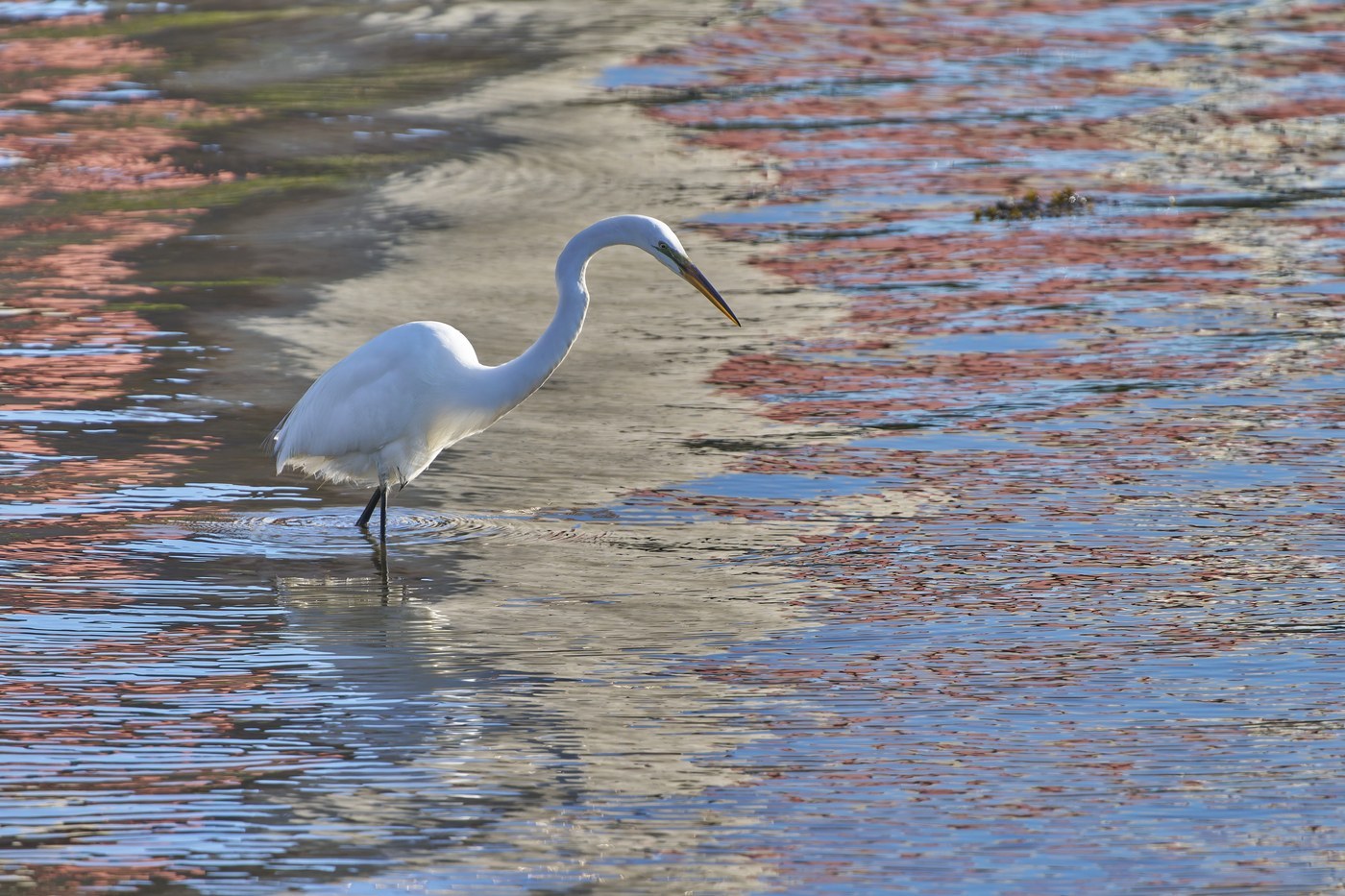
Key Field Marks
- Size & shape: Very large heron, 80–104 cm (32–41 in) tall with a wingspan of 130–170 cm (52–67 in). Long, slender neck often held in a tight S-curve; long dagger-like bill.
- Plumage: Entirely white in all plumages.
- Bill: Bright yellow-orange, long and straight.
- Legs & feet: Black legs and black feet year-round.
- Breeding condition: Develops long, lacy plumes (aigrettes) cascading from the back over the tail, and the lores (skin between eye and bill) turn bright green for a short period at the height of courtship.
- Behavior: Hunts by standing motionless or walking with slow, deliberate steps in shallow water before striking prey with a rapid stab of the bill. In flight, the neck is tucked into an S-shape (unlike cranes, which fly with necks outstretched) and wingbeats are slow and deep.
Separating Great Egret from Similar Species
- Snowy Egret: Much smaller (56–66 cm), with a black bill, black legs, and contrasting bright yellow feet ("golden slippers"). Snowy Egrets are also more active, often stirring water with their feet while foraging.
- Great Blue Heron (white morph / "Great White Heron"): Found mainly in southern Florida and the Caribbean; noticeably larger and bulkier than a Great Egret, with pale yellowish legs (not black) and a thicker bill.
- Cattle Egret: Much smaller and stockier, with a shorter yellow or orange bill, a hunched posture, and a habit of following livestock or machinery away from water.
- Immature Little Blue Heron: All white like an egret but has dull greenish-yellow legs and a bicolored bill (pale base, dark tip), and is much smaller.
Where & When to See One
Great Egrets are found on every continent except Antarctica. In North America they occur year-round across the southern United States and expand into the northern and interior U.S. and southern Canada during the breeding season (spring through fall). Look for them in freshwater and saltwater marshes, lake and pond margins, flooded fields, mangroves, and estuaries. They often forage alone but roost and nest colonially, frequently alongside other herons and egrets in mixed-species rookeries.
Voice
Generally silent away from nesting colonies. When alarmed or interacting with other birds, gives a low, harsh croaking "kraak" or guttural "cuk-cuk-cuk."
Frequently asked questions
How can I tell a Great Egret from a Snowy Egret?
Look at the bill and feet: Great Egrets have a yellow-orange bill with black legs and feet, while Snowy Egrets have a black bill with black legs but bright yellow feet. Great Egrets are also noticeably larger.
Do Great Egrets have black legs all year?
Yes, their legs and feet are black year-round; only the bill color and lore color change seasonally.
What does it mean if a Great Egret's face turns green?
The green lores appear briefly during peak courtship in the breeding season and fade once pairs have formed and nesting is underway.
Are Great Egrets and Great White Herons the same bird?
No. The 'Great White Heron' is a white color morph of the Great Blue Heron found mainly in Florida; it is larger, bulkier, and has pale legs, unlike the black-legged Great Egret.