
Great Crested Flycatcher Identification Guide
A large, noisy canopy flycatcher of eastern woodlands, identified by its olive-brown back, gray throat, lemon-yellow belly, and rusty-edged wings and tail.
Read the full Great Crested Flycatcher encyclopedia entry →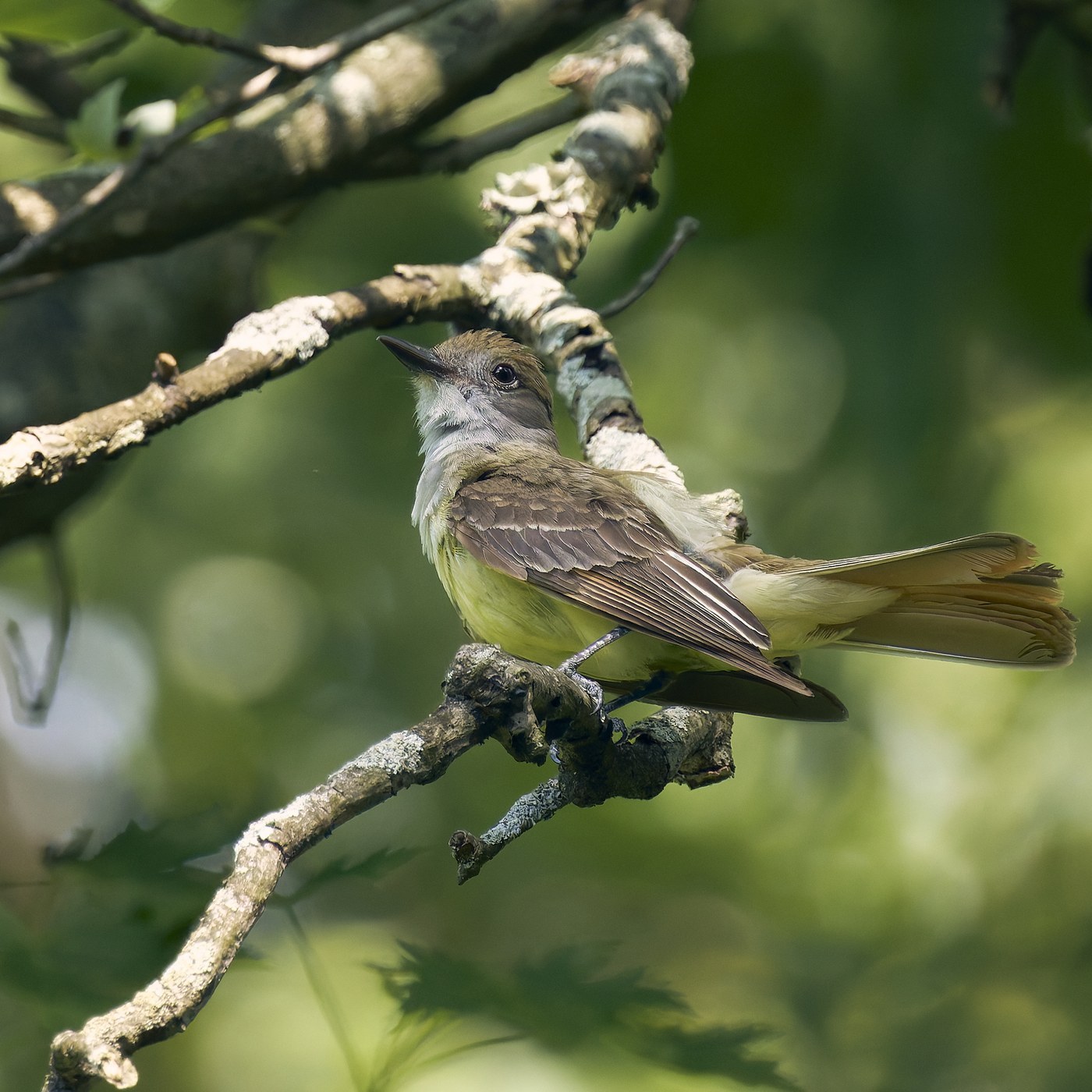
Key Field Marks
- Size & shape: A big flycatcher, about 6.5-8 inches (17-21 cm) long, with a bushy, slightly peaked crest, a stout bill, and a long tail — noticeably larger and bulkier than the smaller Empidonax flycatchers.
- Plumage: Olive-brown back and crown, pale gray throat and upper breast contrasting with a bright lemon-yellow belly, and rufous-chestnut edging on the wing feathers and, especially, the tail (visible as a rusty flash when the tail is spread or from below).
- Bill & behavior: Fairly large, broad-based blackish bill; typically stays high in the canopy and is more often heard than seen, perching upright and sallying out for flying insects.
Similar Species
- Brown-crested Flycatcher / Ash-throated Flycatcher (West): Very similar overall pattern but paler yellow belly and less extensive rufous in the tail; ranges barely overlap with Great Crested Flycatcher, mainly separated geographically.
- Great Kiskadee: Much bolder with a black-and-white striped head and bright rufous wings/tail combined with a yellow belly, but has a bold face pattern Great Crested lacks.
- Eastern Kingbird: Lacks yellow belly and rufous tail; has a black-and-white plumage with a white-tipped tail instead.
Habitat & Range
Breeds in deciduous and mixed woodlands, forest edges, orchards, and parks across the eastern and central United States and southern Canada. A cavity nester, often using old woodpecker holes or nest boxes, and famous for sometimes weaving a shed snakeskin (or shiny plastic substitute) into its nest lining.
Season
A long-distance migrant, arriving on breeding grounds in spring (April-May) and departing by September for wintering grounds in Mexico, Central America, and northern South America.
Voice
Loud and distinctive: a rising, whistled wheeep! and a rolling, burry prrrreet given frequently from the canopy, often the first clue to its presence in leafy summer woodlands.
Frequently asked questions
What is the best field mark for Great Crested Flycatcher?
The combination of an olive-brown back, pale gray throat, bright lemon-yellow belly, and rusty-rufous edges to the wings and tail is diagnostic among eastern flycatchers.
How is Great Crested Flycatcher usually detected?
Most often heard first — its loud, rising wheeep! call and rolling prrrreet notes carry from high in the canopy well before the bird is seen.
Does Great Crested Flycatcher nest in cavities?
Yes, it is a secondary cavity nester that uses old woodpecker holes, natural tree cavities, or nest boxes, and is known for sometimes adding shed snakeskin to the nest lining.
Where does Great Crested Flycatcher spend the winter?
It migrates south to winter in Mexico, Central America, and northern South America, returning to eastern North American woodlands each spring to breed.