
Great Cormorant Identification Guide
A large, bulky, all-dark waterbird identified by its heavy build, white throat/cheek patch, and — in breeding plumage — a white flank patch, often seen perched upright with wings spread to dry.
Read the full Great Cormorant encyclopedia entry →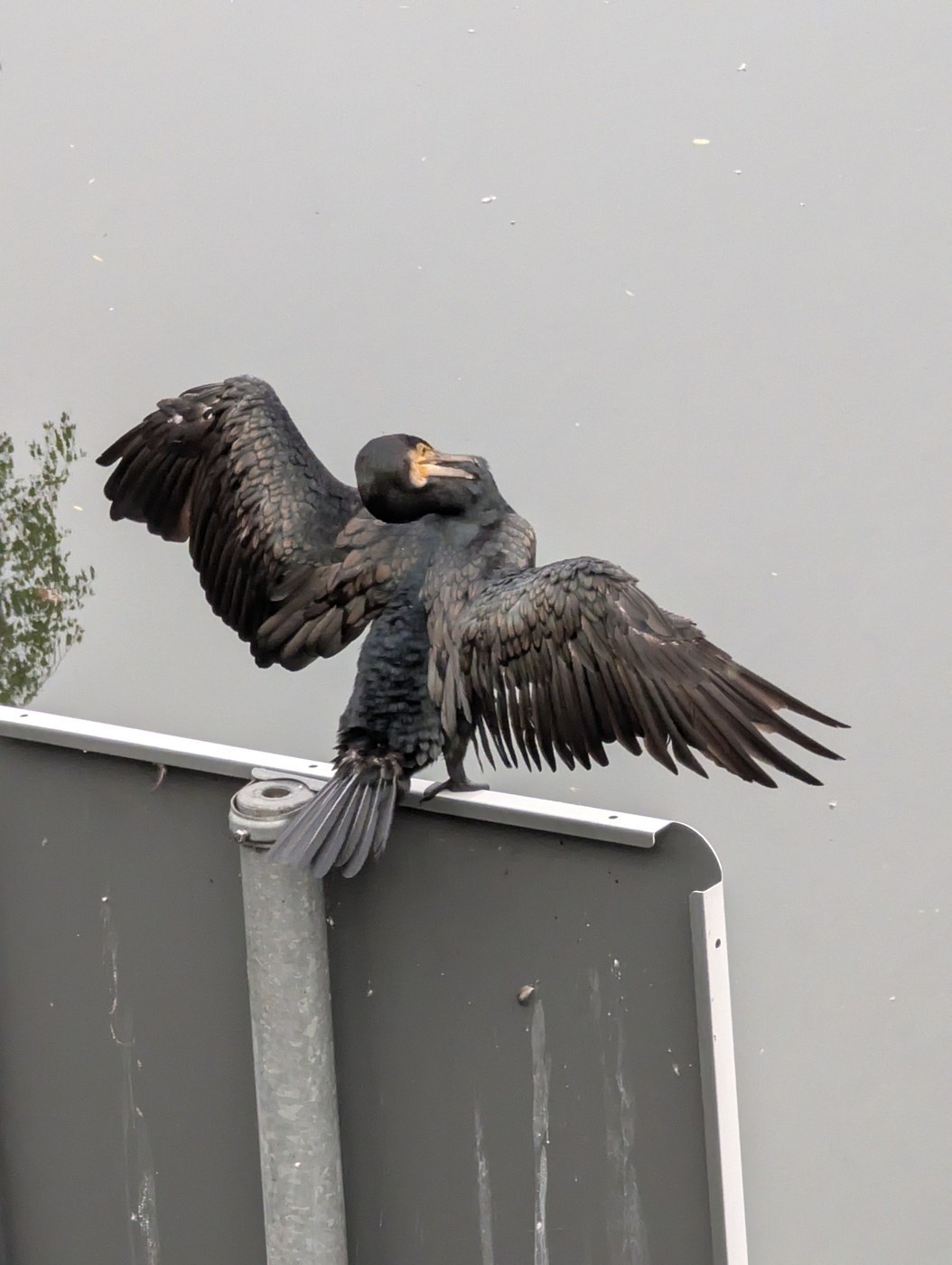
Key Field Marks
- Size & shape: The largest cormorant across most of its range, about 33-39 inches (84-100 cm) long, with a bulky body, thick neck, and a longish, hook-tipped bill. Heavier and broader-winged than most other cormorants.
- Plumage: Overall glossy blackish body with a bronze-green sheen on the back and wing coverts (scaled appearance from pale feather edges). Adults show a bright white patch on the throat and lower face/chin that extends onto the upper neck, most obvious at close range or in good light. In breeding season, adults also develop a striking white patch on the flank/thigh and fine white filoplumes on the head/neck.
- Bill & face: Heavy, hook-tipped grayish bill with a bare yellow-orange patch at the base (gular pouch) bordered by white.
- Behavior: Often perches upright on rocks, pilings, or trees with wings spread wide to dry (lacking fully waterproof plumage). Swims low in the water with only the head, neck, and back visible, diving from the surface to pursue fish.
Similar Species
- Double-crested Cormorant (North America): Smaller and slimmer with an orange-yellow throat patch that comes to more of a point and lacks the extensive white face/chin patch of Great Cormorant; bright orange (not yellow-white bordered) facial skin.
- European Shag / Shag: Smaller, slimmer, glossier all-dark green-black with a thinner bill and no white face patch; develops a recurved crest in breeding season.
- Neotropic Cormorant: Much smaller and slimmer with a thin bill and a pointed white border to the gular pouch rather than a broad white throat/cheek patch.
Habitat & Range
Extremely widespread across coastal and inland waters of Europe, Asia, Africa, and Australia, with a more localized coastal presence in northeastern North America (Atlantic Canada, Maine). Uses rocky coasts, estuaries, large lakes, and rivers, often nesting colonially on cliffs, rocky islands, or in trees.
Season
Largely resident in milder regions; northern populations move south to more open coastal waters in winter. In North America, most easily found along the northeastern Atlantic coast, especially in winter.
Voice
Generally silent away from breeding colonies; at nesting sites gives low guttural grunts and croaks.
Frequently asked questions
How do I tell Great Cormorant from Double-crested Cormorant?
Great Cormorant is larger and bulkier with an extensive white throat and cheek patch, while Double-crested Cormorant is smaller and slimmer with a smaller, more orange-yellow throat patch that comes to a point and no white face patch.
Why do cormorants stand with their wings spread out?
Their feathers are not fully waterproof like ducks', so after diving they perch and spread their wings to dry them out, which also helps regulate body temperature.
What does breeding-plumage Great Cormorant look like?
In addition to the white throat patch, breeding adults grow a conspicuous white patch on the flank/thigh and fine white filoplumes scattered over the head and neck.
Where is Great Cormorant found in North America?
It has a limited range compared to its huge Old World distribution, found mainly along the coast of Atlantic Canada and Maine, especially in winter, in contrast to the far more widespread Double-crested Cormorant.