
Great Bustard Identification Guide
One of the heaviest flying birds in the world, identified by its massive gray-headed, chestnut-and-black barred body, upright stance, and preference for open steppe and farmland.
Read the full Great Bustard encyclopedia entry →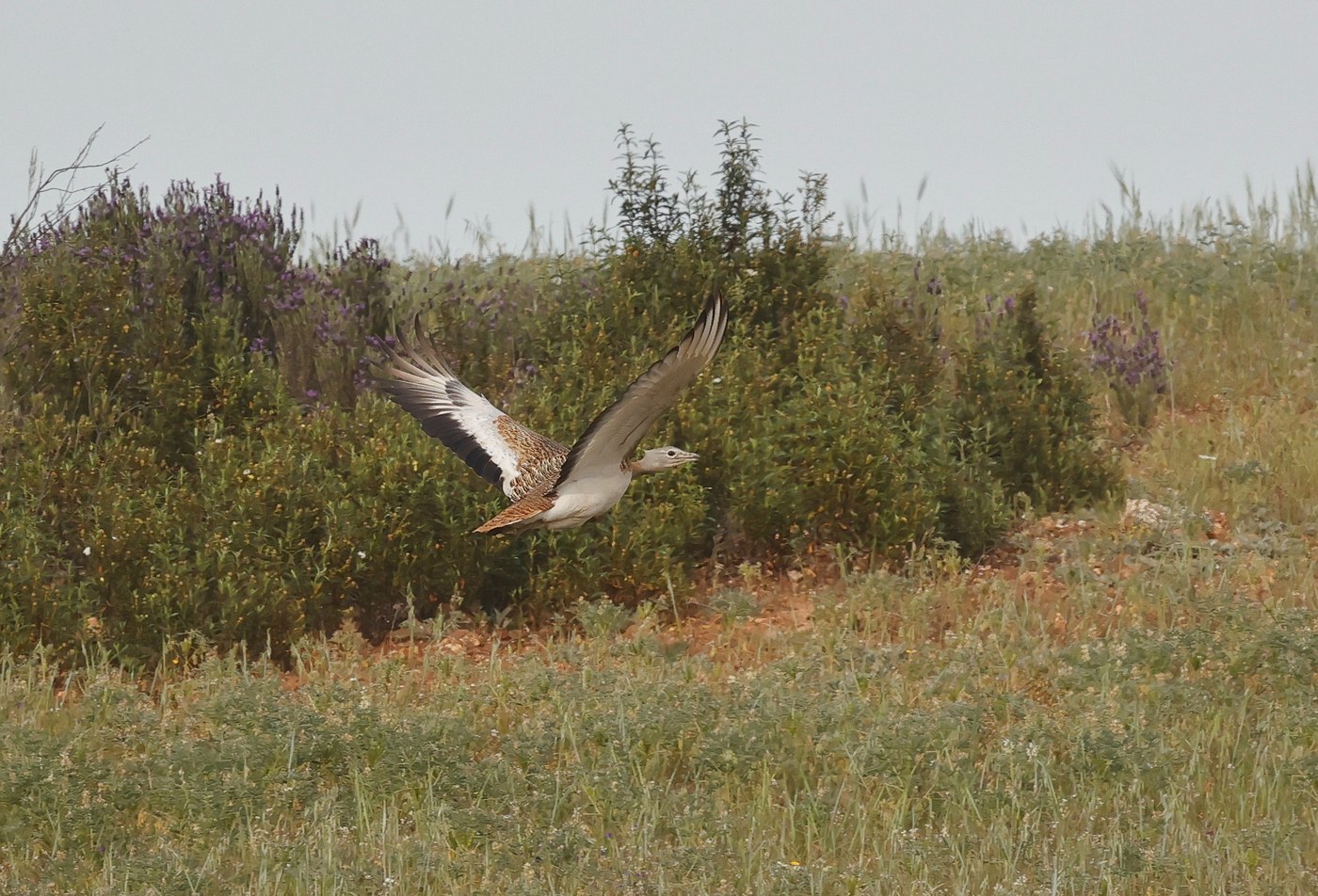
Key Field Marks
- Size & shape: Enormous and heavy-bodied, males up to 40 inches (100+ cm) tall and among the heaviest flying birds (males can exceed 30+ lbs/14+ kg), with females notably smaller. Bulky, horizontal body carried on long, thick legs; thick neck and small head give a distinctive silhouette recalling a large goose crossed with an ostrich.
- Plumage: Head and neck pale gray, breast and upper back rich chestnut-orange barred with black, underparts and belly white, wings show large white patches visible in flight. Breeding males develop long, bristly white "whiskers" (modified throat feathers) fanning from the sides of the neck/chin.
- Bill & legs: Short, stout grayish bill; thick, sturdy legs, gray to horn-colored.
- Behavior: Walks with a slow, deliberate, upright gait across open ground; wary and often flushes at long distance. Flies with slow, powerful wingbeats on broad wings, neck extended. Males perform a dramatic, balloon-like courtship display, inverting their wings and puffing out white body feathers ("foam-bath" display).
Similar Species
- Little Bustard: Much smaller, more compact, lacking the huge bulk, deep chestnut breast band, and neck whiskers of Great Bustard.
- Common Crane: Superficially similar gray tones but has a very long neck and legs held extended in flight, plus a red crown patch, and is far slimmer overall.
- No other bird in its range approaches the Great Bustard's sheer bulk combined with the chestnut-barred breast pattern.
Habitat & Range
Found in open steppe, extensive dry grassland, and large-scale arable farmland across scattered populations from the Iberian Peninsula through central and eastern Europe to Central Asia, Mongolia, and China. Requires large, open, undisturbed landscapes with minimal tall vegetation or trees.
Season
Largely resident to partially migratory depending on population; birds breeding in colder continental regions (e.g., Mongolia, parts of Russia) move south in winter, while Iberian populations are mostly sedentary.
Voice
Generally silent away from the breeding lek; males may give low grunts during display, but the species is not known for vocal calls compared to visual courtship displays.
Frequently asked questions
How heavy can a Great Bustard get?
Adult males can weigh well over 30 pounds (14+ kg), making the species one of the heaviest birds in the world still capable of sustained flight.
What does the male Great Bustard's courtship display look like?
Males perform a dramatic 'foam-bath' display, inverting their wings over the back, fanning white feathers and neck whiskers outward, and puffing themselves up to appear as a large white ball visible from a great distance.
How do I distinguish Great Bustard from Little Bustard?
Great Bustard is vastly larger and bulkier with a deep chestnut, black-barred breast band and long neck whiskers on breeding males, while Little Bustard is small, slim, and lacks these features.
What habitat does Great Bustard need?
Large expanses of open steppe grassland or extensive arable farmland with minimal trees or tall structures, as the species is very wary and avoids enclosed or disturbed landscapes.