
Great Bowerbird Identification Guide
A large, plain grayish-fawn bowerbird of northern Australia, best known for the male's impressive avenue bower decorated with gray and white objects, and told from similar species by its size and subtle nuchal crest.
Read the full Great Bowerbird encyclopedia entry →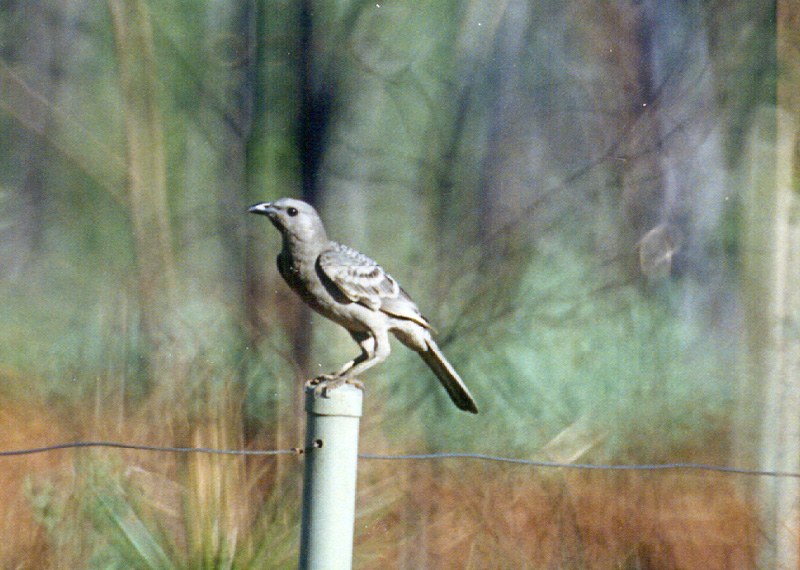
Key Field Marks
- Size & shape: The largest bowerbird in Australia, about 13-15 inches (34-38 cm) long, with a fairly heavy build, stout bill, and moderately long tail.
- Plumage: Overall plain grayish-brown to fawn-gray above and paler buffy-gray below, with fine vermiculated (scaly-looking) patterning on the back and wings. Adult males show a small, often-concealed lilac-pink to pale mauve nuchal crest on the nape, visible mainly during display and otherwise hard to see.
- Bill & legs: Blackish, moderately stout bill; grayish legs.
- Behavior: Males build and maintain elaborate "avenue" bowers of parallel sticks, decorated with piles of gray and white objects (bones, shells, stones, sometimes glass or plastic) used purely for courtship display, not nesting. Often forages on the ground and in trees for fruit and insects, generally in pairs or small groups outside the breeding display.
Similar Species
- Spotted Bowerbird: Smaller, with bolder buffy-white spotting on the back and wings (versus Great Bowerbird's finer vermiculation), and largely allopatric/overlapping in range in parts of interior Queensland.
- Fawn-breasted Bowerbird: Found in New Guinea and Cape York, warmer fawn-buff tones and different, smaller range with little overlap.
- Female/immature bowerbirds of these species are notoriously similar and often best separated by range and bower type near a displaying male rather than plumage alone.
Habitat & Range
Resident across northern Australia, from the Kimberley region of Western Australia through the Top End of the Northern Territory to Queensland's Cape York and central-eastern regions. Found in a range of wooded habitats including monsoon forest, eucalypt woodland, mangrove edges, and gardens.
Season
Non-migratory resident year-round; bower-building and display activity by males peaks during the local breeding season (roughly the dry season into early wet season, varying by region).
Voice
A harsh, chattering series of churrs, clicks, and rasping notes, along with mimicry of other birds and even mechanical sounds; males often vocalize while displaying at the bower.
Frequently asked questions
What is a bower and does the Great Bowerbird nest in it?
The bower is an elaborate stick avenue structure decorated with gray/white objects that males build purely to attract and court females; it is not used as a nest, which the female builds separately in nearby vegetation.
How can I tell Great Bowerbird from Spotted Bowerbird?
Great Bowerbird is larger with finer, more subtly vermiculated back patterning, whereas Spotted Bowerbird shows bolder, more distinct buffy-white spots on the back and wings.
What color decorations does a Great Bowerbird use at its bower?
Predominantly gray and white objects such as bones, shells, stones, and sometimes bits of glass or plastic, deliberately sorted and arranged around the bower avenue.
Where in Australia is Great Bowerbird found?
Across the tropical north, including the Kimberley, the Top End of the Northern Territory, and Queensland, in wooded and semi-open habitats including gardens.