Great Blue Heron Identification Guide
North America's largest and most widespread heron, identified by its tall gray-blue body, long yellow bill, black plume over the eye, and slow, deliberate stalking of shallow water.
Read the full Great Blue Heron encyclopedia entry →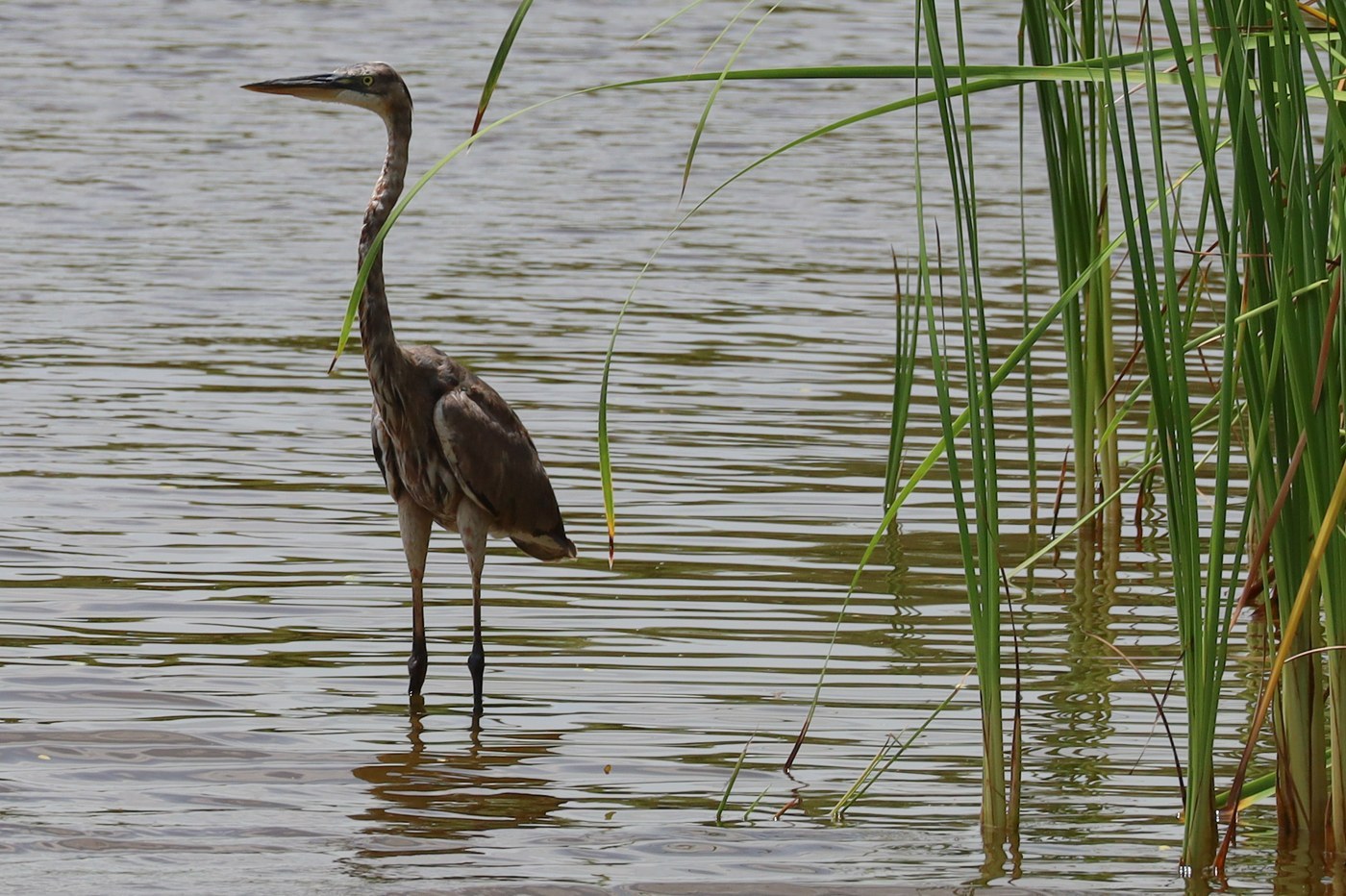
Key Field Marks
- Size & shape: A very large wading bird, 38-54 inches (97-137 cm) tall with a wingspan around 6 feet, long legs, a long S-curved neck, and a long, dagger-like bill.
- Plumage: Overall blue-gray body, with a whitish face and crown bordered by a black stripe extending from above the eye into long black plumes trailing off the back of the head. Neck is grayish with black-and-white streaking down the foreneck; shoulder shows a rust-and-black patch where the wing meets the body.
- Bill & legs: Long, heavy, yellow-orange bill (brighter orange-yellow in breeding adults); long legs that are dark and can appear yellowish above the "knee" (tibiotarsal joint).
- In flight: Neck folded back into an S-shape (not extended, unlike cranes), slow deep wingbeats, legs trailing straight behind.
- Behavior: Stands motionless or walks with slow, deliberate steps in shallow water before striking prey with a rapid stab of the bill; often seen solitary while foraging but nests colonially in tall trees (heronries).
Similar Species
- Sandhill Crane: Flies with neck extended straight out (not curled), and lacks the heron's dagger bill shape and blue-gray plumage pattern; also more of an upland/grassland forager.
- Great Egret: All white, similar size and shape, but never has the Great Blue Heron's gray-blue body.
- "Great White Heron" (white morph, south Florida): Essentially an all-white form of Great Blue Heron with pale yellowish legs (versus Great Egret's black legs); found mainly in the Florida Keys and Everglades.
Habitat & Range
Extremely widespread across nearly all of North America wherever there is shallow water — freshwater marshes, lake and pond edges, rivers, estuaries, tidal flats, and even ditches. Breeds from southern Canada through the U.S. and into Mexico and Central America.
Season
Present year-round across much of the southern and coastal U.S.; northern interior populations migrate south in winter to open water, returning in spring to breed in tree colonies.
Voice
A harsh, deep, guttural croak, fraahnk or rawk, typically given when flushed or in flight; largely silent while foraging.
Frequently asked questions
How can I tell Great Blue Heron from Sandhill Crane in flight?
Great Blue Heron flies with its neck tucked back in an S-shape, while Sandhill Crane flies with its neck fully extended straight out; herons also have a heavier, dagger-shaped bill.
What is the 'Great White Heron' and how is it different from Great Egret?
It is an all-white color morph of the Great Blue Heron found mainly in south Florida; it has pale yellowish legs and a heavier bill/build than the slimmer, black-legged Great Egret.
Where do Great Blue Herons nest?
They nest colonially, often in large stick nests high in trees near water, forming colonies called heronries that can contain dozens to hundreds of pairs.
Do Great Blue Herons migrate?
Southern and coastal populations are largely resident year-round, but northern interior breeders migrate south to open water in winter when their habitat freezes.
Great Blue Heron identified by the community
Recent Great Blue Heron sightings identified with Bird Identifier.