
Gray-headed Chickadee Identification Guide
A large, brown-backed chickadee of remote subarctic scrub, distinguished from other North American chickadees by its gray-brown (not black) cap and buffy flanks.
Read the full Gray-headed Chickadee encyclopedia entry →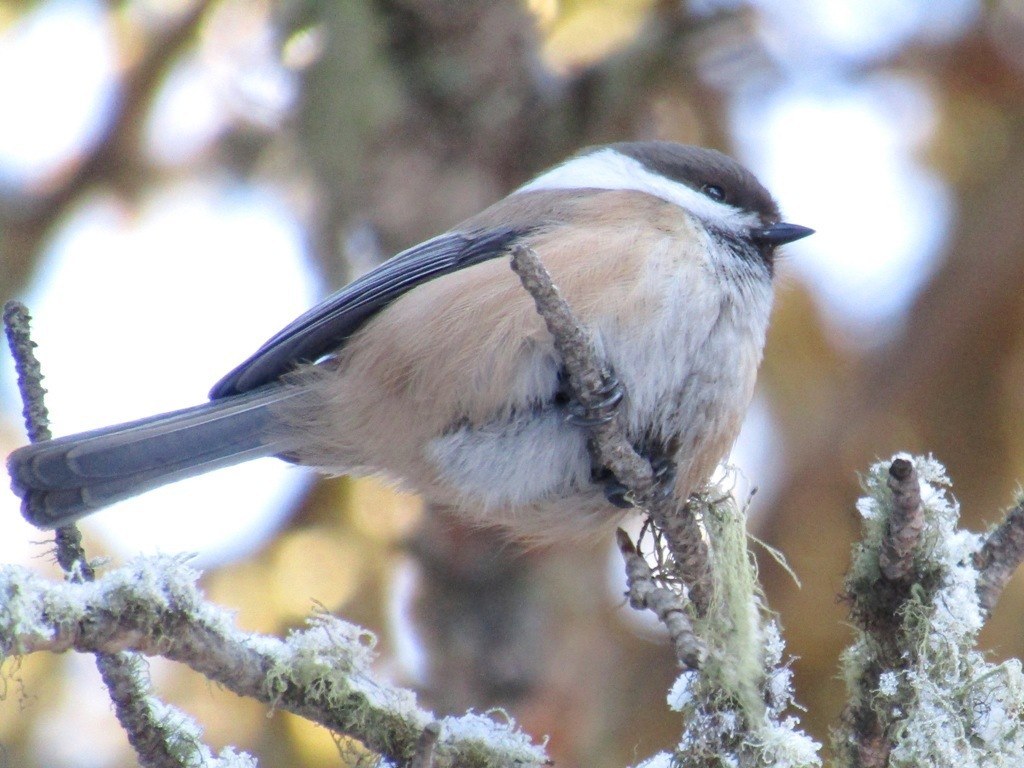
Key Field Marks
- Largest of the North American chickadees, noticeably bulkier with a longer tail than Black-capped or Boreal Chickadee.
- Cap is dull grayish-brown rather than solid black or bright brown, giving the head a soft, muted look.
- Back is warm brown, and the flanks show a rich buffy-cinnamon wash, often more extensive than in Boreal Chickadee.
- White cheek patch is large and can look slightly duller or grayer than the crisp white cheek of Black-capped Chickadee.
- Small black bib on the throat, less extensive and less crisply defined than in Black-capped Chickadee.
Separating It From Similar Species
- Boreal Chickadee: has a warmer, more solidly brown cap (not gray-brown) and a grayer back, without the same combination of gray-brown crown and rich buffy flanks.
- Black-capped Chickadee: shows a glossy black cap and a crisp, bright white cheek, quite different from the duller gray-brown cap of Gray-headed Chickadee.
- Range is one of the most useful distinguishing factors, since Gray-headed Chickadee occupies a very limited and remote range in North America compared to the widespread Boreal and Black-capped Chickadees.
Habitat, Range & Season
- In North America, found only in remote subarctic willow and birch scrub near treeline in far northern Alaska and extreme northwestern Canada, making it one of the least-seen breeding birds on the continent.
- More widespread across northern Eurasia, where it is known as the Siberian Tit, occupying boreal forest and scrub across a broad swath of Scandinavia, Russia, and Siberia.
- Non-migratory; resident year-round on its remote breeding grounds, which contributes to how rarely it is encountered by birders.
Behavior & Voice
- Forages actively in willow and birch scrub and mixed conifer edges for insects, spiders, and seeds, often caching food for the harsh winter months like other chickadees.
- Typically found in pairs or small family groups rather than large mixed flocks.
- Voice includes buzzy, harsh calls similar in structure to other chickadees but generally lower and coarser, along with a rough "cheerrr" note distinct from the clearer calls of Black-capped Chickadee.
Frequently asked questions
How do I tell a Gray-headed Chickadee from a Boreal Chickadee?
Gray-headed Chickadee has a duller gray-brown cap and richer buffy flanks, while Boreal Chickadee shows a more solidly warm brown cap and grayer back.
Why is the Gray-headed Chickadee so rarely seen in North America?
It occupies a very small and extremely remote range limited to subarctic willow and birch scrub in far northern Alaska and northwestern Canada, far from most birders.
Is the Gray-headed Chickadee the same as the Siberian Tit?
Yes, they are the same species; it is called Gray-headed Chickadee in North America and Siberian Tit across its much larger Eurasian range.
Does the Gray-headed Chickadee migrate?
No, it is a non-migratory, year-round resident of its subarctic breeding range.
What habitat should I search for Gray-headed Chickadee?
Remote willow and birch scrub near treeline, typically well north of areas where Boreal or Black-capped Chickadees are common.