
Gray Hawk Identification Guide
A slim, pale gray buteo of riparian woodlands along the U.S.-Mexico border, marked by fine barring below and a bold black-and-white banded tail.
Read the full Gray Hawk encyclopedia entry →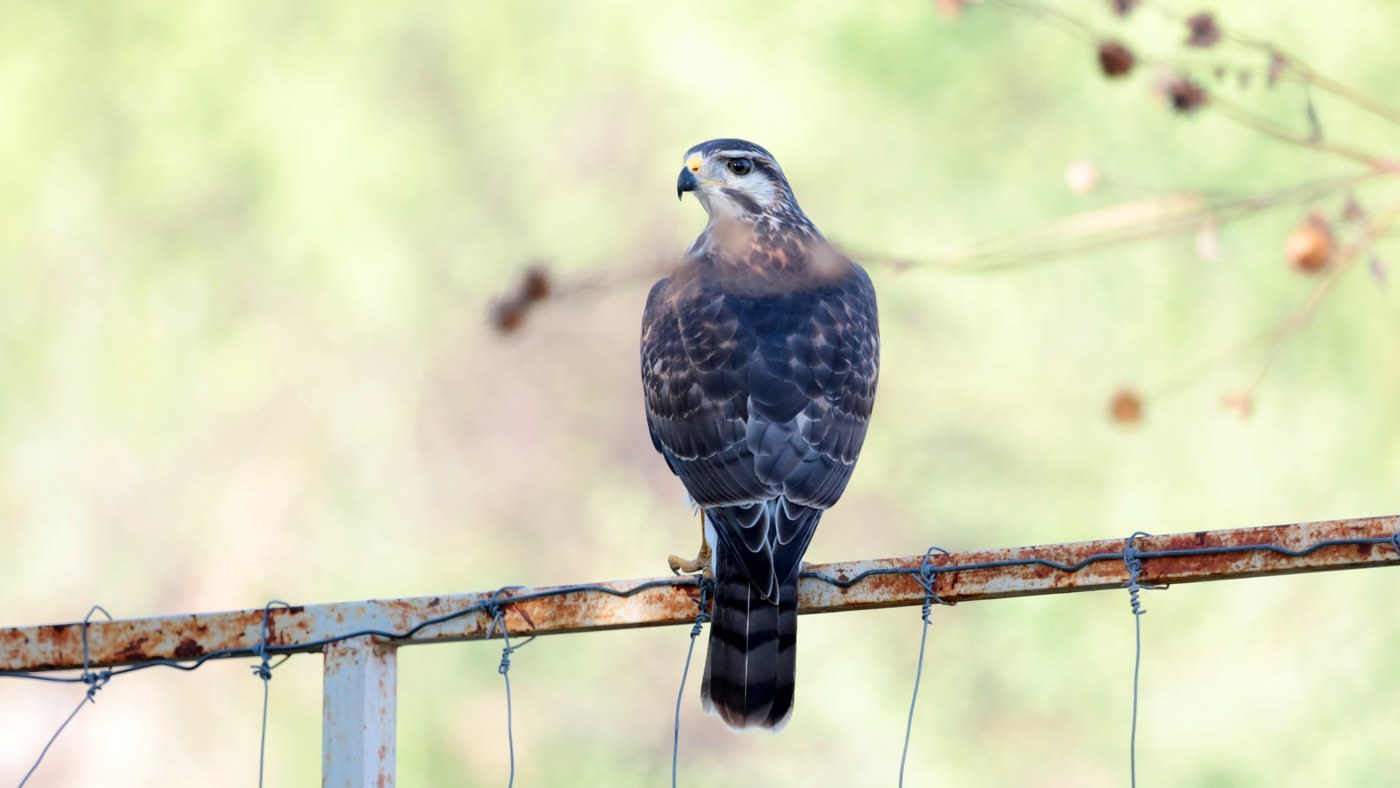
Key Field Marks
- Medium-sized buteo with a slim build, relatively long tail, and paddle-shaped, somewhat rounded wings compared to bulkier buteos.
- Adults show pale gray upperparts and finely barred gray-and-white underparts, giving an overall soft, pale-gray look at a distance.
- Tail is boldly banded black and white with a broad black subterminal band, especially conspicuous in flight.
- White uppertail coverts form a bright white U-shaped band at the base of the tail, visible from above in flight.
- Immatures are brown above with streaked underparts and a banded tail, more similar to other immature buteos, requiring more care to identify.
Separating It From Similar Species
- Broad-winged Hawk: brown rather than gray above with a different tail pattern of fewer, broader bands, and prefers different habitat.
- Red-shouldered Hawk: shows warm rufous shoulder patches and rufous barring below, quite different from the cool gray tones of an adult Gray Hawk.
- Cooper's Hawk: superficially similar in some lighting due to gray tones, but is an accipiter with a longer tail, shorter rounded wings, and a very different flight style (flap-flap-glide vs. soaring).
- Agile, buoyant flight with quick wingbeats interspersed with glides, more accipiter-like than typical soaring buteos, is also a useful behavioral clue.
Habitat, Range & Season
- Restricted in the U.S. to riparian corridors of cottonwood, willow, and mesquite along rivers in southeastern Arizona and southern Texas, extending south through Mexico and Central America to South America.
- Closely tied to gallery forest and dense streamside woodland, rarely found far from water and tall riparian trees.
- U.S. breeders are largely migratory, arriving in spring (around March-April) and departing by early fall, while populations further south in the range tend to be resident.
Behavior & Voice
- Hunts from a perch within or at the edge of riparian woodland, dropping down to catch lizards, which make up a large part of its diet, along with small birds and mammals.
- Flight is more agile and accipiter-like than most buteos, with quick, snappy wingbeats.
- Voice is a loud, descending scream, often given repeatedly, rendered as "kee-eee-eer," frequently the first clue to its presence in dense riparian canopy.
Frequently asked questions
How do I identify a Gray Hawk?
Look for a slim, pale gray buteo with finely barred underparts, a boldly black-and-white banded tail, and a white U-shaped band at the base of the tail visible in flight.
Where does the Gray Hawk live in the United States?
It is restricted to riparian cottonwood, willow, and mesquite woodland along rivers in southeastern Arizona and southern Texas.
What does a Gray Hawk eat?
Lizards make up a large portion of its diet, supplemented by small birds and mammals, typically caught by dropping from a perch.
How can I tell a Gray Hawk from a Broad-winged Hawk?
Adult Gray Hawk is gray above with a bold black-and-white banded tail, while Broad-winged Hawk is brown above with a different, broader-banded tail pattern.
What does a Gray Hawk sound like?
A loud, descending scream, often rendered as "kee-eee-eer," frequently heard before the bird is spotted in dense riparian canopy.