
Grasshopper Warbler Identification Guide
A secretive Eurasian warbler best known for its mechanical, insect-like reeling song, more often heard than seen as it skulks through dense scrub.
Read the full Grasshopper Warbler encyclopedia entry →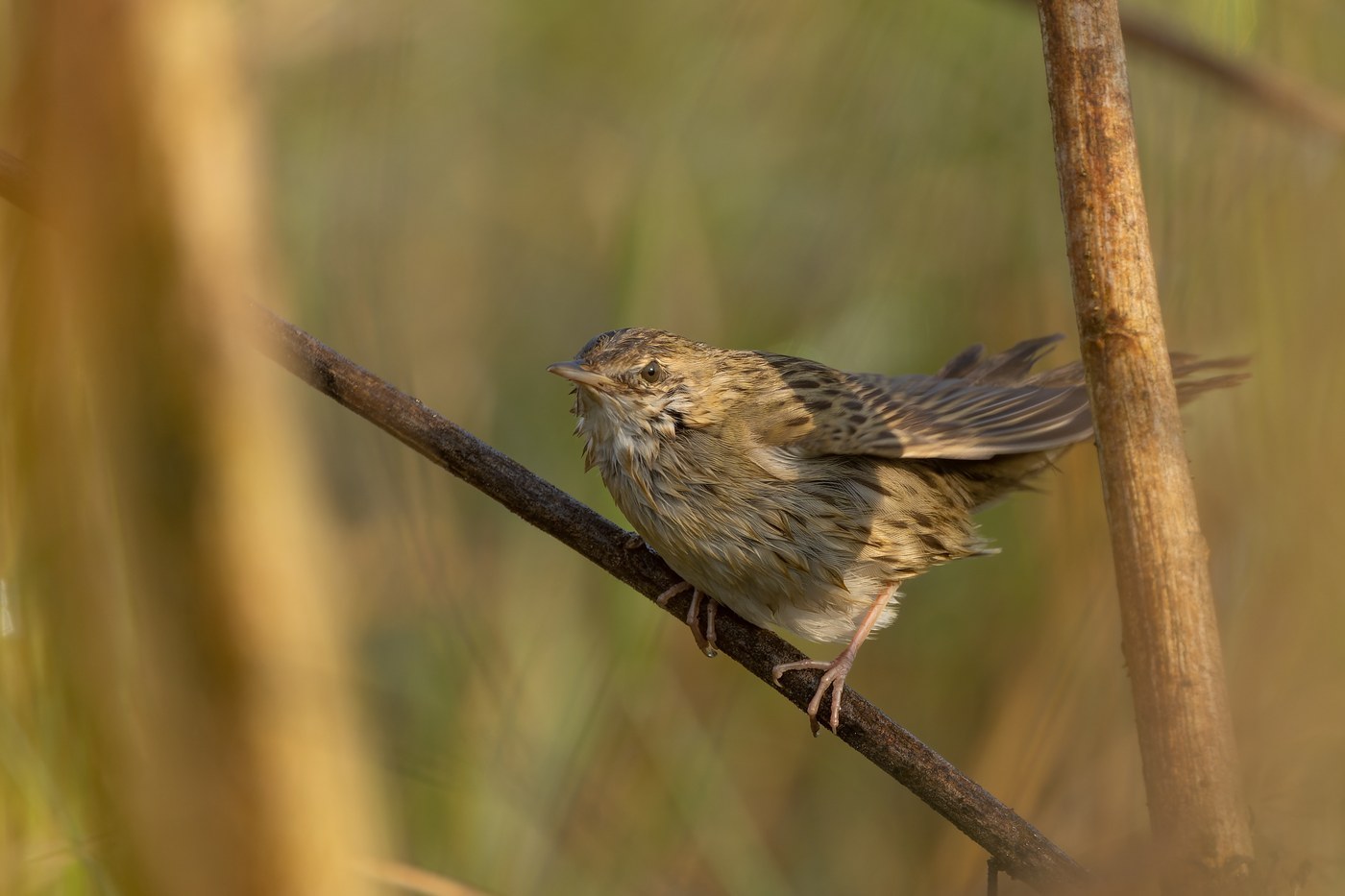
Key Field Marks
- Small, olive-brown Old World warbler with fine dark streaking across the crown, back, and rump, giving an overall mottled, cryptic appearance.
- Underparts are pale buffy-white with faint fine streaking on the breast and flanks, less prominent than the upperpart streaking.
- Rounded, graduated tail, often fanned or cocked slightly, with fine barring visible at close range.
- Rounded head, short pale supercilium, and an overall skulking, low-slung posture as it creeps through vegetation.
- Legs are pale pinkish, and the bill is fine and pointed, typical of Locustella warblers.
Separating It From Similar Species
- Savi's Warbler: unstreaked rufous-brown upperparts and a plainer rump, lacking the crown and back streaking that defines Grasshopper Warbler.
- Sedge Warbler: has a bold pale supercilium and streaked crown but unstreaked, warmer rufous rump, plus a different, more varied chattering song.
- Reed Warbler: unstreaked, uniformly warm brown above with no streaking at all, and lacks the graduated, barred tail.
- The combination of streaked crown, back, and rump with pale underparts is the key to separating Grasshopper Warbler from other skulking Locustella and Acrocephalus warblers.
Habitat, Range & Season
- Breeds across much of Europe and western/central Asia in dense low scrub, brambles, rank grassland, young conifer plantations, and heathland edges, often near damp ground.
- A long-distance migrant, wintering mainly in sub-Saharan West Africa; present on breeding grounds roughly late April through August.
- On migration it can turn up in almost any patch of dense low cover, including reedbeds and hedgerows.
Behavior & Voice
- Extremely skulking, creeping mouse-like through the base of vegetation and rarely showing itself in the open, so most encounters are auditory.
- Song is the famous "reeling" call: a sustained, mechanical, insect-like trill delivered on a single pitch for extended periods, often compared to the sound of a fishing reel being cast or an old sewing machine.
- The reeling song is ventriloquial and can be hard to pinpoint, and males often sing at dusk and after dark as well as by day, sometimes turning their head while singing to throw the sound in different directions.
Frequently asked questions
What does the Grasshopper Warbler's song sound like?
A sustained, mechanical, insect-like reeling trill on one pitch, often compared to the whirring sound of a fishing reel or an old sewing machine.
How do I tell Grasshopper Warbler from Savi's Warbler?
Grasshopper Warbler shows fine dark streaking on the crown, back, and rump, while Savi's Warbler is plain, unstreaked rufous-brown above.
Why is the Grasshopper Warbler so hard to see?
It is a persistent skulker that creeps through dense low cover near the ground and rarely perches in the open, so it is usually detected by its distinctive song.
Where does the Grasshopper Warbler spend the winter?
Most of the population winters in sub-Saharan West Africa after breeding across Europe and western Asia.
What habitat should I check for Grasshopper Warblers?
Dense low scrub, brambles, rank damp grassland, young plantations, or heathland edges, especially where growth is thick close to the ground.