
Grasshopper Sparrow Identification Guide
A small, flat-headed grassland sparrow with a plain buffy breast and an insect-like buzzy song, easily overlooked as it runs mouse-like through dense grass.
Read the full Grasshopper Sparrow encyclopedia entry →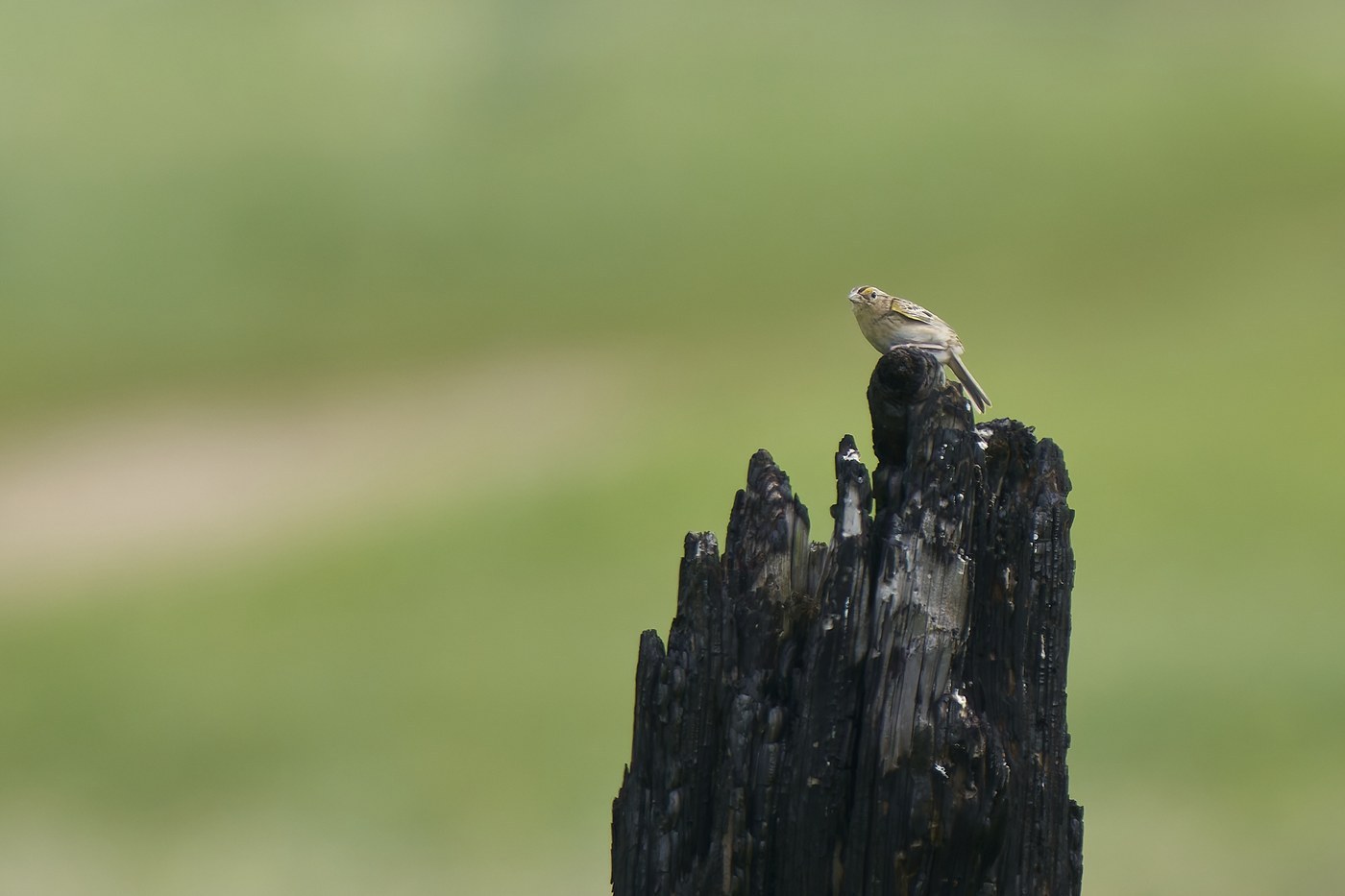
Key Field Marks
- Small, chunky, short-tailed sparrow with a distinctly flat-headed profile and a large bill relative to its body.
- Unstreaked buffy-orange breast and flanks, contrasting with a complex, scaled back pattern of chestnut, black, buff, and white.
- Pale central crown stripe bordered by dark lateral crown stripes; a subtle orange-yellow spot at the bend of the wing (visible at close range) and often a touch of yellow at the front of the eyebrow.
- Short, spiky tail that looks stubby in flight.
- Overall pale, unmarked underparts give it a clean, insect-like look distinct from most other streaky grassland sparrows.
Separating It From Similar Species
- Baird's Sparrow: shows fine streaking across a buffy breast band and a more contrasting head pattern; Grasshopper Sparrow's breast is essentially unstreaked in adults.
- Le Conte's Sparrow: has a much brighter orange face and finely streaked underparts with a distinct necklace of streaks, unlike the plain buffy breast of Grasshopper Sparrow.
- Henslow's Sparrow: has an olive-greenish head and heavily streaked underparts, quite different from Grasshopper Sparrow's plain buffy chest.
- Juvenile Grasshopper Sparrows do show some breast streaking, which disappears with the first prebasic molt, so age can affect the streaking impression.
Habitat, Range & Season
- Breeds in native and restored grasslands, prairies, pastures, and hayfields across much of North America, from southern Canada through the U.S. and locally into Mexico, Central America, and the West Indies.
- Prefers grass with a mix of bare ground and scattered forbs rather than dense, uniform cover.
- Most North American breeders are migratory, wintering in the southern U.S., Mexico, and Central America; look for them on breeding territory from April/May through August.
Behavior & Voice
- Highly secretive on the ground, running mouse-like through grass rather than flushing, and often only detected by voice.
- Males sing from low perches such as fence posts or grass stems, sometimes tossed high in a brief flight display.
- Song is a thin, insect-like buzz — a couple of quiet introductory ticks followed by a sustained high buzzy trill, often described as "tik-tuk-zeeeeeee," closely resembling the sound of a grasshopper.
Frequently asked questions
Why is it called the Grasshopper Sparrow?
Its dry, buzzy song closely resembles the stridulation of a grasshopper, which gives the species its name.
How do I tell a Grasshopper Sparrow from a Baird's Sparrow?
Adult Grasshopper Sparrows have a plain, unstreaked buffy breast, while Baird's Sparrow shows fine streaking across the breast and a more patterned head.
What habitat is best for finding Grasshopper Sparrows?
Open native or restored grassland, prairie, pasture, or hayfield with a mix of grass cover and some bare ground, avoided if too dense or shrubby.
Why are Grasshopper Sparrows so hard to see?
They tend to run through grass on foot like a mouse rather than flush, and stay low, so they are often located by song rather than sight.
Do juvenile Grasshopper Sparrows look different from adults?
Yes, juveniles show fine streaking on the breast that adults lack; this streaking is lost after the first molt.