
Gouldian Finch Identification Guide
A strikingly rainbow-colored Australian grassfinch with a purple breast, yellow belly, turquoise back, and a head that comes in black, red, or rare yellow.
Read the full Gouldian Finch encyclopedia entry →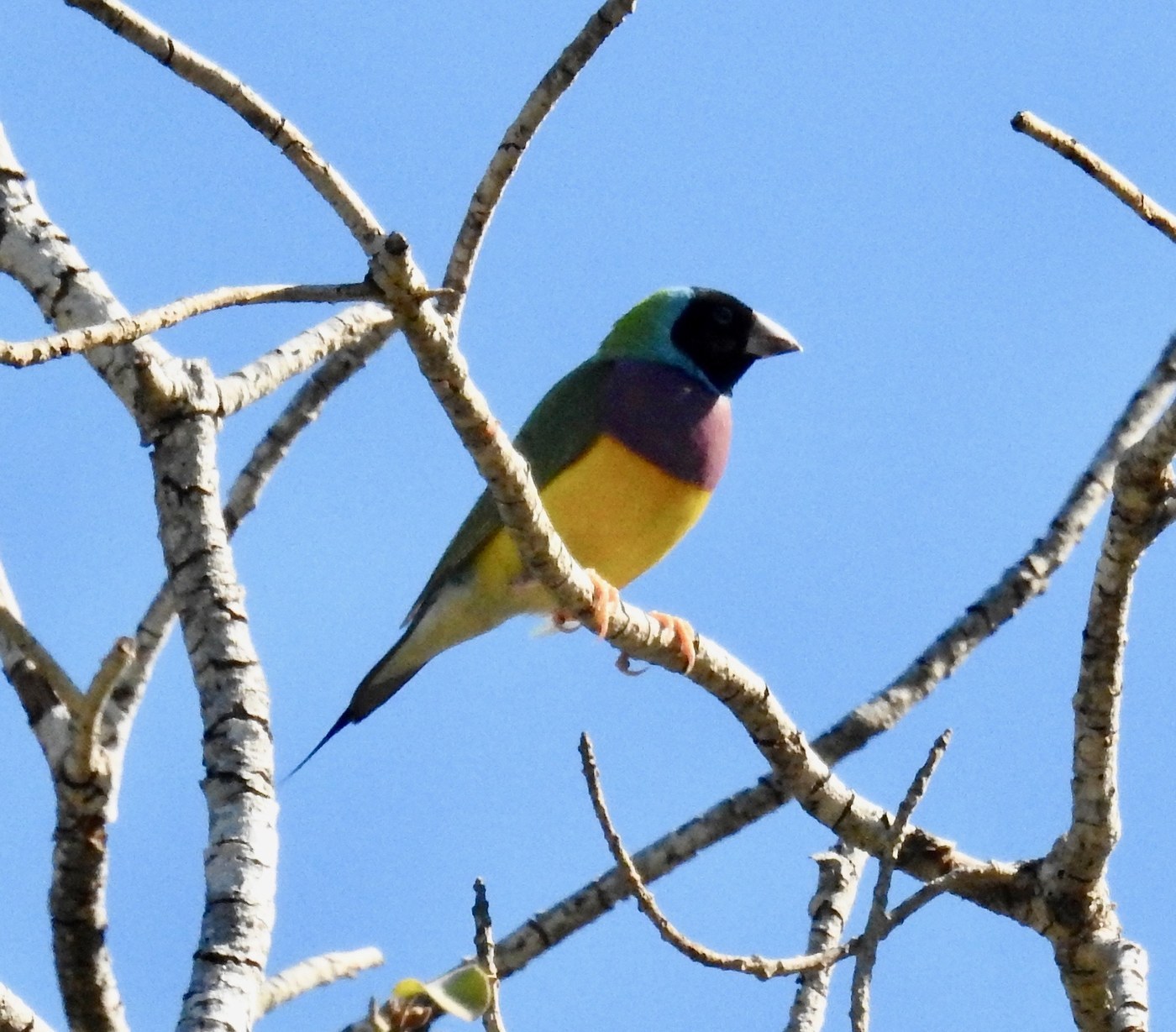
Key Field Marks
- Small, compact finch with an unmistakable multicolored pattern: turquoise-green back and wings, a violet-purple breast band, and a bright yellow belly.
- Head color is polymorphic — most birds have a black face and forehead, a smaller percentage have a red face, and a very rare form shows a yellow-orange face.
- A narrow pale turquoise band separates the colored face from the purple breast in all morphs.
- Bill is pale, whitish to horn-colored with a reddish tip in breeding adults.
- Juveniles are drab olive-gray overall, lacking the adult's bright colors, and take several months to molt into full adult plumage.
Separating It From Similar Species
- No other Australian finch combines turquoise, purple, and yellow in this pattern, so adults are essentially unmistakable.
- Duller juveniles can be confused with young Long-tailed Finches or other grassfinches, but Gouldian Finch juveniles show a shorter tail and a more uniformly gray-olive body without strong barring.
- The black-headed, red-headed, and yellow-headed morphs are all the same species — head color is not a separate species or subspecies distinction.
Habitat, Range & Season
- Endemic to tropical savanna woodland of northern Australia, including the Kimberley, the Top End of the Northern Territory, and parts of Cape York in Queensland.
- Favors open eucalypt woodland with native grasses for seed and nearby permanent water; nests in tree hollows or termite mounds.
- Nomadic within its range, tracking seeding grasses and water availability through the dry and wet seasons; listed as endangered in the wild due to habitat degradation and altered fire regimes.
Behavior & Voice
- Highly social, foraging and moving in small flocks that feed on ripening grass seed heads, often clinging sideways to seed stalks.
- Visits waterholes in groups, especially in the cooler early morning hours.
- Voice is soft and high-pitched rather than a loud song: thin contact calls and a sibilant "tsuit" or "seet," easy to overlook compared to louder Australian finches.
Frequently asked questions
Why do Gouldian Finches have different colored heads?
Head color is a natural genetic polymorphism within the same species — most wild birds are black-headed, a smaller number are red-headed, and a rare form is yellow-headed.
Where do wild Gouldian Finches live?
They are endemic to tropical savanna woodland across northern Australia, including the Kimberley, the Northern Territory's Top End, and Cape York.
Are Gouldian Finches endangered?
Yes, wild populations are considered endangered, largely due to changes in fire management and grass seed availability in their savanna habitat.
How can I tell a juvenile Gouldian Finch from an adult?
Juveniles are dull olive-gray overall without the bright turquoise, purple, or yellow of adults, and they gradually molt into adult colors over several months.
What does a Gouldian Finch sound like?
It gives soft, high-pitched contact calls and a thin "tsuit" rather than a loud, complex song.