
Golden-winged Warbler Identification Guide
A gray, white, and yellow warbler with a bold yellow wing patch and crown, best known for its buzzy song and its tendency to hybridize with the Blue-winged Warbler.
Read the full Golden-winged Warbler encyclopedia entry →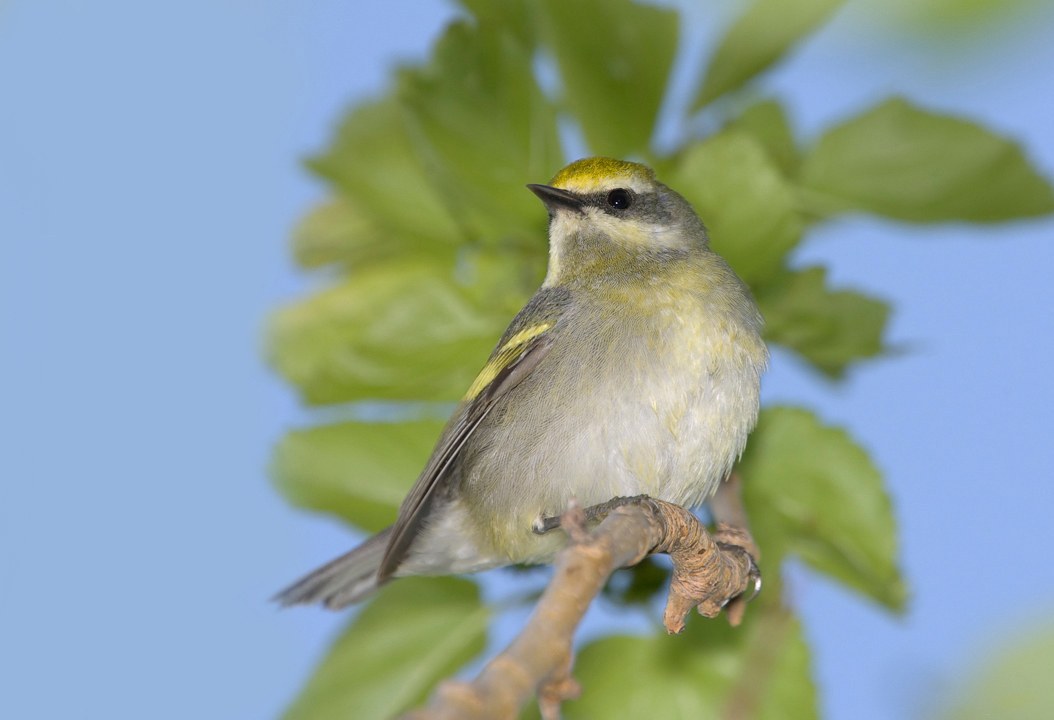
Key Field Marks
- Small warbler (about 12 cm) with clean gray upperparts and white underparts.
- Bright yellow crown patch and a bold yellow wing patch (looks like a solid yellow panel rather than two thin wingbars).
- Adult males show a black throat patch and a black auricular (cheek) patch, both outlined in white, giving a bandit-mask look.
- Females and immatures are much duller, with the throat and cheek patches replaced by pale gray, though the yellow crown and wing patch remain.
- Fine, sharply pointed bill typical of Vermivora warblers, used for probing rather than gleaning open leaves.
Separating It From Similar Species
- Blue-winged Warbler: yellow overall (not gray/white) with a black eyeline instead of a full face mask; the two species hybridize freely.
- Brewster's Warbler (hybrid): whitish underparts like Golden-winged but lacks the black throat/mask, usually shows a weak yellow wingbar and yellowish wash on the breast.
- Lawrence's Warbler (hybrid): yellow underparts like Blue-winged but retains the black throat and mask of Golden-winged.
- Overall gray-and-white body plus solid yellow wing patch is the fastest way to rule out all warblers except the hybrids above.
Habitat, Range & Season
- Breeds locally in shrubby early-successional habitat: overgrown pastures, regenerating clearcuts, and wetland edges with scattered saplings, primarily in the western Great Lakes and the Appalachians, with smaller pockets in New England.
- A long-distance migrant that winters mainly in Central America and the northern Andes of South America, using shade coffee plantations and forest edge.
- Look for it on the breeding grounds from May through July; it is an early fall migrant, often gone from the U.S. by late August.
Behavior & Voice
- Forages actively low in shrubs and saplings, often hanging upside down or probing dead curled leaves and leaf clusters for caterpillars and spiders, a habit shared with chickadees.
- Song is a distinctive buzzy, insect-like "bee-bzz-bzz-bzz," with one introductory note followed by a series of lower buzzes.
- Numbers have declined sharply due to habitat loss and hybridization/competition with the expanding Blue-winged Warbler, making confirmed sightings notable for birders.
Frequently asked questions
What is the easiest way to identify a Golden-winged Warbler?
Look for a gray-backed, white-bellied warbler with a bright yellow crown and a solid yellow wing patch; males add a black throat and cheek patch outlined in white.
How is it different from a Blue-winged Warbler?
Blue-winged Warbler is yellow-bodied with only a black eyeline, while Golden-winged is gray-and-white with a full black throat and face mask (in males).
What do Brewster's and Lawrence's Warblers have to do with this species?
They are hybrids between Golden-winged and Blue-winged Warblers; Brewster's looks pale like Golden-winged but lacks the black mask, and Lawrence's looks yellow like Blue-winged but keeps the black throat and mask.
Where should I look for Golden-winged Warblers in summer?
Search brushy, regenerating fields and forest edges with scattered young trees in the Appalachians or western Great Lakes region during the breeding season.
What does its song sound like?
A distinctive buzzy "bee-bzz-bzz-bzz," with a clear first note followed by several lower, insect-like buzzes.