
Golden Whistler Identification Guide
A robust Australasian songbird in which males show a bold black-and-yellow head/breast pattern and an olive-green back, prized for a loud, ringing whistled song.
Read the full Golden Whistler encyclopedia entry →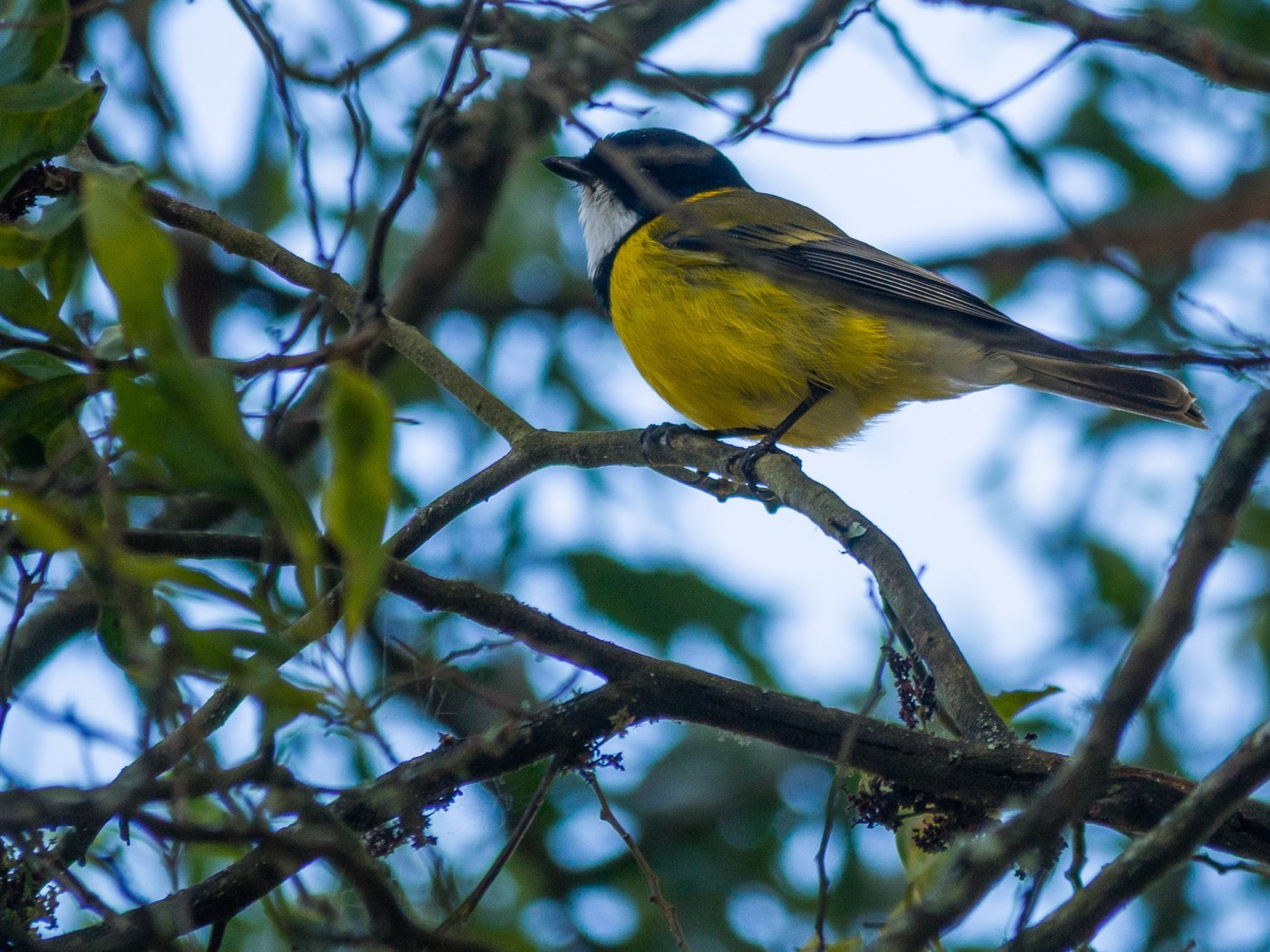
Key Field Marks
- Size & shape: A stocky, robust songbird about 17 cm long, with a fairly large rounded head, short thick neck, and a stout, slightly hooked bill typical of whistlers.
- Plumage (male): Bright yellow underparts and nape contrasting with an olive-green back and wings, a black head and black band across the upper breast, and a small white throat patch bordered by the black breast band — a bold, high-contrast pattern.
- Plumage (female): Much plainer — grayish-brown above and dull whitish-buff below with fine, indistinct streaking on the throat/breast, lacking any black or bright yellow, making females far less conspicuous than males.
- Bill & eye: Stout, slightly hooked grayish bill typical of whistlers, adapted for taking larger insects; eye dark.
- Behavior: Forages actively but often stays within cover in the understory to mid-story, gleaning insects from foliage and bark; males sing persistently from cover, often being heard far more than seen.
Similar Species
- Other whistler species (Pachycephala spp.): Many regional whistlers show some yellow-and-black or yellow-and-olive combinations; Golden Whistler is best distinguished by its extensive plain yellow underparts, black head, and black breast band together with the white throat patch, though exact pattern varies by subspecies across its wide range.
- Rufous Whistler: Shows rufous/orange on the flanks and breast rather than clean yellow, with a different overall tone.
- Female Golden Whistler vs. other female whistlers: Females of many whistler species are similarly dull grayish-brown, so females are often best identified by association with a nearby singing male or by range/habitat.
Where & When to See It
Widespread and highly variable across its range, from eastern and southeastern Australia to New Guinea and many Pacific islands, with numerous recognized subspecies differing somewhat in extent of black and yellow. It occupies rainforest, wet eucalypt forest, woodland, and dense scrub, generally in the understory and mid-story. Most populations are resident/sedentary, though some Australian populations show local or altitudinal movement; the species can be encountered year-round within its range.
Voice & Song Cues
Song is a loud, ringing, whip-cracking series of whistled notes that builds and often ends in an explosive final note, among the most distinctive and far-carrying songs of Australasian forest birds; the male sings frequently and persistently, often from dense cover, making voice the most reliable way to detect the species even when it stays hidden.
Frequently asked questions
How do male and female Golden Whistlers differ?
Males are boldly patterned with a black head, black breast band, white throat patch, yellow underparts, and olive-green back, while females are plain grayish-brown above and dull whitish-buff below with little contrast.
What does the Golden Whistler's song sound like?
A loud, ringing series of whistled notes that often builds to an explosive, whip-crack-like final note — one of the most distinctive and far-carrying songs in its range.
Where does the Golden Whistler live?
It occupies rainforest, wet eucalypt forest, and dense scrub understory across eastern/southeastern Australia, New Guinea, and numerous Pacific islands, with many regional subspecies.
Is the Golden Whistler easier to hear or to see?
It is usually easier to hear — males sing persistently and loudly from dense cover but can be difficult to spot, so following the song is the best way to locate one.