
Golden Tanager Identification Guide
A brilliant golden-yellow Andean tanager with black-streaked upperparts, a black cheek patch, and a black mask that varies subtly by subspecies.
Read the full Golden Tanager encyclopedia entry →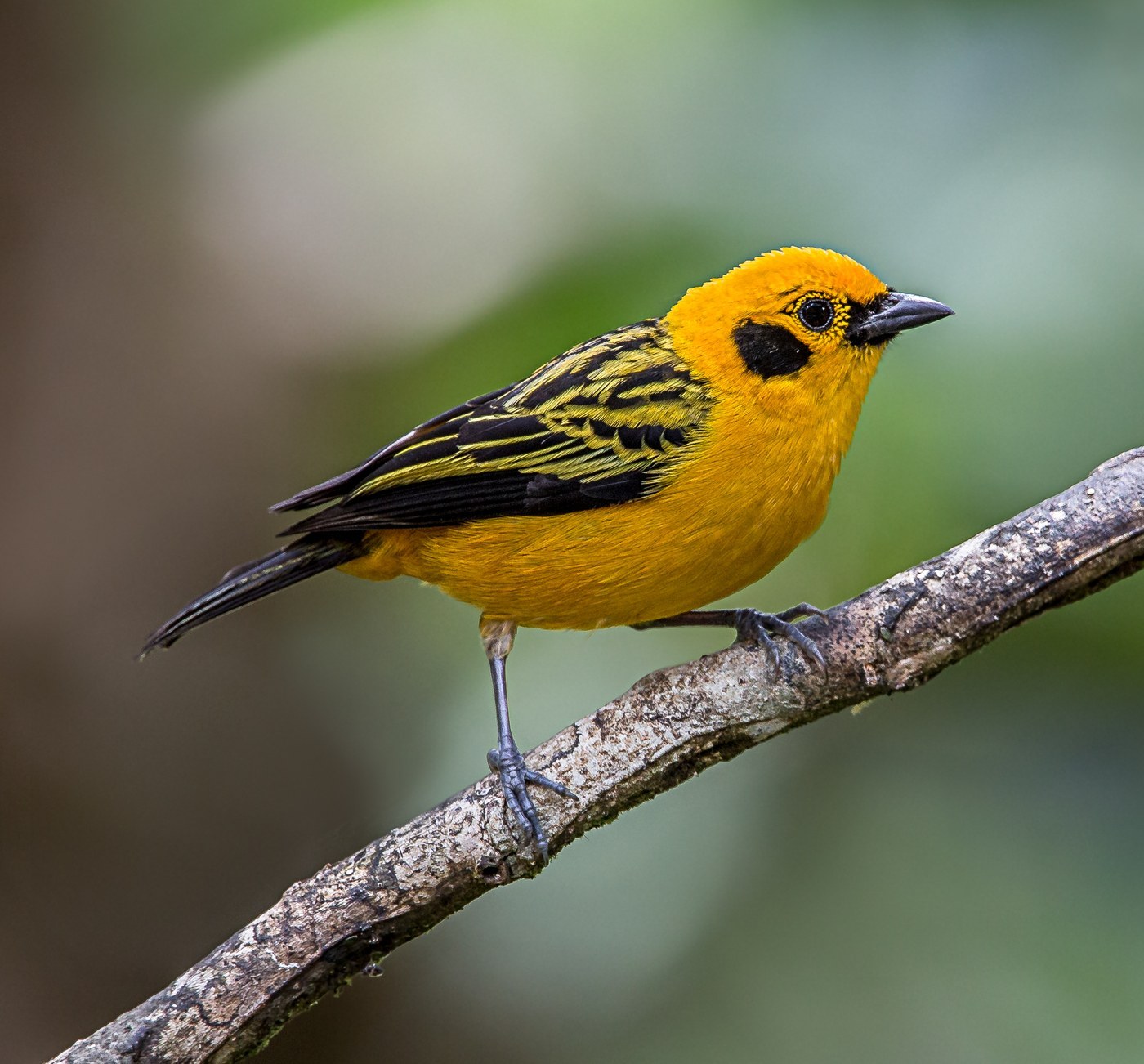
Key Field Marks
- Size & shape: A small tanager, about 13-14 cm, compact-bodied with a short, fine bill typical of the genus Tangara.
- Plumage: Overall rich golden-yellow to orange-yellow body with black streaking across the back forming a scaled or striped pattern, and black flight feathers edged with yellow-green; a black patch or spot on the ear coverts/cheek is a key mark, and some subspecies show a black mask through the eye.
- Head pattern: Bright golden-yellow head with a small black auricular (cheek) patch below and behind the eye; the extent of black on the face varies geographically across subspecies, from a small spot to a more extensive mask.
- Bill & legs: Short, fine, dark bill; legs dark, unremarkable.
- Behavior: Forages actively, often in pairs or small mixed-species tanager flocks, gleaning insects and taking fruit in the forest canopy and at forest edge; regularly visits fruit feeders at Andean lodges.
Similar Species
- Saffron-crowned Tanager: Also largely yellow-orange but shows an orange crown patch and different face pattern with more black overall on the head; ranges can overlap in the Andes.
- Golden-eared Tanager / Flame-faced Tanager: Both show more extensive black and additional colors (e.g., turquoise, red-orange) on the face compared to Golden Tanager's simpler golden head with a small black cheek patch.
- Bay-headed Tanager: Chestnut head rather than yellow, easily separated.
Where & When to See It
Resident along the Andes from Venezuela and Colombia south through Ecuador and Peru into Bolivia, favoring humid montane forest, forest edge, and adjacent secondary growth, typically at mid-elevations roughly 500-2,300 m. It is non-migratory and present year-round, often encountered in mixed tanager flocks moving through the mid-story and canopy, and is a regular visitor to fruit feeders at Andean birding lodges.
Voice & Song Cues
Vocalizations are thin, high-pitched "tsip" or "sit" notes typical of small tanagers, given as contact calls within foraging flocks; not particularly loud or musical, so visual detection in mixed flocks is the more reliable way to find it.
Frequently asked questions
What is the key mark separating Golden Tanager from similar yellow tanagers?
A simpler golden-yellow head with just a small black cheek patch (rather than an orange crown patch or extensive facial black/turquoise seen in relatives like Saffron-crowned or Flame-faced Tanager) along with black-streaked upperparts.
Does the black facial pattern vary across the Golden Tanager's range?
Yes, different subspecies show varying amounts of black on the face, from a small cheek spot to a more extensive mask through the eye, so face pattern alone can vary regionally.
At what elevation is the Golden Tanager typically found?
Mid-elevation humid montane forest along the Andes, roughly 500 to 2,300 meters, from Venezuela and Colombia south to Bolivia.
Will Golden Tanagers visit feeders?
Yes, they are regular visitors to fruit feeders at birding lodges within their Andean range, often alongside other colorful tanager species.