
Golden-hooded Tanager Identification Guide
A small, vividly patterned Central American tanager with a shining golden crown, black mask, and turquoise-and-black body plumage.
Read the full Golden-hooded Tanager encyclopedia entry →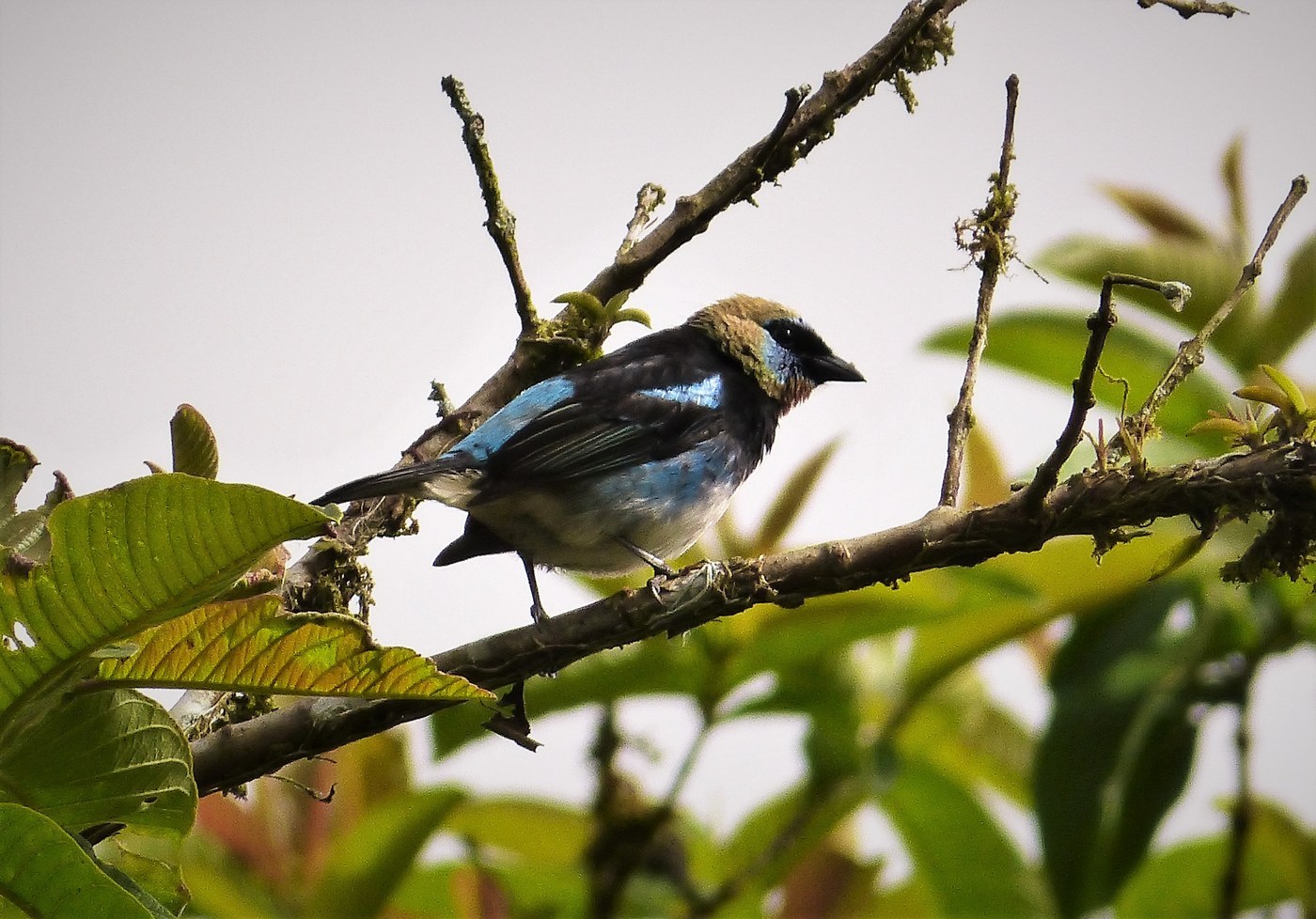
Key Field Marks
- Size & shape: A small tanager, about 12-13 cm, compact and short-tailed, typical of the genus Tangara/Stilpnia.
- Head pattern: Bright, shining golden-yellow crown and forecrown contrasting with a bold black mask through the eye and a turquoise-blue nape and hindneck — an unmistakable combination when seen well.
- Body plumage: Upperparts and wings mostly black with turquoise-blue edging and a turquoise rump; underparts are pale turquoise-white with a black band across the upper breast/throat area in some views, and the overall look is a jewel-like mix of gold, black, and turquoise.
- Bill & legs: Short, fine, dark conical bill typical of tanagers; legs blackish.
- Behavior: Forages actively in pairs or small mixed-species flocks in the mid- to upper-canopy and forest edge, gleaning insects and eating fruit; often joins mixed tanager flocks moving through the canopy.
Similar Species
- Spangle-cheeked Tanager / other Tangara tanagers: Most co-occurring Tangara species show green as a dominant color rather than the turquoise-and-black combination; the golden crown plus black mask of Golden-hooded Tanager is distinctive within its range.
- Bay-headed Tanager: Shows a chestnut/bay-colored head rather than gold, with green body plumage, easily separated by head color alone.
- Juveniles are duller and greener than adults but retain a hint of the head pattern, which sharpens with age.
Where & When to See It
Resident from southern Mexico through Central America (Belize, Guatemala, Honduras, Nicaragua, Costa Rica, Panama) into northwestern South America (Colombia, Ecuador), inhabiting humid lowland and foothill forest edge, second growth, gardens, and plantations with scattered trees. It is non-migratory and can be found year-round, often visiting fruiting trees and forest-edge habitat, including gardens and lodges within its range.
Voice & Song Cues
Gives thin, high-pitched "tsip" or "seet" contact notes typical of small tanagers, along with a soft, high-pitched twittering song; not especially loud or distinctive vocally, so it is more often located visually or through mixed-flock activity.
Frequently asked questions
What is the easiest field mark for the Golden-hooded Tanager?
The combination of a bright golden crown, bold black mask, and turquoise-blue nape and rump is unique among Central American tanagers and is diagnostic even at a glance.
Does the Golden-hooded Tanager travel in flocks?
Yes, it commonly forages in pairs or joins mixed-species tanager flocks moving through the canopy and forest edge.
Where can I find a Golden-hooded Tanager?
In humid lowland and foothill forest edge, second growth, and gardens from southern Mexico through Central America into northwestern South America, year-round.
How does the Golden-hooded Tanager differ from the Bay-headed Tanager?
Bay-headed Tanager has a chestnut (bay) colored head and mostly green body, while Golden-hooded Tanager has a golden crown, black mask, and turquoise-and-black body plumage.