
Golden-headed Quetzal Identification Guide
A glittering Andean trogon relative with an emerald-green body, coppery-golden head, and long trailing tail streamers in males.
Read the full Golden-headed Quetzal encyclopedia entry →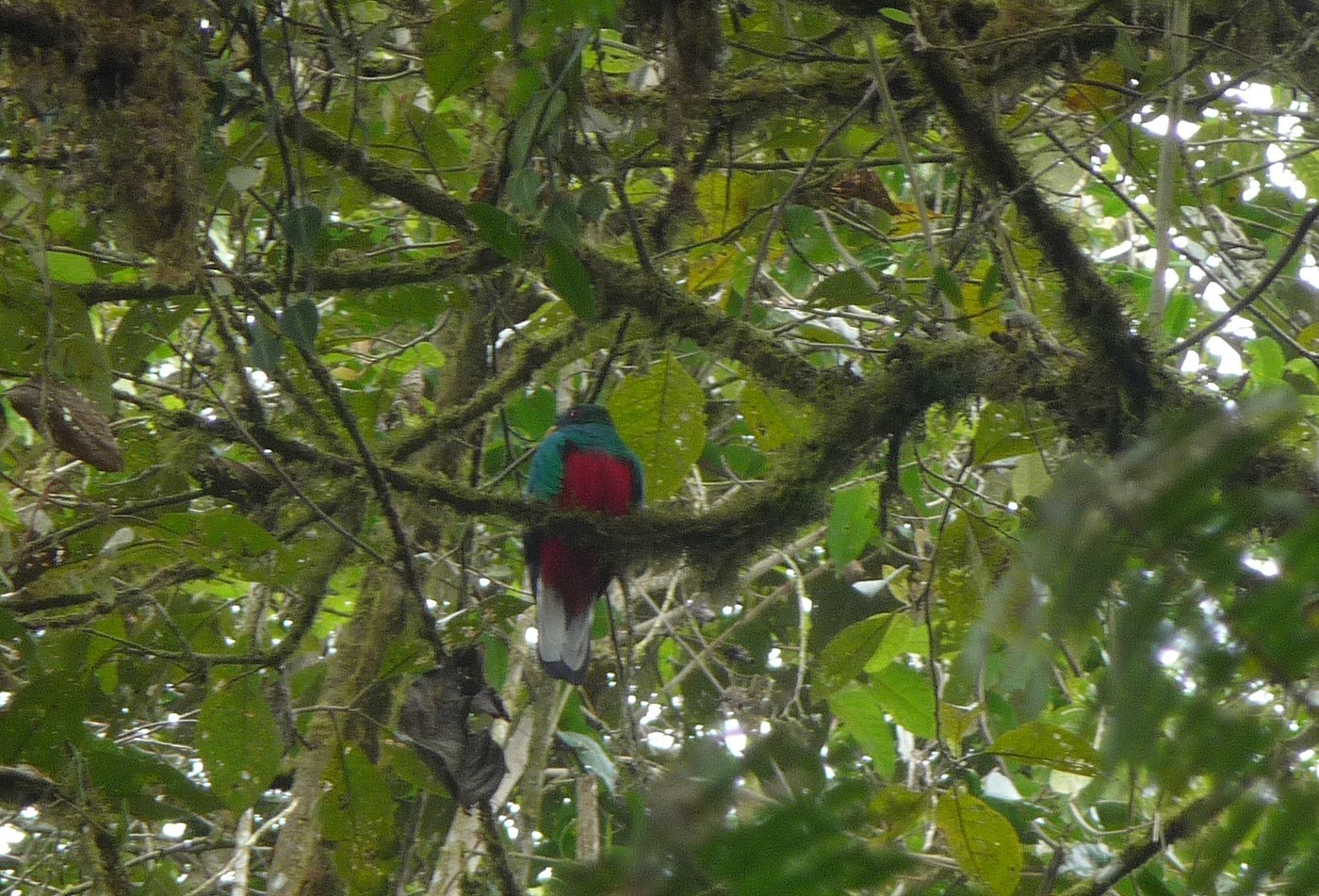
Key Field Marks
- Size & shape: A medium-large trogon-family bird, about 34-36 cm including the male's long tail; stocky-bodied with a short neck, short broad bill, and an upright perching posture typical of quetzals and trogons.
- Plumage (male): Brilliant iridescent green body shading to golden-coppery on the head and nape (the feature giving the species its name), with a bright red belly and undertail area; the long uppertail coverts extend well past the tail tip as trailing streamers.
- Plumage (female): Duller and browner overall, lacking the male's long tail streamers and showing a grayer head without strong golden iridescence, but retains a reddish belly, though less vivid than the male's.
- Bill & eye: Short, broad, slightly hooked yellowish to pale bill; eye is dark, often surrounded by a bare orbital ring.
- Behavior: Sits quietly and upright on mid- to upper-canopy perches for long periods, often hard to spot despite bright colors due to still, unobtrusive behavior; sallies out to pluck fruit (especially figs and lauraceous fruit) or catch insects in flight before returning to a perch.
Similar Species
- Crested Quetzal: Overlaps in parts of the Andes; told by a shaggy, forward-curling crest on the forehead (absent in Golden-headed Quetzal) and a different bill color/shape.
- White-tipped Quetzal: Similar green-and-red pattern but shows white in the tail (white outer tail feathers/tips), which Golden-headed Quetzal lacks; ranges overlap in parts of the Andes.
- Other Pharomachrus quetzals: Best separated by head color/iridescence, presence/shape of a crest, and tail pattern; the golden-coppery head sheen (versus purely green or blue-green) is the key mark for this species.
Where & When to See It
Found along the Andes from Venezuela and Colombia south through Ecuador, Peru, and into Bolivia, inhabiting humid montane forest and cloud forest, typically between about 1,000 and 2,800 m elevation. It is largely resident/sedentary, with some local altitudinal movement tied to fruiting seasons, and can be looked for year-round in appropriate cloud-forest habitat, often located by call before being seen perched quietly in the canopy or subcanopy.
Voice & Song Cues
Gives a series of soft, low, hollow whistled or piping notes, often repeated slowly and somewhat mournfully; calls carry well through humid forest and are frequently the first clue to the bird's presence given how motionless and inconspicuous it can be while perched.
Frequently asked questions
What distinguishes a Golden-headed Quetzal from other Andean quetzals?
Its golden-coppery iridescent head sheen (rather than purely green or blue-green), combined with a lack of any crest and no white in the tail, separates it from Crested Quetzal and White-tipped Quetzal respectively.
Do female Golden-headed Quetzals have long tail streamers?
No — the elongated trailing uppertail covert streamers are a male-only feature; females have shorter tails and duller, grayer heads without the golden iridescence.
What elevation and habitat should I search for this species?
Humid montane cloud forest along the Andes, typically between roughly 1,000 and 2,800 meters elevation, from Venezuela and Colombia south to Bolivia.
What does the Golden-headed Quetzal eat?
Primarily fruit, especially figs and other lauraceous fruits taken in short sallies from a perch, supplemented with insects caught on the wing.