
Golden Eagle Identification Guide
A massive, powerful raptor of open and mountainous country across the Northern Hemisphere, told from other large eagles by its golden-brown nape, feathered legs, and long, broad-winged soaring silhouette.
Read the full Golden Eagle encyclopedia entry →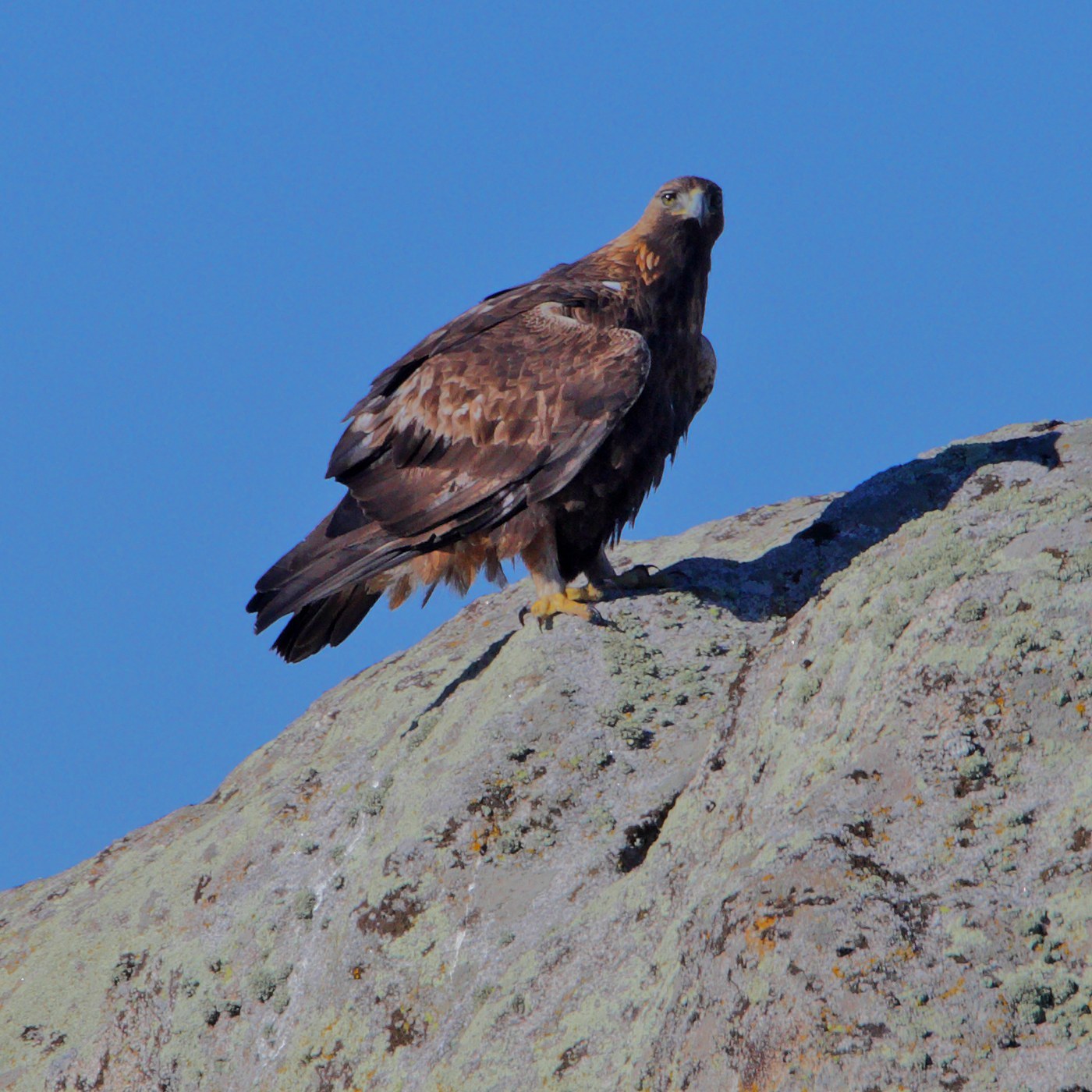
Key Field Marks
- Size & shape: A very large eagle, 66-100 cm long with a wingspan of 1.8-2.3 m; in flight shows long, broad wings held in a shallow dihedral (slight V-shape), a fairly long tail, and a small head that barely projects beyond the leading edge of the wing.
- Plumage (adult): Overall dark brown body with a paler, golden-buff to tawny nape and hindneck that gives the species its name, visible at a distance in good light; some pale mottling can show on the wing coverts.
- Legs: Legs are feathered all the way down to the toes (unlike most other large eagles in its range), a key structural feature when perched or seen well in flight.
- Juvenile plumage: Shows clean white patches at the base of the primaries (flight feathers) and a white base to the tail with a sharply defined dark terminal band — bold, easily visible field marks that fade with each successive molt over about 4-5 years to adult plumage.
- Behavior: Soars on flattened to slightly uplifted wings, often at great height over open country, ridgelines, and mountains; hunts mammals (hares, marmots, ground squirrels) with fast, powerful stoops.
Similar Species
- Bald Eagle (immature): Immature Bald Eagles can show messy white mottling on the body and underwings, but lack the clean, sharply demarcated white primary and tail-base patches of a juvenile Golden Eagle, and Bald Eagles have unfeathered (bare) legs and a proportionally larger head/bill that projects further in flight.
- Turkey Vulture: Soars with wings held in a strong V (dihedral) and rocks unsteadily side to side; Golden Eagle's wings are flatter and flight is much more stable and powerful, with a smaller head and heavier build.
- Rough-legged Hawk / other buteos: Much smaller with proportionally shorter, broader wings and a smaller overall size.
Where & When to See It
Breeds across mountainous and open country of the Northern Hemisphere — western North America, much of Europe and Asia, and North Africa — favoring cliffs, canyons, mountains, and open grassland/tundra away from dense forest. Northern populations are migratory, moving south for winter (visible at hawkwatch sites during migration), while southern and resident populations stay put year-round. Look for it soaring high over open terrain, ridgelines, and canyon country, or perched on cliffs, poles, or the ground in open habitat.
Voice & Song Cues
Generally rather quiet away from the nest; vocalizations include a high, yelping or barking "kya" or "kee-kee-kee" and soft chirping or whistled notes near the nest, but Golden Eagles are identified far more often by sight than by sound.
Frequently asked questions
How do you tell an immature Golden Eagle from an immature Bald Eagle?
Juvenile Golden Eagles show clean, sharply defined white patches at the base of the primaries and a white tail base with a crisp dark band, plus fully feathered legs, while young Bald Eagles have messier white mottling, bare legs, and a larger head/bill.
What does the golden nape look like in the field?
In good light, adult Golden Eagles show a paler, tawny-golden wash across the back of the head and neck contrasting with the otherwise dark brown body — the source of the species' name, though it can be subtle in poor light.
Are Golden Eagles found near water like Bald Eagles?
No — Golden Eagles favor open country, mountains, canyons, and grassland/tundra rather than the lakes, rivers, and coastlines typically used by Bald Eagles.
How long does it take a Golden Eagle to reach adult plumage?
About 4-5 years, with the bold white wing and tail patches of juveniles gradually reducing and disappearing through successive molts until the uniform dark-brown adult plumage is reached.