
Golden Conure Identification Guide
A vivid, entirely golden-yellow Amazonian parrot with green flight feathers, endemic to a small region of northeastern Brazil and classified as vulnerable.
Read the full Golden Conure encyclopedia entry →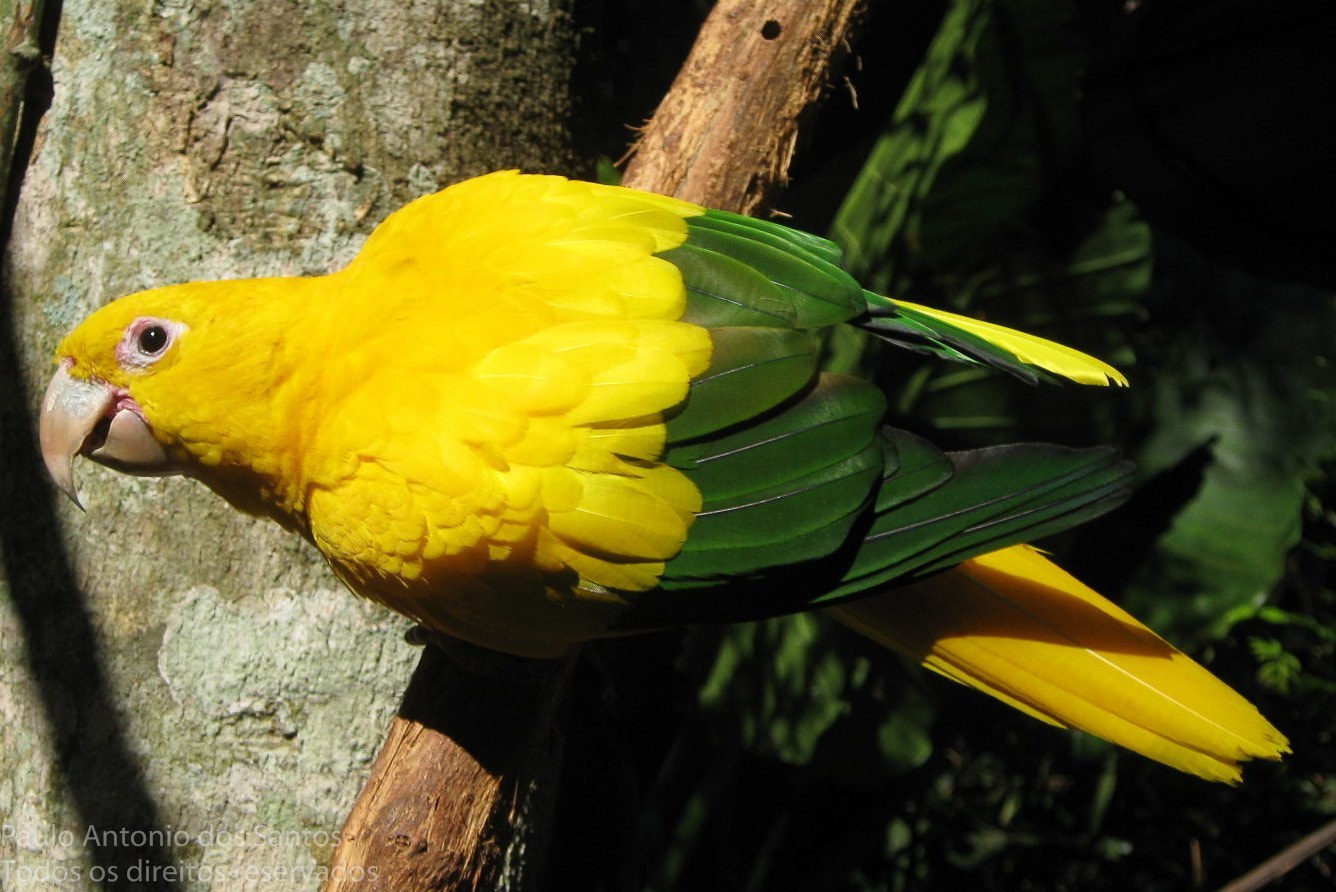
Key Field Marks
- Size & shape: A medium-sized, long-tailed parrot around 34 cm long, with the typical stocky-bodied, long-pointed-tail profile of an Aratinga-type conure.
- Plumage: Almost entirely brilliant golden-yellow on the head, body, and underparts — one of the most saturated all-yellow parrots in the world — contrasting sharply with bright green flight (primary and secondary) feathers on the wings; the tail is mostly yellow with some green.
- Bill & eye: Pale horn-colored to pinkish bill; bare white eye-ring around a dark eye, typical of Aratinga/Guaruba-type conures.
- Behavior: Highly social, moving in noisy flocks through canopy and forest edge, often flying with fast, direct wingbeats; frequently perches conspicuously in the open, unlike many shier forest parrots.
Similar Species
- Sun Conure / Sun Parakeet: Also golden-yellow but shows extensive orange on the face and body plus more green and blue in the wings, and occurs in a different region (northeastern South America, not Brazil's Golden Conure range).
- Other Aratinga conures: Most South American Aratinga species show much more green in the body plumage; the Golden Conure's near-total golden-yellow body with clean green wings is essentially unique in its native range.
- Because Golden Conures do not naturally overlap with Sun Conures in the wild, any all-yellow, green-winged conure seen within its native Brazilian range is very likely this species — most confusion arises with escaped or captive birds outside their natural range.
Where & When to See It
Endemic to a restricted area of eastern Amazonia in northeastern Brazil, primarily in the states of Pará and Maranhão, inhabiting lowland humid forest, forest edge, and semi-deciduous woodland. It is non-migratory and present year-round, but due to habitat loss and historical capture for the pet trade it is classified as Vulnerable, with a fragmented and declining wild range — seeing one now generally requires visiting protected reserves within its native distribution.
Voice & Song Cues
Vocal and social, giving loud, harsh screeching and squawking calls typical of large conures, especially in flight and when flocks gather at fruiting trees or roost sites; contact calls are sharp and far-carrying, helping locate flocks moving overhead.
Frequently asked questions
What color is a Golden Conure?
It is almost entirely brilliant golden-yellow on the head and body, with contrasting bright green flight feathers on the wings.
How is the Golden Conure different from a Sun Conure?
Sun Conures show extensive orange on the face and body along with more green and blue in the wings, while Golden Conures are cleaner golden-yellow with green confined mainly to the flight feathers; the two also occupy different native ranges.
Where in the wild can you find a Golden Conure?
It is endemic to a limited area of eastern Amazonian Brazil, chiefly the states of Pará and Maranhão, in lowland humid forest and forest edge.
Is the Golden Conure endangered?
It is classified as Vulnerable due to habitat loss and historical trapping, with a fragmented and declining wild population confined to a small part of Brazil.