
Golden Bowerbird Identification Guide
A small, striking bowerbird endemic to Australia's Wet Tropics, with males showing bright golden-olive and yellow plumage and famous for building towering maypole bowers.
Read the full Golden Bowerbird encyclopedia entry →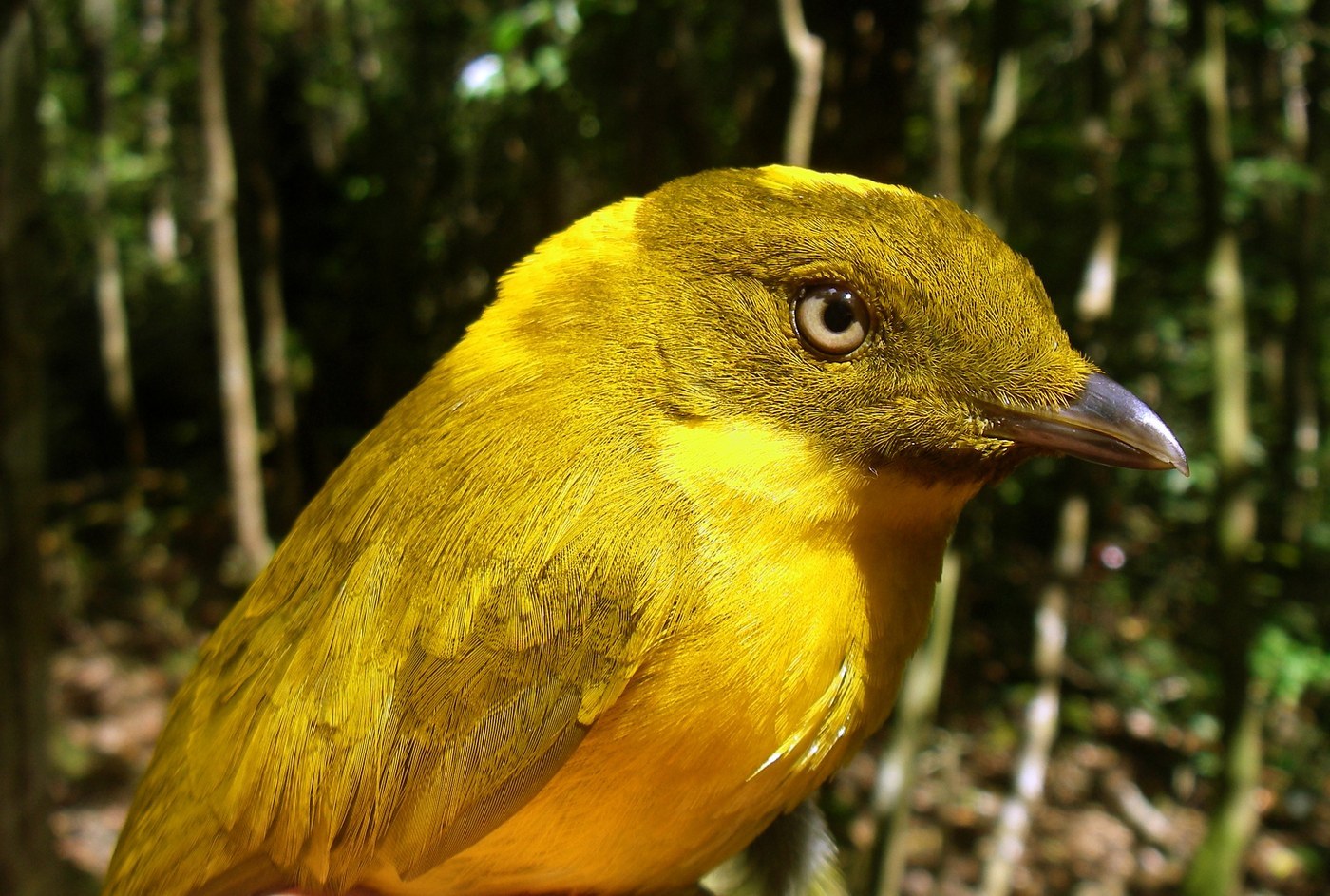
Key Field Marks
- Size & shape: Australia's smallest bowerbird, about 23-25 cm long, with a fairly slim, long-tailed profile compared to the bulkier catbirds and other bowerbirds it shares habitat with.
- Plumage (male): Striking golden-olive crown, nape, and underparts contrasting with dark olive-brown back, wings, and central tail feathers; the outer tail feathers and much of the body show bright golden-yellow, giving an overall gleaming olive-and-gold look unlike any other species in its range.
- Plumage (female/immature): Much duller and easily overlooked — plain olive-grey above and pale grey below, lacking any gold, which can cause confusion with female catbirds or other dull rainforest birds.
- Bill & structure: Fairly short, stout, blackish bill; relatively long tail for a bowerbird, often held loosely.
- Behavior: Male performs at a maypole bower — twin towers of sticks built around saplings and decorated with pale lichen and flowers — and can be located by watching for this structure and the male's activity around it during the breeding season.
Similar Species
- Regent Bowerbird: Also has strong yellow-and-black male plumage, but Regent Bowerbird males are jet-black with yellow patches rather than golden-olive overall, and the two species occupy different, non-overlapping ranges (Regent Bowerbird is further south in eastern Australia).
- Spotted Catbird: Shares the same Wet Tropics rainforest but is uniformly green with a heavy pale bill and red eye, with none of the golden-yellow male plumage.
- Female/immature confusion: Dull female and immature Golden Bowerbirds can resemble other rainforest passerines; look for the shape and any hint of yellow in the tail as a clue.
Where & When to See It
Endemic to the Wet Tropics of far north Queensland, Australia, found in high-altitude rainforest and cloud forest above roughly 900 m elevation, including well-known sites like the Atherton Tablelands (e.g., Mount Hypipamee, Mount Lewis). It is a sedentary, non-migratory resident, so it can be looked for year-round, though the male's bower display activity is most conspicuous during the austral spring-to-summer breeding season (roughly September to January).
Voice & Song Cues
Vocalizations include harsh rasping and churring notes, buzzy chatters, and a distinctive mechanical "tick-tick-tick" or rattling sound; males also give loud, far-carrying calls from display perches near the bower to advertise and attract females.
Frequently asked questions
How can you tell a male Golden Bowerbird from a female?
Males are gleaming golden-olive and yellow with dark olive-brown wings and central tail; females and immatures are plain dull olive-grey overall with no gold, making them much harder to identify on plumage alone.
What makes the Golden Bowerbird's bower distinctive?
Males build a maypole-style bower — two stick towers built up around saplings, decorated with lichen and occasionally flowers — one of the largest bower structures relative to the builder's small size.
Where is the Golden Bowerbird found?
It is endemic to high-altitude rainforest in the Wet Tropics of far north Queensland, Australia, such as the Atherton Tablelands, generally above about 900 m elevation.
Could a Golden Bowerbird be confused with a Regent Bowerbird?
Both males show yellow-and-dark plumage, but Regent Bowerbird males are black with yellow patches rather than golden-olive, and the two species do not overlap geographically.