
Glaucous Gull Identification Guide
A massive, pale Arctic gull, the Glaucous Gull is identified by its entirely white wingtips lacking any black, distinguishing it from nearly every other large gull.
Read the full Glaucous Gull encyclopedia entry →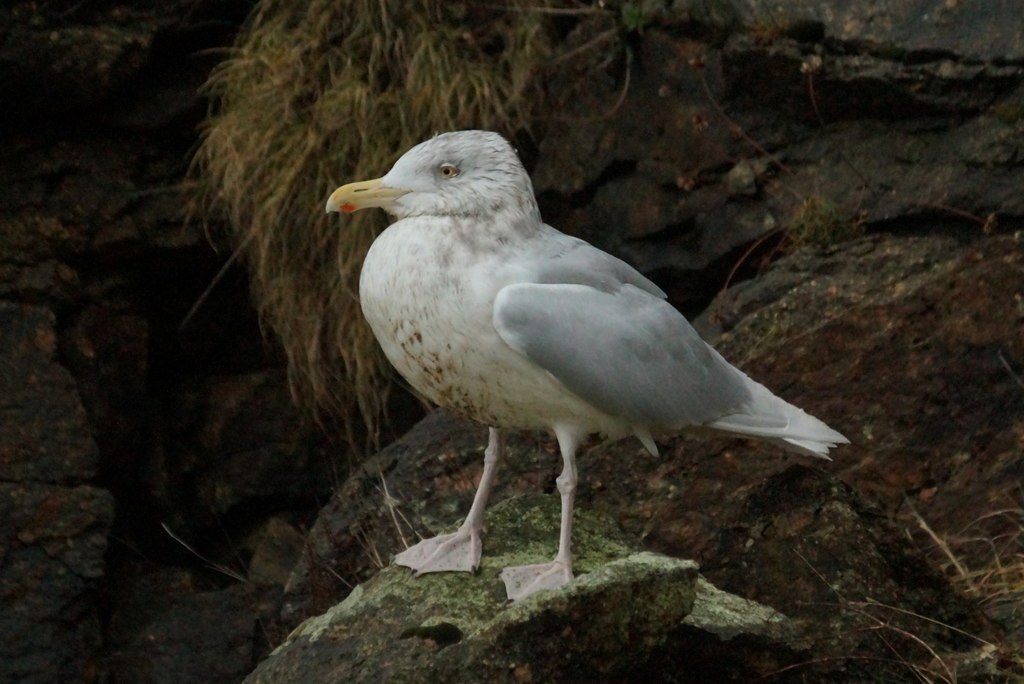
Key Field Marks
- Size: A very large, bulky gull with a heavy bill, among the biggest gull species in the Northern Hemisphere.
- Adult plumage: Very pale gray mantle and wings with wingtips that are entirely white — showing no black pigment at all, a rare and diagnostic trait among large gulls.
- Bare parts: Yellow bill with a red spot near the tip of the lower mandible (gonydeal spot); pale pink legs; pale eye.
- Juvenile/first-winter: Pale buffy-cream overall, with faintly barred pattern and translucent, pale (not white) wingtips; bill is bicolored, pink at the base and black at the tip.
Separating It From Similar Species
- Iceland Gull is the closest match, also lacking black wingtips, but is noticeably smaller and more delicate, with a smaller, less robust bill, rounder head, and gentler expression. Glaucous Gull is larger, bulkier, longer-billed, and flatter-headed.
- Glaucous-winged Gull shows gray (not white) wingtips that match or are only slightly darker than the mantle — a useful distinction from Glaucous Gull's pure white wingtips, and the two also differ substantially in range (Glaucous-winged is a Pacific coast species, Glaucous is circumpolar Arctic).
- Size, bill heft, and head shape are key when separating Glaucous from Iceland Gull, since both share the white-wingtip trait.
Where and When to Find It
- Habitat: Breeds on Arctic coastal cliffs, tundra, and islands; in winter frequents harbors, coastlines, landfills, and river mouths, often scavenging alongside other large gulls.
- Range: Circumpolar Arctic breeder; winters south along temperate coastlines of North America, Europe, and Asia, sometimes reaching well inland at large lakes and garbage dumps.
- Season: Most easily found away from the high Arctic in the non-breeding season (autumn through spring) when it disperses south.
Voice
- Gives deep, resonant bugling and mewing calls typical of large gulls, generally lower-pitched than smaller gull species.
Frequently asked questions
What is the single best field mark for a Glaucous Gull?
Its wingtips are entirely white with no black pigment at all — a trait shared by very few large gulls, making it a strong identification clue when combined with the bird's large size.
How do you tell a Glaucous Gull from an Iceland Gull?
Both lack black wingtips, but Glaucous Gull is considerably larger and bulkier with a heavier bill and flatter head, while Iceland Gull is smaller, more delicate, and rounder-headed.
How is a Glaucous Gull different from a Glaucous-winged Gull?
Glaucous Gull has pure white wingtips, while Glaucous-winged Gull has gray wingtips that match or nearly match the gray mantle; the two also occupy largely different ranges.
Where do Glaucous Gulls spend the winter?
They winter along temperate coastlines of North America, Europe, and Asia, often at harbors and landfills, after breeding on Arctic coasts and tundra.