
Giant Kingfisher Identification Guide
Africa's largest kingfisher, the Giant Kingfisher is a crow-sized, black-and-white speckled bird with a shaggy crest and a chestnut band whose position differs between males and females.
Read the full Giant Kingfisher encyclopedia entry →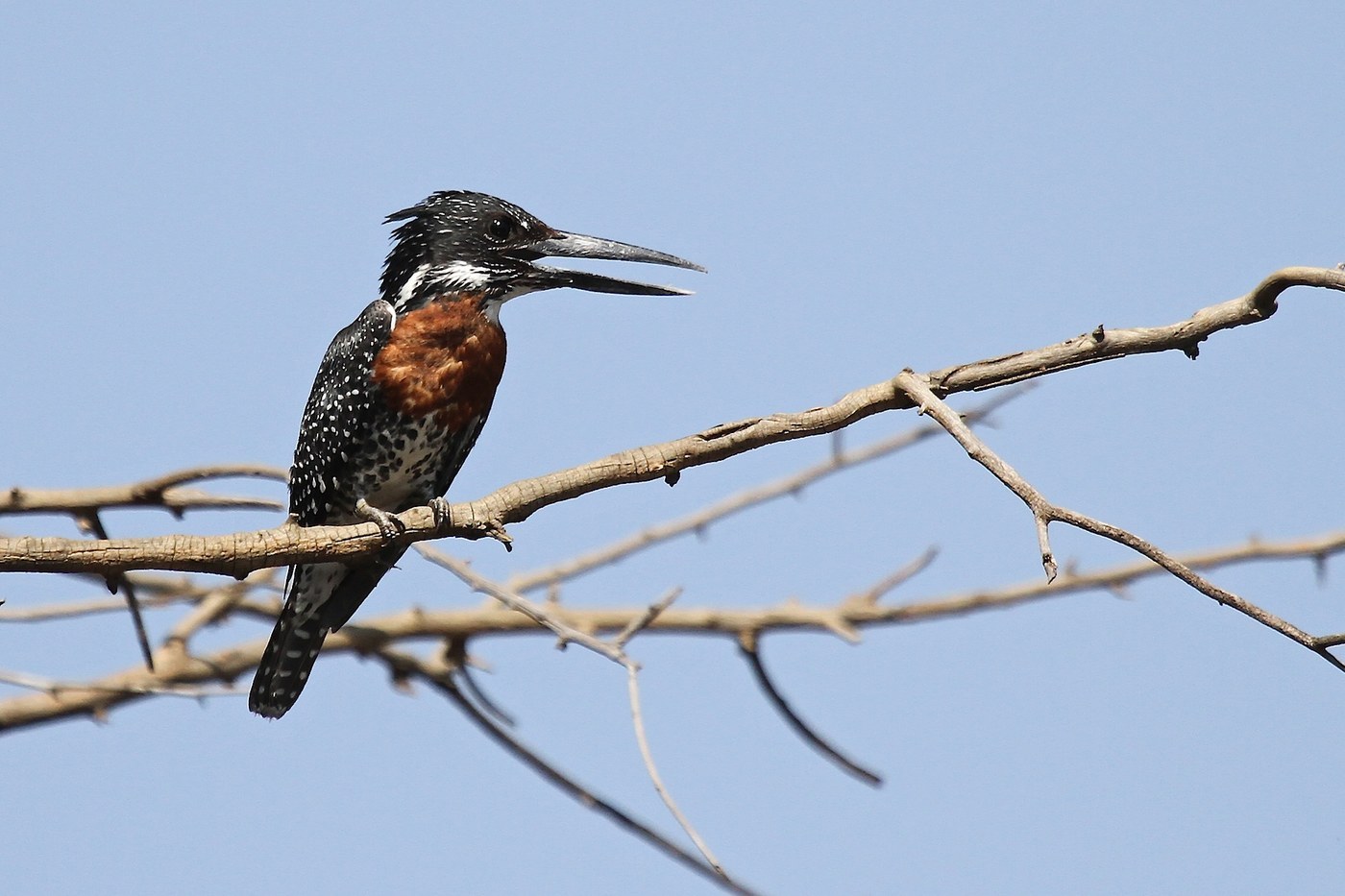
Key Field Marks
- Size: The largest kingfisher in Africa, roughly crow-sized at 42–46 cm (16.5–18 in) long.
- Plumage: Densely speckled black-and-white upperparts give a salt-and-pepper appearance, topped with a shaggy, ragged black crest.
- Sexual dimorphism (reversed from many birds): Males show a white breast finely spotted with black and a solid chestnut belly; females show the opposite pattern — a solid chestnut breast band and a white belly spotted with black.
- Bill: Massive, black, and dagger-like, built for taking fish and crabs.
Separating It From Similar Species
- Pied Kingfisher is the other black-and-white kingfisher across much of the same range, but it is much smaller, entirely black-and-white with no chestnut on the underparts, and habitually hovers over water before diving — a behavior Giant Kingfisher rarely shows.
- Giant Kingfisher instead favors watching from a high perch over water and plunge-diving directly, rather than hovering.
- Its sheer bulk, shaggy crest, and chestnut markings on the underparts readily separate it from all other African kingfishers.
Where and When to Find It
- Habitat: Rivers, lakes, estuaries, mangroves, and forest streams with clear water and overhanging perches; requires fish and crabs as prey, so avoids very small or turbid waters.
- Range: Widespread across sub-Saharan Africa, generally resident year-round wherever suitable permanent water exists.
- Behavior: Usually solitary or in pairs, perching prominently and often quite tolerant of observation before diving for prey.
Voice
- Gives a loud, harsh, cackling "wak-wak-wak" call, often in flight, along with deep guttural croaks near the nest or when disturbed.
- Much louder and harsher-voiced than the smaller Pied Kingfisher.
Frequently asked questions
How can you tell a male from a female Giant Kingfisher?
Look at the underparts: males have a white breast spotted with black and a chestnut belly, while females show the reverse — a chestnut breast band and a white, black-spotted belly.
What is the difference between a Giant Kingfisher and a Pied Kingfisher?
Giant Kingfisher is much larger with chestnut markings on the underparts and a shaggy crest, while Pied Kingfisher is smaller, purely black-and-white, and frequently hovers over water before diving.
What does the Giant Kingfisher eat and how does it hunt?
It mainly eats fish and crabs, hunting by watching from a high perch over water and plunge-diving directly onto prey.
Where is the Giant Kingfisher found?
It occurs widely across sub-Saharan Africa on rivers, lakes, estuaries, and mangroves with clear water, and is generally a year-round resident.