
Giant Hummingbird Identification Guide
The largest hummingbird in the world, the Giant Hummingbird of the Andes is best told by its huge size, dull brownish plumage, and slow, almost swift-like wingbeats.
Read the full Giant Hummingbird encyclopedia entry →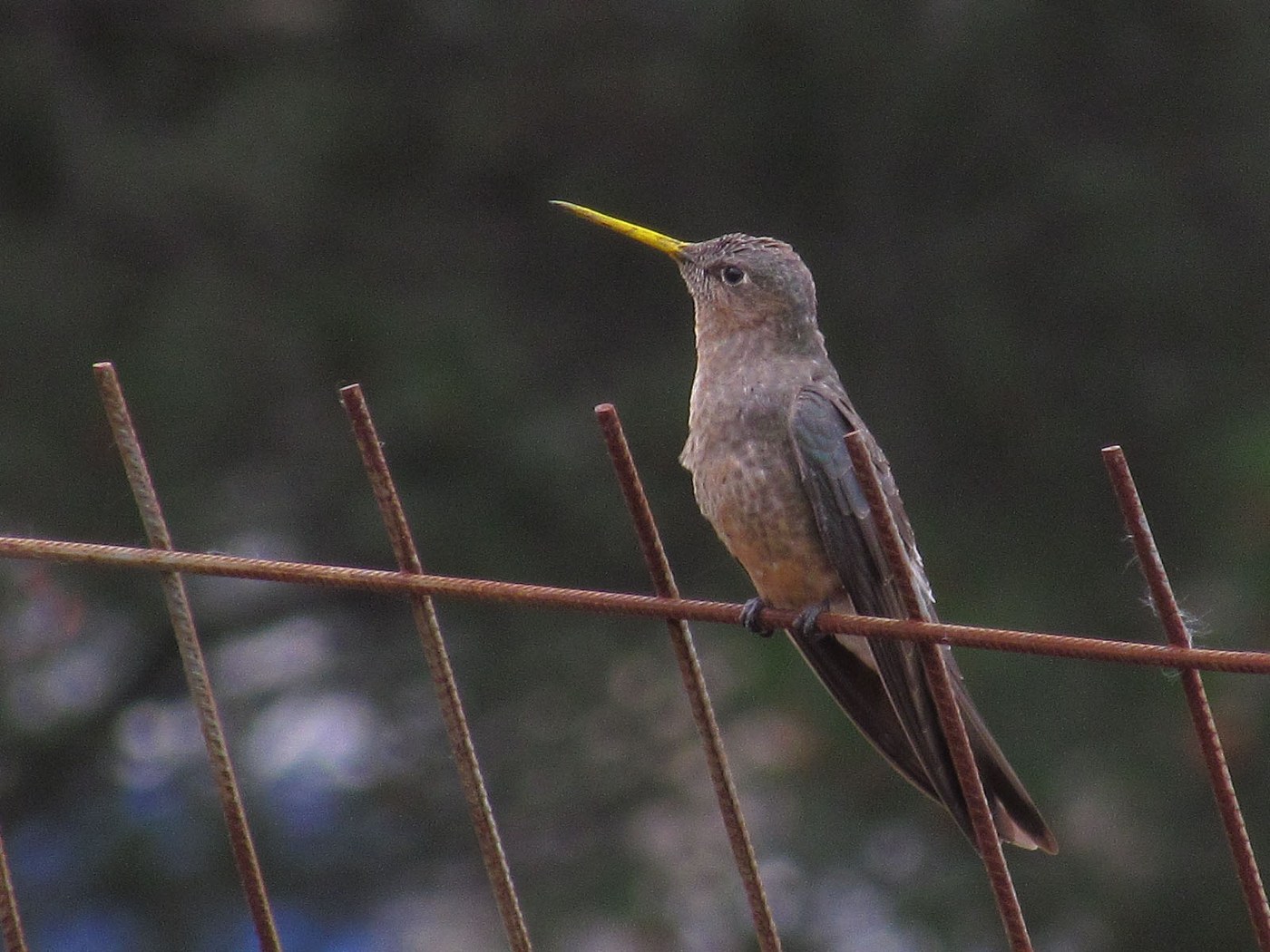
Key Field Marks
- Size: The largest hummingbird species on Earth, measuring 20–23 cm (8–9 in) long — nearly the size of a European Starling and dwarfing every other hummingbird.
- Plumage: Relatively dull for a hummingbird — grayish-brown upperparts, a rufous-buff wash across the underparts, and a whitish patch on the rump/uppertail coverts. It lacks the brilliant iridescent gorget colors typical of most hummingbirds.
- Bill: Long, straight to slightly downcurved, proportionate to its large body.
- Flight: Wingbeats are noticeably slower (roughly 10–15 beats per second) than the blur of typical hummingbirds, sometimes giving it a swift-like or even bat-like flight silhouette, and it will glide briefly between wingbeats.
Separating It From Similar Species
- Size alone eliminates confusion with every other hummingbird species across its range — nothing else in the Andes approaches its bulk.
- At a distance or in flight, its size and slower wingbeat can cause it to be mistaken for a swift or a small falcon; close observation of the long thin bill and hovering behavior at flowers confirms hummingbird identity.
- Its drab brown coloration, unusual for a hummingbird, is itself a clue combined with its size.
Where and When to Find It
- Habitat: High Andean valleys, arid scrubland, agricultural areas, and gardens with abundant flowering plants, typically between 2,000–4,500 m (6,500–14,800 ft) elevation.
- Range: Found along the Andes from Ecuador south through Peru, Bolivia, Chile, and into Argentina.
- Season: Populations in the northern part of the range tend to be resident year-round; the southernmost breeding population (in Chile and Argentina) is migratory, moving north into Peru and Ecuador during the austral winter.
Voice
- Gives sharp, high chip and chatter notes typical of hummingbirds, along with buzzy chases between rival birds at flowering patches.
- Not known for an elaborate song; vocalizations are simple and utilitarian, mostly used in territorial disputes over nectar sources.
Frequently asked questions
How big is a Giant Hummingbird compared to other hummingbirds?
It is the largest hummingbird species in the world at 20–23 cm long, roughly the size of a starling — many times the bulk of a typical hummingbird.
Why does the Giant Hummingbird look different from other hummingbirds in flight?
Its wingbeats are much slower (about 10–15 per second versus 50+ in typical hummingbirds), giving it a more gliding, swift-like flight style rather than the classic hummingbird blur.
Does the Giant Hummingbird have bright iridescent colors like other hummingbirds?
No, it is unusually drab for a hummingbird, with grayish-brown upperparts and buffy underparts rather than a flashy iridescent gorget.
Where do Giant Hummingbirds live?
They live in high-elevation Andean valleys and scrubland from Ecuador to Chile and Argentina, generally between 2,000 and 4,500 meters elevation.