
Gang-gang Cockatoo Identification Guide
A small, endangered Australian cockatoo, the Gang-gang is easily known by the male's fiery red head and wispy curled crest against otherwise scaly gray plumage.
Read the full Gang-gang Cockatoo encyclopedia entry →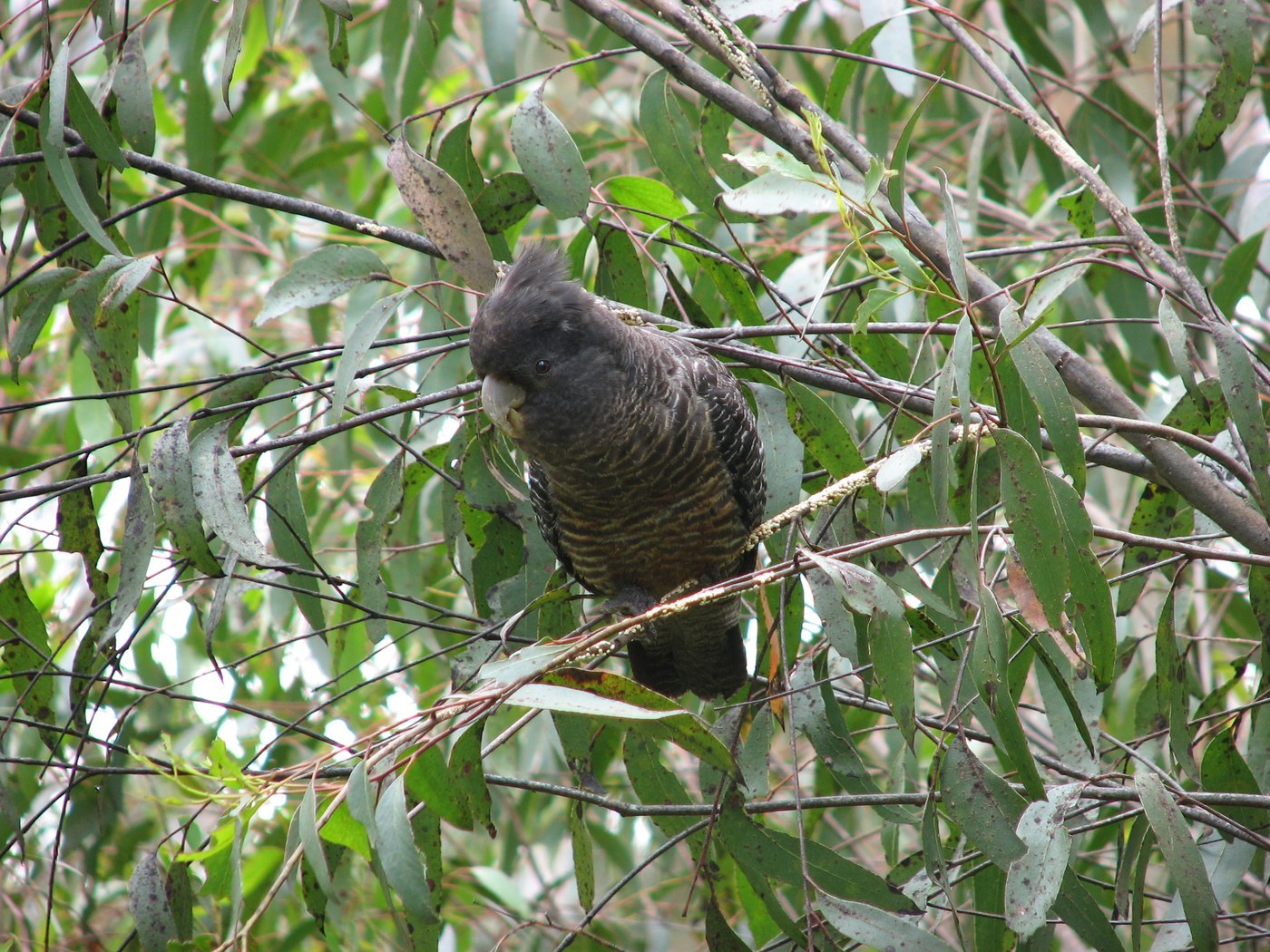
Key Field Marks
- Size: A relatively small, compact cockatoo, about 32–37 cm (13–14.5 in) long.
- Male: Overall slate-gray body with pale scalloped edging on each feather, and a distinctive bright red head and wispy, curled crest that looks almost like a tousled mop.
- Female: Gray overall including the head (no red), with the scalloped pattern extending onto the underparts in orange-buff barring; her crest is shorter and grayer.
- Bill: Pale horn-gray, relatively small for a cockatoo.
- Flight: Direct and somewhat labored on shallow wingbeats, often flying low between trees.
Separating It From Similar Species
- No other Australian cockatoo shares the male's solid red head and curly crest, making adult males unmistakable.
- Females and juveniles are duller and could be mistaken for other gray parrots at a glance, but the finely scalloped, almost "crocodile-skin" texture of the plumage and small curled crest are distinctive once learned.
- Its diminutive size compared to Sulphur-crested and other larger white cockatoos, plus its all-gray (not white) body, rules out confusion with those species.
Where and When to Find It
- Habitat: Wet eucalypt forest and woodland in hilly or mountainous country during the breeding season; moves to lower-elevation woodlands, parks, and suburban gardens in autumn and winter to feed on eucalypt seed capsules, wattle seeds, and introduced hawthorn and cotoneaster berries.
- Range: Restricted to southeastern Australia — southeastern New South Wales, the Australian Capital Territory, and Victoria, with an isolated population on Kangaroo Island (King Island birds are now extinct).
- Season: Present year-round within its range but shows an altitudinal migration, breeding in tall montane forest in spring/summer and descending to lower elevations and urban areas in autumn/winter.
- Listed as endangered due to habitat loss, especially loss of old-growth nesting hollows.
Voice
- Utters a distinctive creaky, growling call often likened to a rusty gate hinge or a cork being pulled from a bottle — quite unlike the harsh screech of most cockatoos.
- Feeding flocks give soft grinding and crunching sounds as they methodically shell seed capsules.
Frequently asked questions
What does a Gang-gang Cockatoo's call sound like?
It has a distinctive creaky, growling call, often compared to a rusty door hinge or a cork squeaking out of a wine bottle — quite different from the harsh screech typical of other cockatoos.
How do you tell a male from a female Gang-gang Cockatoo?
Only the male has the bright red head and crest; females are entirely gray with orange-buff barred underparts and a shorter gray crest.
Where do Gang-gang Cockatoos live?
They are found only in southeastern Australia (New South Wales, the ACT, Victoria, and Kangaroo Island), moving between mountain forests in summer and lower woodlands or gardens in winter.
Is the Gang-gang Cockatoo endangered?
Yes, it is currently listed as endangered, primarily due to loss of old-growth forest nesting hollows and severe bushfires affecting its habitat.